Knights of the Round Table
Sir Gawain and the Green KnightThe Knights of the Round Table are the celebrated fellowship gathered around King Arthur, whose renown the poem first presents as the glory of an Arthurian court and later shows unsettled by a single speaker. The brotherhood’s most lasting visible sign is not the gold device on Sir Gawain’s shield but the green baldric adopted by the whole company after his return: a communal token that makes one knight’s trial part of the fellowship’s continuing identity.
Identity and Courtly Setting
The poem places the Knights of the Round Table among the greatest knights beneath Christ, in a court also distinguished by its ladies and by King Arthur’s own courtly presence. Their importance is established through collective reputation: the Round Table is named as a company of rich brothers, not merely as a backdrop for an individual hero. Its members gather at Camelot at Christmas, when the hall’s magnificence and the fellowship’s fame appear to confirm one another.
That gathering is marked by feasting, merriment, and tournaments. Lords and ladies share the celebrations, and the knights take part in contests; the fellowship is therefore presented both as an honored body and as a company whose standing is made visible in courtly festivity. The poem’s opening frames its adventure as a marvel from the history of Arthur and his renowned company. The Round Table’s reputation gives the story its high stakes: an extraordinary challenge matters because it confronts a fellowship already acclaimed as exceptional.
Renown Tested by a Stranger
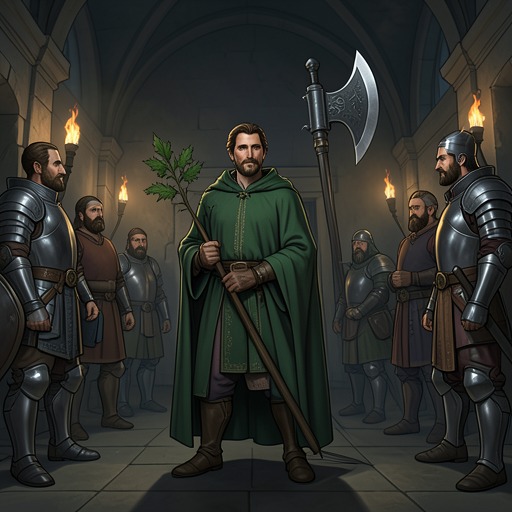
The company’s festive confidence does not protect it from public embarrassment. In the challenge scene, a speaker asks where the Round Table’s pride, conquests, anger, and bold words have gone. He declares that its revelry and renown have been overturned by the speech of one man, and that fear has made the company shrink without a blow being struck. The accusation turns fame against its owners: the more celebrated the fellowship, the sharper the contrast between its public reputation and its hesitation in this moment.
The scene makes speech itself consequential. Before any physical contest has begun, the stranger’s words claim a victory over the company’s collective name. The poem thus distinguishes reputation from action: the Round Table can be praised as the most renowned fellowship and still be challenged to demonstrate its courage when the test arrives. Its response is not simply a measure of individual bravery; the challenge is staged before the court and directed at the company’s honor.
The story also links the fellowship’s identity to Arthur’s appetite for adventure. The poem describes this as an adventure offered in Arthur’s younger years, when he was eager to hear boasting. That detail places the challenge within a courtly culture that welcomes extraordinary exploits and the words announcing them. The Round Table’s fame and the king’s youthful desire for marvels help explain why an audacious encounter can become a test of the whole court’s values.
The Fellowship and Sir Gawain’s Trial
Sir Gawain’s journey carries the court’s ideals beyond Camelot. On a morning ride he enters a deep, wild forest among high hills, leaving the festive setting for a landscape of danger and uncertainty. His departure gives the company’s adventure a personal center, but his conduct continues to bear on the fellowship whose renown the challenge has put at issue.
The poem gives Sir Gawain an individual emblem before the fellowship acquires its shared one. His shield is bright red, with a gold pentangle displayed upon it. The narrator explains the pentangle as an endless knot and connects its fivefold, enduring design to Sir Gawain’s reputation for fidelity and goodness. The shield makes an ideal of knightly virtue visible on one person. At the poem’s conclusion, by contrast, the green baldric becomes a sign worn by every brother of the Table, shifting the story’s emblematic focus from the individual knight’s shield to a collective act of remembrance.
The fellowship’s ordeal also takes place within relationships of hospitality and obligation. When Sir Gawain fears that he has little time before his appointed destination, a lord laughs and tells him to stay, assuring him that the Green Chapel will not escape him. The reassurance makes the approach to the trial an occasion of delay and welcome as well as danger. Later, at the Green Chapel, the wounded knight asks his opponent to state his true name; the answer identifies him as Bertilak de Hautdesert and discloses Morgan le Fay’s power in the events. These revelations show that the journey’s test has involved concealed identities and connections, not only the public contest first associated with the Round Table.
The Green Baldric and Collective Memory
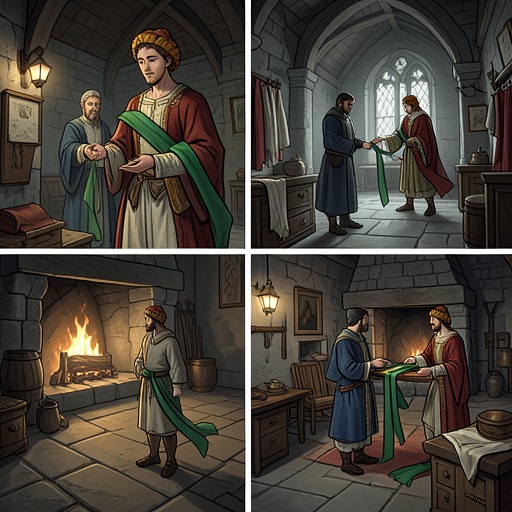
After the trial, the poem returns to the fellowship’s response. King Arthur comforts Sir Gawain, and the court laughs and agrees that every member of the brotherhood should wear a bright green baldric around the waist, gladly, for Sir Gawain’s sake. The change is specific and collective: the green token first associated with the knight becomes an object adopted by the whole company.
The narrator presents that agreement as adding to the Round Table’s renown, and says the baldric was honored thereafter. The fellowship does not leave Sir Gawain’s experience isolated as a private failure or a solitary achievement. Instead, it makes his sign part of the company’s visible identity, so that every brother carries a reminder connected to his story. Where the shield’s pentangle articulates Sir Gawain’s ideal virtues, the shared baldric preserves the fellowship’s response to his ordeal. The ending therefore gives the Knights of the Round Table a form of continuity: their fame is renewed not by avoiding a test, but by making one knight’s experience a sign held in common.