Morgan le Fay
Sir Gawain and the Green KnightMorgan le Fay is the aged woman at Bertilak’s Castle whose concealed magical agency links the Green Knight’s marvels to a plan directed at King Arthur’s court. The late revelation makes her both a member of Arthur’s family and a power behind the adventure: what first appears as an outrageous wonder is disclosed as something shaped by human craft and kinship.
Identity and Introduction
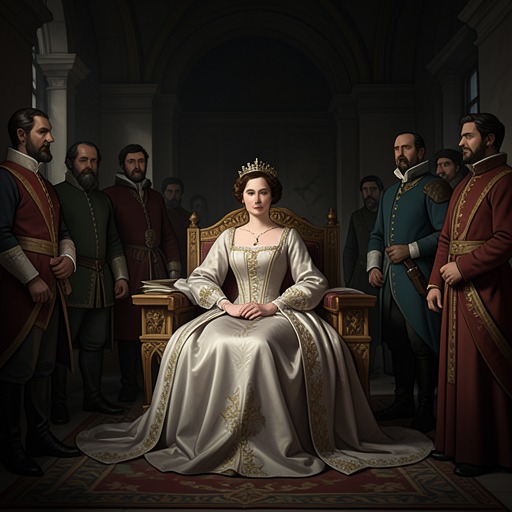
The poem introduces its central adventure as a marvel among the wonders of King Arthur, whose court provides the story’s point of origin. Morgan herself is not named at the outset. At Bertilak’s Castle, she appears beside a younger woman: the younger lady is praised for her beauty, while her companion is described as old-seeming and accorded high honor. That contrast makes the older woman conspicuous without yet explaining her importance.
Only near the conclusion, when the Green Knight speaks before the high table with his severed head in his hand, does the narrative identify the ancient lady at the castle as Morgan. The recognition retrospectively changes the meaning of her earlier presence. She had not been an incidental member of the household but a figure whose identity and power were withheld until the adventure’s explanation.
Kinship and Place in Arthur’s World
Morgan is identified as King Arthur’s half-sister and Sir Gawain’s aunt. Her descent is traced through the Duchess of Tintagel, and her family connection places her within the same dynastic world as the court whose confidence the adventure unsettles. The revelation is therefore more than a name supplied to an unfamiliar face: it makes the marvel an affair involving Arthur’s own kin.
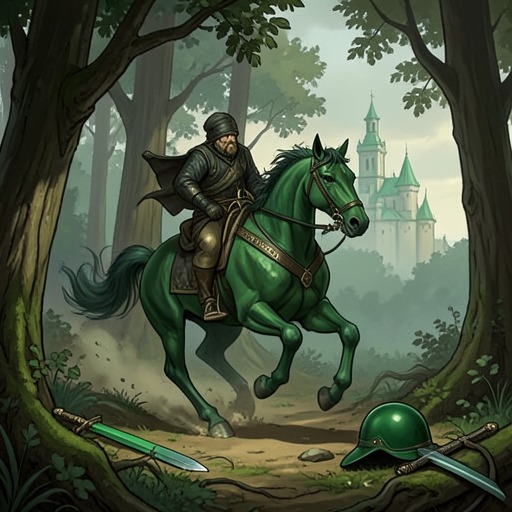
Her position also complicates the poem’s opening emphasis on Arthur’s appetite for adventures and marvels. The court receives the Green Knight’s challenge as an astonishing intrusion, and Sir Gawain eventually rides out from that world into a deep forest and toward the Green Chapel. At the end, Morgan’s identity connects the distant marvel back to Arthur’s household. The adventure has crossed the boundary between court and wilderness, but its hidden agency belongs to someone closely related to the king.
Magic and the Green Knight’s Challenge
In the final explanation, Bertilak attributes the events to Morgan’s power and to her knowledge of learned arts. He says she lives in his house and has acquired the mastery associated with Merlin’s lore. The passage gives her agency through another character’s account rather than through an extended speech or a scene showing her at work. Even so, it establishes that the Green Knight’s extraordinary role is not simply an inexplicable marvel: Morgan’s magic is part of its making.
The disclosure changes how the challenge can be read. The poem has presented an adventure of astonishing appearances, including a Green Knight who survives decapitation and a journey whose promised destination is the Green Chapel. Morgan’s involvement places such wonders within a design. The story identifies that design as intended to terrify Guinevere, making the queen—not only the knight who accepts the challenge—central to the purpose attributed to Morgan. Sir Gawain’s ordeal unfolds within the larger consequences of that scheme, even though the revelation does not make him its original target.
Narrative Role and Significance
Morgan’s importance depends on delayed recognition. The old woman is visible at the castle before the poem explains who she is; the final disclosure then gathers together her presence there, her family relation to Arthur, and the magic credited with producing the Green Knight’s challenge. Her role turns a sequence of apparently disconnected marvels into a courtly design with a hidden maker and a stated object.
The poem also places her revelation beside Sir Gawain’s own assessment of the ordeal. He recalls the weakness of the flesh when it is tempted and resolves to look at the token he carries as a warning against pride. That moral reckoning does not erase Morgan’s part in arranging the circumstances; instead, the two explanations occupy different levels of the story. Her craft helps set the extraordinary events in motion, while Gawain’s response reveals the limits of the virtue by which he judges himself. Morgan thus connects supernatural plotting to the poem’s examination of human conduct, without becoming the voice through which that examination is resolved.