Sir Gawain
Sir Gawain and the Green KnightSir Gawain is the courtly knight at the center of an extraordinary adventure that tests the distance between an ideal of virtue and the instinct to preserve one’s life. First seen beside Guinevere at King Arthur’s court, he travels alone through a wild landscape, bears a shield marked with a gold pentangle, and enters a series of encounters structured by promises and exchanges. His final meeting with the Green Knight makes the test’s meaning explicit: Gawain has fallen short in loyalty, but through fear of death rather than wickedness.
Identity and Place at Court
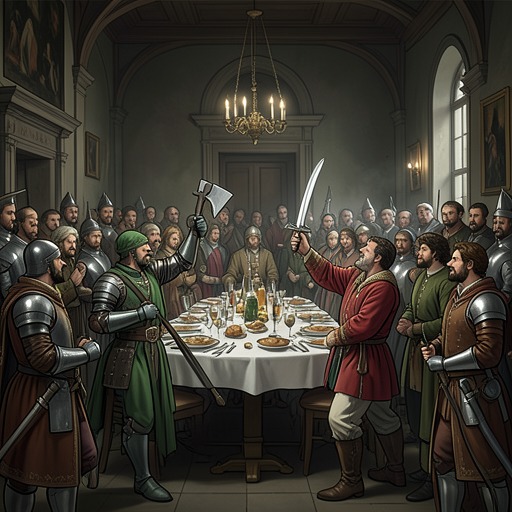
The narrative introduces the adventure through the reputation of King Arthur’s court. Arthur is described as the most courteous of Britain’s kings, and the tale is offered as a wonder among his marvels. Gawain’s place in this world is established at the feast: seated beside Guinevere, he inclines toward the king to make a request. The scene locates him within the court’s social order before the story sends him beyond it, from the public company of the court into solitary travel.
The adventure is also framed as something Arthur receives in his youth, when he desired to hear boasts and tales of adventure. That recollection makes Gawain’s later departure part of a courtly culture that welcomes marvels and tests, even when their consequences become grave. The tale’s movement from the king’s hall to a remote forest therefore carries more than a change of scenery: it turns the court’s appetite for adventure into an ordeal borne by one of its own knights.
The Journey and Its Emblems
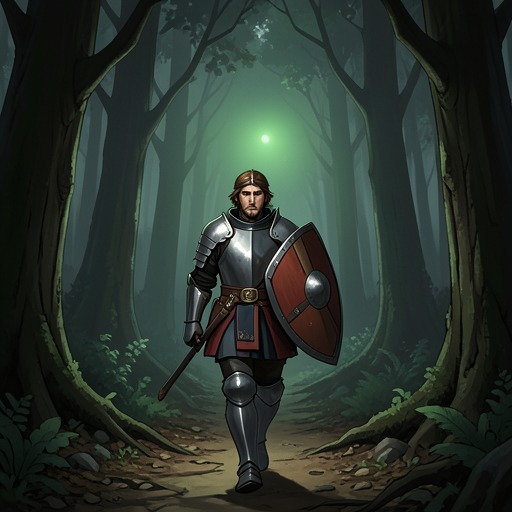
Gawain’s equipment gives visible form to the standards against which his conduct will be measured. His shield is bright red and bears a pentangle painted in pure gold. The emblem accompanies him as he leaves court, making the ideal of ordered, enduring virtue present in the same narrative that will reveal his vulnerability. The evidence identifies the device but does not enumerate its meanings; its clear role here is as a striking mark on the knight’s gear, set against the choices he must later make.
On the following morning, Gawain rides over a mountain and into a deep forest described as wild, with high hills on either side and woodland below. The landscape places him at a distance from the court and its witnesses. Later, a lord asks what daring deed has driven him from the king’s court to travel alone at such a time. Gawain explains that he has only three days left and would rather meet death than fail in his errand. The urgency of his quest is thus stated in terms of a deadline and a readiness to die rather than abandon his purpose.
The lord responds with laughter and urges Gawain to stay longer, promising to guide him to the Green Chapel when the appointed time comes and assuring him that the place will trouble him no more. The offer changes the immediate shape of the journey: instead of continuing alone in uncertainty, Gawain is invited to remain under a host’s guidance. The reassurance also sharpens the contrast between the apparent welcome and the mortal appointment toward which the story is moving.
Promises, Gifts, and the Threat to Life
At the lord’s proposal, Gawain agrees to an exchange: whatever the lord wins in the wood is to become Gawain’s, and whatever Gawain achieves is to be exchanged in return. The compact turns hospitality into an obligation with two directions. What happens in the woods belongs within the bargain, but so does whatever Gawain gains elsewhere during the same stay. Its force lies not simply in the promise to exchange objects; it gives each man a claim on the other’s winnings.
The lord later calls Gawain over in front of the assembled people and, in a playful manner, shows him the tails of well-trussed animals and the fat cut along their ribs. This public display makes the products of the hunt concrete and visible. It also recalls the exchange agreement: the lord’s winnings are not private possessions outside the compact but the very things he has promised to deliver. In a different encounter, a woman offers Gawain a rich ring of red-gold workmanship, topped by a shining stone. The contrast between the displayed spoils of the hunt and this finely worked personal gift broadens the story’s attention to what can be offered, accepted, and owed.
The green lace is associated with a more urgent promise than either wealth or courtesy. It is described as something kept close and hidden, and as protection so powerful that no man under heaven could cut down the person girded with it. The object therefore concentrates the conflict between keeping faith and preserving life: its appeal is not merely ornamental, since its stated value is survival. Set beside the golden pentangle on Gawain’s shield, the concealed green lace creates a pointed contrast between a public emblem of virtue and a private safeguard against death.
The Test’s Outcome and Gawain’s Significance
When the appointed encounter approaches, Gawain calls out at the place and announces that he is coming. The scene brings the solitary traveler to the meeting on which his errand has turned; the approach is marked by his readiness to answer the challenge rather than disappear from it. Afterward, the judgment he receives is measured rather than absolute. He is told that he lacked a little and fell short in loyalty, but that the failure came neither from a wicked act nor from improper wooing. He loved his life, and for that reason he is blamed less.
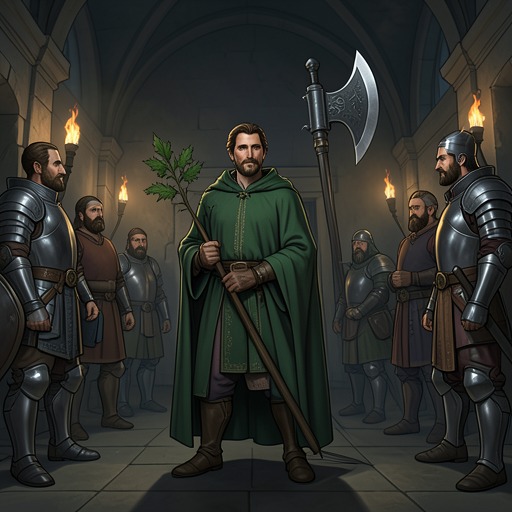
The final disclosure gives the ordeal a new frame. The other knight identifies himself as Bertilak of Hautdesert and says that Morgan le Fay, who lives in his house, acted through her power. The revelation links the host’s earlier welcome and the final encounter to a design involving an identity concealed until the test is complete. Gawain’s experience is thus not only a journey toward a distant meeting: it is a trial whose apparent roles change when the person administering it reveals who he is.
Gawain’s significance rests in the discrepancy between the ideals made visible by his shield and the small but consequential failure named at the end. The judgment does not erase his courage: he leaves court alone, keeps his errand despite the danger, and comes forward to meet the appointed challenge. Nor does courage make him invulnerable to fear. His love of life leads him to value a hidden protection, and the Green Knight’s assessment distinguishes that human motive from malice or sexual misconduct. The adventure therefore presents virtue not as an effortless possession but as a standard tested under mortal pressure, with Gawain’s limit becoming as important to the story as his standing at court.