The Code of Chivalry
Sir Gawain and the Green KnightThe Code of Chivalry is the poem’s measure of knightly conduct and the standard against which Sir Gawain’s reputation and choices are judged. Its ideal is both splendidly visible and painfully difficult to sustain: the gold pentangle on his shield signifies a many-sided, seemingly unbroken virtue, while his later admission of cowardice and covetousness reveals how fear can fracture that ideal. The code is not merely a list of ceremonial qualities; the narrative puts its claims under pressure and makes the difference between aspiration and performance central to Sir Gawain’s story.
Virtue as an Ideal
When Sir Gawain prepares to leave Arthur’s court, his shield is described as bright red, with a pentangle painted in pure gold. The poem pauses to explain the emblem: its five points are interlinked, and it is called the endless knot. The image offers a compact figure for a virtue whose parts depend on one another rather than standing as isolated accomplishments. The emblem suits Sir Gawain’s arms because he is regarded as faithful in fivefold ways and refined like gold.
The poem gives that fivefold ideal several dimensions. Sir Gawain is said to be faultless in his five senses and not to fail in the use of his five fingers; his faith is associated with the five wounds. The inner side of the shield bears a woman’s image, which steadies him when he looks toward it. These bodily, devotional, and visual details make the ideal more than an abstract rule: it is carried into the wilderness on the knight’s shield, where it accompanies him as a standard for conduct.
A further set of five virtues defines how Sir Gawain behaves toward other people. The poem names generosity and fellowship, purity and courtesy, and pity, which it places above the other qualities. It presents these virtues as unusually concentrated in him: he is praised as truthful in speech and exceptionally gentle among knights. Such praise establishes the height of the expectation. Chivalric excellence requires not only courage or noble appearance, but reliable conduct across speech, personal discipline, social obligation, and compassion.
Courtesy Under Pressure
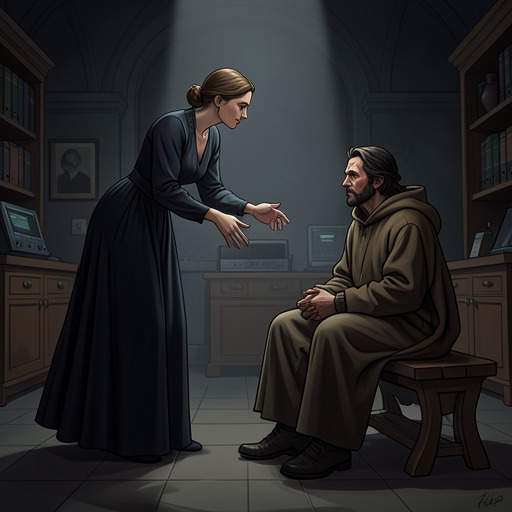
The code is tested not in a public contest alone but through exchanges in which courtesy can become a constraint. During his stay at Bertilak’s Castle, Lady Bertilak presses Sir Gawain with intimate attention. He answers through the language of courtly manners, making a witty appeal that she release him from the bed’s confinement and allow him to rise. His response registers both the force of her attention and his effort to remain within the forms of polite conduct.
Their conversation makes courtesy itself a subject of negotiation. Lady Bertilak invokes kissing as something a courteous knight should understand, while Sir Gawain questions the reverence she accords him and asks what explains her interest in a young man such as himself. He is not simply silent before temptation: he participates in the exchange, answering and redirecting her words. The scene shows the code operating as a social practice, where graceful speech can help a knight manage pressure but also leaves him exposed to competing obligations.
The poem sharpens that pressure through the repeated distinction between accepting a woman’s love and refusing it discourteously. Lady Bertilak presses him so closely that, as the narration puts it, he must either accept her love or refuse it harshly. The dilemma tests the gap between courtesy and other duties: preserving a reputation for graciousness does not by itself resolve what loyalty and integrity require. The code’s virtues are interdependent, but in practice they can pull a knight toward difficult choices.
The Green Girdle and the Failure of Integrity
The Green Girdle makes the test concrete. Sir Gawain accepts it and keeps it concealed, treating it as protection against the danger he expects at the Green Chapel. The poem’s account of the girdle gives its concealment moral weight: whoever wears the green lace close about himself is said to be beyond being cut down. The object therefore stands at the intersection of physical fear and the knight’s obligations, turning an inward conflict into something he can carry on his person.
That concealment contradicts the virtues displayed on the pentangle. When Sir Gawain later confronts his conduct, he links the failure directly to fear of the coming blow: cowardice taught him to make terms with covetousness and abandon his nature. He names largesse and loyalty as qualities belonging to knights, then admits that he has been faulty and false and fears he has acted treacherously. His confession does not treat the lapse as an obscure technical breach; it identifies a choice made for self-preservation at the expense of the conduct the code demands.
The contrast between shield and girdle is especially pointed. The pentangle is an emblem of interconnected and enduring virtue; the girdle is a private safeguard whose concealment exposes the limit of that ideal in practice. Sir Gawain’s shame follows from recognizing that the visible signs of chivalry cannot guarantee that a knight will meet its demands when his life seems at risk. The poem thus makes the code’s difficulty part of its meaning: its worth lies not in claiming that a knight is incapable of failing, but in revealing what a failure costs and requires him to acknowledge.
Confession and the Code’s Measure
The Green Knight’s judgment gives Sir Gawain’s admission a public frame. After Sir Gawain condemns cowardice and covetousness, the Green Knight takes the knot and loosens it, then draws the belt from him. The gesture makes the concealed object visible and ties the knight’s confession to a material sign of the breach. Sir Gawain has already named the failing; the Green Knight’s action brings that failing into view rather than allowing it to remain hidden beneath the clothing.
The conclusion does not erase the standard embodied by the pentangle, nor does it present Sir Gawain as wholly defined by his lapse. Instead, it distinguishes an ideal of complete fidelity from the vulnerable person who has failed to uphold it under pressure. The code remains severe precisely because its virtues—especially loyalty, generosity, courtesy, and pity—are meant to govern conduct when self-interest offers an easier course. Sir Gawain’s return to the language of knightly virtue after confessing his fear makes the code both a measure of his shame and the framework through which his experience can be understood.