The Green Girdle
Sir Gawain and the Green KnightThe Green Girdle turns a small, wearable gift into the measure of Sir Gawain’s most consequential failure. Offered by Lady Bertilak as protection against death, it gives him a reason to conceal something from Bertilak despite their agreement to exchange what each wins. When the Green Knight reveals the concealment at the Green Chapel, the girdle changes from a private safeguard into a public sign of fault—and, for Gawain, a chosen reminder of his limits.
Appearance and Promised Protection
The girdle is a lace of green silk worked with gold, worn around the body and tied over the wearer’s tunic beneath a mantle. Its value in the story rests less on its materials than on the power Lady Bertilak claims for it: a man who wears it, she says, cannot be slain by any skill on earth. The claim offers apparent security, not merely finery, to a knight who believes he is travelling toward a potentially fatal encounter.
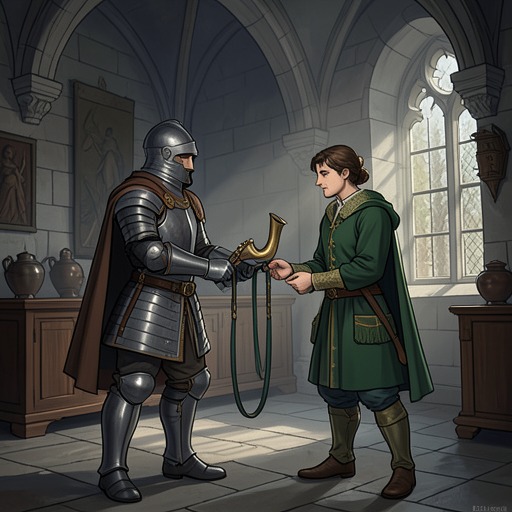
The promise gives the object its particular force. Gawain regards the girdle as a prize suited to the danger he faces, and accepts it when Lady Bertilak offers it after he has declined a rich ring. The exchange makes protection tangible: instead of meeting danger through courage alone, he can carry a safeguard close against his body. Yet the poem’s account does not establish that the girdle truly makes its wearer invulnerable. Its power is the protection Lady Bertilak represents it as offering, and the belief in that protection shapes Gawain’s choice.
Gift, Secrecy, and the Exchange Agreement
The gift enters a household already bound by an explicit bargain. In the Bertilak’s Agreement to Exchange Daily Winnings, Gawain and Bertilak promise to give each other what they win. The arrangement makes hospitality reciprocal and measurable: what is gained in the day is to be handed over at their meeting. Lady Bertilak’s private offer therefore tests more than Gawain’s response to her; it places a new gift inside an existing obligation.
Gawain accepts the girdle, and Lady Bertilak asks him to keep it secret from her husband. He agrees to conceal it. His acceptance is thus joined from the outset to a decision about what he will not disclose, even though he has promised Bertilak to exchange his winnings. The object’s protective promise explains why he prizes it, but does not remove the conflict between keeping it and honouring the bargain.
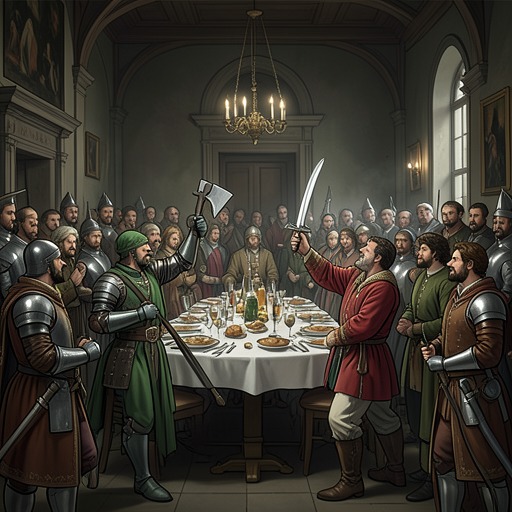
The contrast becomes visible when the daily exchange is performed. Bertilak presents the day’s hunting proceeds before the company, including the venison from the hunt, and meets Gawain with the expectation that their agreement will be fulfilled. Gawain’s concealment means that the exchange cannot be complete: the girdle remains with him rather than being yielded to Bertilak. A private gift has therefore become the withheld item in a public test of reciprocity.
Exposure at the Green Chapel
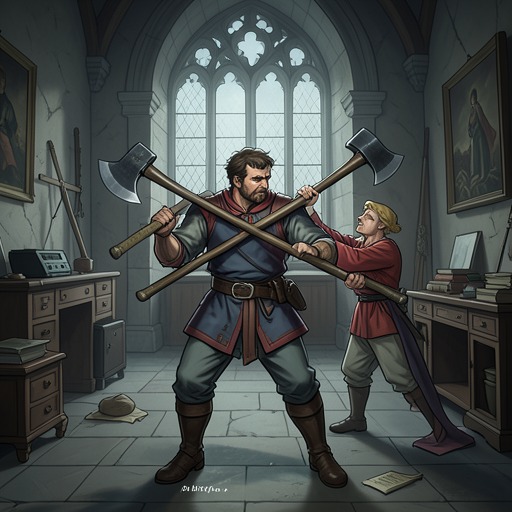
At the Green Chapel, the Green Knight identifies the girdle as his own and tells Gawain that his wife wove it. He connects it to the third stroke of the axe: Gawain failed at that point, and the girdle is the reason for the mark he bears. The revelation recasts the earlier gift as part of the trial and confirms that the secrecy Gawain kept from Bertilak has not remained hidden from the Green Knight.
The Green Knight catches the girdle’s knot and casts it back to Gawain, calling it the token of his falseness. Its meaning now differs sharply from the promise that first made it attractive. What Gawain had treated as a means of escaping death becomes the visible reminder of the fear that led him to withhold a winning from his host. The object carries both sides of the test: the genuine peril that made protection desirable and the breach of an obligation that protection could not excuse.
A Worn Reminder
Gawain keeps the girdle after the encounter, but changes how he understands and uses it. He says he will wear it as a sign of his transgression and remember his fault and the frailty of the flesh. The token is no longer presented as an assurance that danger can be defeated; it becomes a deliberate aid to recollection, fastening the experience of the trial to his person.
The ending makes that remembrance concrete. After the wound on his neck has healed, Gawain still wears the bright girdle bound around his side, tucked beneath his left arm. Its position recalls its original function as something wrapped around the body, while its continued presence records what happened when fear unsettled his conduct. Beside Gawain’s pentangle shield, associated with the faithful virtues for which he is renowned, the girdle marks the distance between an ideal of constancy and a human being who falters. It does not erase his failure or restore an unblemished reputation; it lets him carry the failure openly as a continuing reminder.