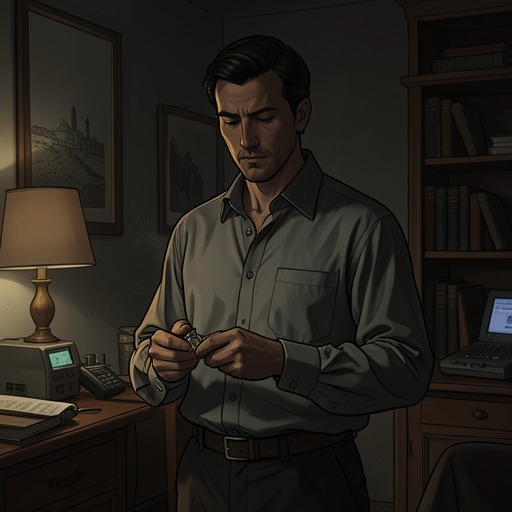
Carl Bertolli
Slow BurnCarl Bertolli is Kate MacKenna’s friend, an art-gallery owner, and a consequential link between two attacks on her. He turns his inherited estate, Liongate, into a gallery project and uses his connections to help Kate find business space. Those same connections and properties later make him part of the investigation: he has controlling interest in the company that owns the warehouse where Kate was nearly killed, and he recognizes that she was endangered at both his estate and the warehouse. His importance lies in that uneasy overlap between friendship, opportunity, and responsibility—not in any established knowledge of who caused the attacks.
Liongate and the Gallery
Carl inherited Liongate from his father and was building an art gallery on the property. The estate’s electronic iron gates, decorated with two large lion faces, open onto a winding drive. His two-story house stands near the top, while the gallery intended to exhibit Cinnamon’s work sits farther down the hill, on the south side. The partly completed gallery could not hold the expected crowd, so a large white tent was set up beside the white-stone building. Security staff and waiters moving between the annex and tent reflected the scale of the occasion Carl anticipated.
The exhibition placed commerce and controversy side by side. Cinnamon, an artist from Houston, had attracted protests and threatening phone calls; Carl welcomed the attention because he believed publicity, whether favorable or not, would benefit the gallery. Kate considered the work mediocre, while recognizing Cinnamon’s talent for attracting notice. The paintings were nevertheless priced extravagantly. Carl’s enthusiasm for the opening thus involved not only hosting a friend and presenting an artist, but also treating public attention as a practical asset for his new gallery.
Friendship with Kate
Kate’s attendance at the opening mattered to Carl because she was his friend. Although the drive from Silver Springs to the other side of Charleston would take more than an hour, she felt she could not simply decline without hurting him. She planned to help with final preparations and leave once the party was underway, expecting Carl to be too occupied to notice. The arrangement shows the ordinary personal obligation surrounding the event before it acquired a more dangerous significance.
Carl called Kate while preparing for the evening, weighing what to wear and anticipating the critics who would attend. He was not yet ready to come downstairs and had to collect Cinnamon from her hotel by limousine, so he asked Kate to inspect the tent setup in his place. He relied on her judgment, praising her taste and asking her to make sure everything was in order. Kate agreed, smiling at his dramatic manner. The favor placed her directly in the preparations at Liongate, while also illustrating how readily Carl entrusted practical tasks to his friend.
Business Connections and Withdrawal
Carl’s connection to Kate continued beyond the exhibition. When she needed a larger business space, he suggested that a Realtor contact her; the Realtor then showed her several locations, including the warehouse Kate considered ideal. This assistance establishes a direct route from Carl’s recommendation to Kate’s eventual association with the warehouse. It does not, by itself, establish that he knew the property would become dangerous or explain why he made the referral.
Carl also has a pattern of withdrawing when life becomes stressful. Isabel MacKenna told Kate that Carl had called to say he was going away, adding that he sometimes secludes himself and returns refreshed. Kate offered this behavior as an explanation when the others wondered where he was, while Nate Hallinger rejected waiting for his return and said he would find him. The account presents seclusion as a familiar response for Carl, but does not establish how long he would be gone or what prompted this particular departure.
The Warehouse and the Investigation
The connection between Carl and the warehouse changes the meaning of his earlier help. Dylan Buchanan had investigated the company that owned the warehouse where an explosion occurred and had struggled to identify its shareholders through the layers of ownership. He eventually found that Carl held a controlling interest. Carl later clarified that he was only one of the owners, but confirmed that he had control. The distinction matters: he was not the sole owner, yet his stake gave him a substantial connection to the property.
When asked what he had to gain, Carl answered that he wanted satisfaction. The exchange does not explain that answer further, and it does not establish that satisfaction was a motive for the attacks. Asked why he had not told Kate about his ownership, he was confronted with the implications of his links to the warehouse. He then reasoned from the circumstances: he had invited Kate to his estate and urged her to bring her products, where she was nearly killed; he had also encouraged her to consider the warehouse, where she was nearly killed again. Because he owned both properties, he said he was responsible, while maintaining that he did not know how or why the explosions had occurred and wanted the investigators to work it out.
Conduct Under Questioning and Narrative Role
During questioning by Chief Drummond, Carl’s crying made it difficult for the chief to begin. Kate understood Drummond’s bewilderment and described Carl as dramatic. The episode continues the contrast between Carl’s conspicuous manner at the gallery opening and the practical seriousness of the investigation: his emotional display complicates the interview, but does not resolve the questions about the explosions.
The account characterizes Carl as someone who tells what he knows readily, perhaps to anyone willing to listen. That openness makes him a possible source of information, but also leaves room for others to have used him to obtain it. His position in the plot is therefore deliberately ambiguous. He has welcomed Kate onto his estate, helped her locate the warehouse, and held a controlling stake in the company behind it; these facts make him answerable to suspicion and, in his own formulation, responsible for the danger. Yet he disclaims knowledge of the mechanism or purpose of the attacks. The distinction between being connected to the places and knowing who exploited those connections remains central to his role.