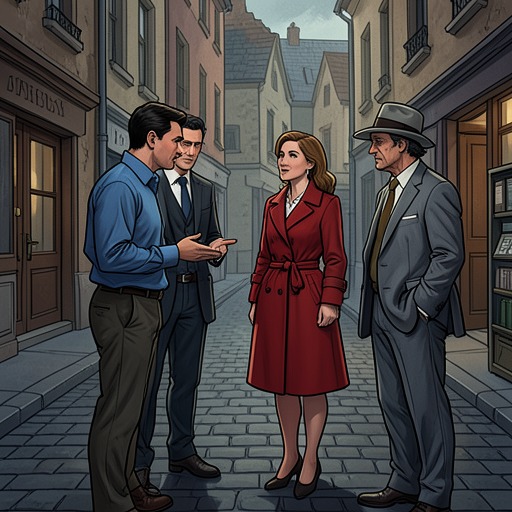
Carl Bertolli Turns Himself In at the Police Station
Slow BurnCarl Bertolli’s voluntary arrival at the police station shifts a baffling threat into a personal admission of responsibility, though the scene withholds the crucial explanation of what he believes he set in motion. His insistence on confinement, his relief at finding Kate MacKenna safe, and his claim that the idea was his make the encounter both a surrender and the beginning of an unfinished account.
Arrival at the Station
Chief Drummond tells Kate and Dylan Buchanan that Carl came to the station about half an hour earlier. Carl had driven a considerable distance to visit Kate; when she was not home, he went instead to the police station to turn himself in. The order matters: he sought Kate first, then chose to approach the authorities when that visit failed.
The news catches Kate off guard. Chief Drummond leads the pair upstairs to his office, where Kate waits impatiently for an explanation. When he tells her Carl is at the station, she asks what Carl is turning himself in for. Drummond’s answer—that Carl says he is responsible—deepens rather than resolves her confusion. Dylan, leaning against the office door with his arms folded, appears to take the news more calmly; Kate is flabbergasted, setting her briefcase and purse beside her chair as questions race through her mind.
A Cell by His Own Request
Kate immediately wants to see Carl and is ready to search the building herself if necessary. Drummond corrects her assumption that Carl is waiting in a conference room or the lounge: Carl is in a cell. Kate objects to the thought of him being locked up, but Drummond explains that he did not arrest Carl. Carl insisted that the chief put him there.
That distinction defines the surrender. The cell is not presented as the result of an arrest; it is a form of confinement Carl himself requests. Kate cannot understand why he would ask for it, and the available explanation remains limited to his assertion that he is responsible. His decision to submit to custody therefore signals the seriousness with which he views his own part, without establishing what that part is or what charge, if any, he faces.
The Meeting with Kate
Before meeting Carl, Kate says she will listen but intends to challenge him if he manipulates her, tell him to stop if she dislikes what he says, and threaten him back if he threatens her. Dylan pulls out a chair for her in the small interrogation room but stays standing as they wait. The room’s oblong table, four chairs, and two-way mirror place their personal encounter inside a formal police setting.
Dylan has already made snap judgments about Carl, but Carl’s entrance changes his view. Carl is visibly glad to see Kate and hugs her before Dylan can stop him. He apologizes and says that the danger to her is all his fault. His embrace and apology give his claim a personal force: he is not simply reporting himself to the police but confronting the person he believes has borne the consequences.
The Unanswered Explanation
Carl’s manner initially includes ordinary, even light conversation. He asks for a decaf latte and remarks that he supposes there is no nearby Starbucks; Dylan confirms there is not. Dylan then cuts through the chitchat and asks why Carl thinks he is responsible. Carl says it is because the idea was his. When Dylan asks what the idea was, the scene has not yet supplied an answer.
The episode thus reveals a crucial limit as well as a disclosure. Carl accepts personal responsibility and identifies himself as the originator of an idea, but neither the idea nor its connection to the danger facing Kate is explained in this encounter. The scene’s movement is from Kate’s bewilderment, through Carl’s self-imposed confinement and emotional apology, to Dylan’s direct demand for specifics. It ends at the threshold of the account Carl has come to give.