Inheritance, Family Legacy, and Charitable Giving
Slow BurnInheritance, Family Legacy, and Charitable Giving centers on Kate MacKenna’s decision to accept her great-uncle Compton Thomas MacKenna’s estate, dismiss its advisers, and give its value to charitable work commemorating her mother, Leah MacKenna. The change does not erase her initial rejection: it makes the inheritance’s meaning a matter of choice. Wealth arranged by a dead relative passes through legal and financial procedures, but Kate ultimately refuses to let either the benefactor’s wishes or his advisers determine what the fortune will stand for.
The Inheritance and Its Conditions
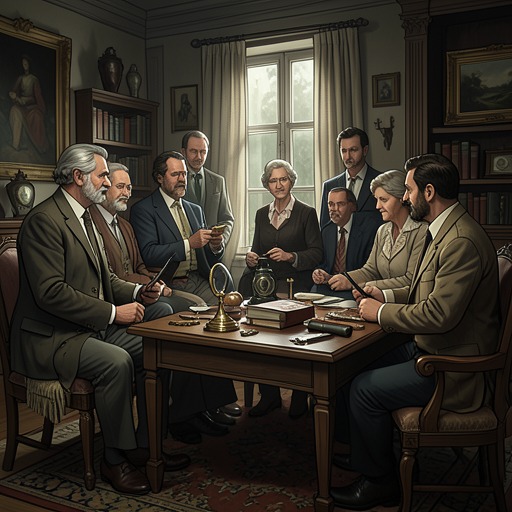
At the estate meeting, Kate’s first response is an emphatic refusal. Anderson Smith explains that Compton Thomas MacKenna had planned the transfer in detail and gives her a binder summarizing cash holdings and other assets. The records are meant to help her understand what Compton Thomas MacKenna accomplished; a meeting with financial advisers is scheduled for the following afternoon. The inheritance arrives, then, not as an unstructured gift but as an organized transfer accompanied by documents, professional guidance, and an expectation that Kate will consider how to manage it.
Kate does not accept that expectation at once. She tells Anderson Smith that she wants none of the inheritance and asks him to prepare any papers needed to decline it. Her objection is not merely a request for more time to inspect the assets: she calmly insists that she will not change her mind. Anderson Smith explains that he cannot force her to accept the estate, while also making clear that carrying out her great-uncle’s wishes is his responsibility. The episode establishes a tension between the deceased benefactor’s planned transfer and the living recipient’s freedom to refuse it.
That freedom matters to the family as well as to Kate. One of the men asks whether refusal would pass the estate to the next of kin; Anderson Smith does not answer him, instead returning the decision to Kate. Dylan Buchanan stands beside her in case one of the brothers approaches, but recognizes that she is handling the confrontation herself. The estate is therefore both a financial transfer and a point of conflict in which Kate’s authority over her own decision is tested.
Acceptance Without Financial Guardianship
Kate later changes course, but accepting the inheritance does not mean accepting every arrangement attached to it. At seven o’clock, she and Dylan Buchanan arrive at the Smith and Wesson law offices for a two-hour meeting with Compton Thomas MacKenna’s advisers and accountants. The men report on their work and speak as though they collectively own the money, while presenting future management as an established plan. They ask Kate to authorize the continuation of their financial guardianship and offer annual reports.
After hearing them out, Kate signs the papers prepared by Anderson Smith, formally accepting the inheritance. The attorney confirms that there are no further stipulations and that Compton Thomas MacKenna’s wishes have been fulfilled. Yet the advisers’ assumption that they will continue managing the estate does not survive the meeting. As they gather their belongings, Kate asks them to remain seated, thanks them for their work, and tells them their services are no longer needed. Her acceptance is thus also an assertion of control: the transfer is complete, but professional custody of the wealth is not automatic.
The distinction between receiving and using the fortune is made explicit in Kate’s earlier conversation with Dylan Buchanan. She says she intends to seek a loan to pay off another loan, describing the borrowing as a temporary measure that would buy her time. Dylan reminds her that signing the next day’s papers will make her a millionaire. Kate understands that the inheritance will appear as an asset on a bank application, but stresses that she regards it as temporary. The exchange presents her planned use of the money as different from treating it as personal wealth to keep.
Charity as Family Remembrance
When an adviser challenges her about what she will do with the estate, Kate says she is giving it away. She has several possibilities and intends to discuss them with her sisters before choosing. One is a research facility connected to the terrible disease that killed her mother; another is a new cancer wing at the hospital in Silver Springs. She has settled on a principle even though she has not finalized the institution: whatever the money supports will bear her mother’s name, Leah MacKenna.
This proposed gift changes the inheritance’s direction without making Kate its sole moral interpreter. She reserves the final decision for discussion with her sisters, while defining the remembrance at its heart. The advisers react with horror, and one says that Compton Thomas MacKenna would object because he had not considered Leah MacKenna part of his family. Their response makes the family dispute visible in the argument over charity: a legacy conceived by one relative is being redirected toward honoring someone that relative excluded.
The ending turns that intention into a practical arrangement. After the suspects have been taken from the bank for questioning, Mr. Radcliffe offers to cooperate with the police investigation and to arrange an unsecured loan for payment of Kate’s mother’s loan. He also says that First National Bank of Silver Springs is honored to hold the funds for the charitable trust under Anderson Smith’s supervision. Kate and her sisters leave smiling. Isabel MacKenna points out the contrast that Kate has taken out a loan while giving away millions rather than using the inheritance to pay their mother’s loan; Kate answers that her mother would not have wanted her to use it that way.
Separate Shares and a Shared Legacy
The sisters’ conversation shows that the family inheritance does not become a single, uniform charitable act. Isabel MacKenna has received land in Scotland, and Kate advises her to visit it after graduation before deciding what to do with it. Kiera MacKenna is unsure what she will do with the bonds she received, but says that whatever she chooses will bear their mother’s name. The sisters do not announce a final shared plan for every asset; instead, each faces a decision about what her portion can mean.
The contrast defines the subject’s central tension. Compton Thomas MacKenna’s estate is carefully documented and transferred through formal procedures, but its passage does not settle its purpose. Kate accepts the wealth only after refusing its initial claim on her, ends the advisers’ proposed guardianship, and directs the main fortune toward public causes associated with Leah MacKenna. Her sisters retain their own choices about their separate inheritances. Family legacy consequently emerges not as a fixed instruction handed down intact, but as a set of decisions through which the recipients determine whom the wealth will remember and serve.