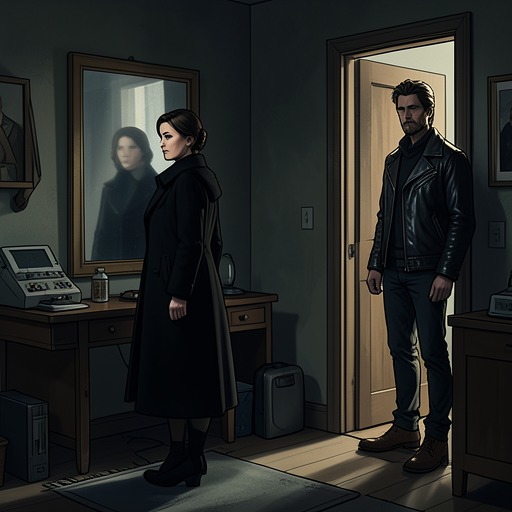
Kate Hides Her Grief over Her Mother’s Death with Anger
Slow BurnKate MacKenna’s anger over her mother’s deception and the damage left in its wake is bound up with a more painful truth: Leah MacKenna became ill and died, and Kate could not stop it. The distinction matters because Kate initially names her hurt as disappointment and insists it is about the mess her mother left behind. Dylan Buchanan presses her to recognize what that account excludes. Later, the hospital bills and loan papers give Kate’s anger a new, difficult context: the silence she resented had concealed both desperate fear and an effort to protect her daughters from debt.
Anger and the Fear of Another Surprise
Before meeting her relatives, Kate worries that the gathering may bring another unwelcome discovery connected to her mother. The letter delivered by special messenger has made her wonder whether Leah borrowed money from an uncle and whether the estate will now demand repayment. The prospect shows how financial uncertainty has become inseparable from Kate’s memory of her mother: even a family meeting can look like the prelude to another burden or disappointment.
Dylan reminds Kate that her mother never mentioned her husband’s relatives, and he considers her suspicion remote. But he does not let the exchange remain a question about the estate. He asks how long she will stay angry. Kate rejects that word and calls herself disappointed; when Dylan says she is furious, her defiance falters and tears come. The sequence makes the gap between her chosen description and her visible distress part of the scene: she can dispute his interpretation, but she cannot keep the grief from showing.
Naming the Loss
Kate eventually acknowledges anger and connects it to the scale of what she believes Leah concealed and left behind. Dylan answers that the deeper wound is not money: Leah became sick, died, and Kate could not prevent it. His formulation does not deny the financial damage or establish that Kate’s complaints about deception are unfounded. Instead, it shifts attention from the consequences Kate can itemize to a loss she had no power to reverse.
Kate initially says this explanation does not make sense. Even so, when Dylan suggests that she consider forgiving her mother, she does not simply dismiss him. She wants to argue that his amateur analysis is wrong, yet pauses over the possibility that anger has been shielding her from the pain of losing Leah. The possibility remains a question for Kate rather than a settled diagnosis: the scene records an opening in her certainty, not a completed reconciliation or an announced act of forgiveness.
The Papers Behind the Silence
A later review gives that emotional conflict concrete evidence. Kate reads the loan papers Leah signed alongside bills and receipts from hospitals where, during the last year of her life, Leah spent more time than at home. As Kate works through the documents, she understands that her mother’s limited insurance had run out and that, in desperation, Leah signed away everything so her daughters would not inherit her debt.
The hospital bills are described as astronomical. Their scale makes the hidden strain legible to Kate, while the absence of any account from Leah leaves her to imagine how much worry, heartache, and fear her mother bore in silence. Kate’s tears cloud her vision as she reads; she turns away from Dylan, wipes her face with a tissue from her purse, and tries to keep him from noticing. The gesture repeats the scene’s central tension in a changed form: pain is present, but Kate still tries to conceal it even as the papers make concealment harder to sustain.
Anger, Grief, and Moral Choice
Kate’s reactions do not reduce to a simple reversal in which discovering Leah’s sacrifice erases the harm of her secrecy. Earlier, she had already known that her mother’s decisions had devastated her business and personal circumstances; the documents add the reason Leah signed away the assets, not proof that every consequence has disappeared. Her anger and her recognition of her mother’s fear can therefore coexist. The narrative’s emphasis is on a changed understanding of the silence, rather than an uncomplicated vindication of it.
The estate material offers a related, but distinct, measure of Kate’s response to inherited money. After reading Compton Thomas MacKenna’s financial history, she concludes that she will not spend his money on herself, her family, her company, or her future; she judges him selfish and cruel and resolves to prove she is not like him. This decision concerns Compton’s wealth, not Leah’s loan papers, but it sharpens the contrast between money as inheritance and money as a source of obligation. In both strands, Kate refuses to treat a financial outcome as morally neutral. Her grief over Leah is exposed not by a neat resolution, but through a sequence of resistance, tears, documents, and revised understanding.