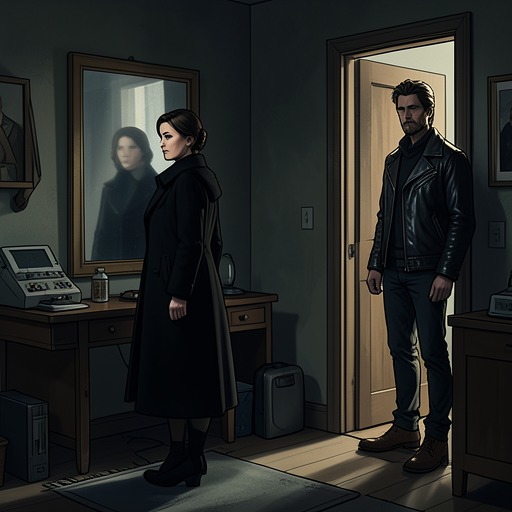
Kate MacKenna and Dylan's engagement
Slow BurnKate MacKenna and Dylan Buchanan’s engagement resolves a relationship shaped by repeated encounters, irritation, and feelings neither had clearly named. Dylan’s proposal follows his explanation that his apparent annoyance concealed a pattern of seeking Kate out; Kate, afraid that honesty might drive him away, answers with her own declaration of love. The epilogue confirms that they are engaged, but leaves their wedding date undecided.
From Repeated Encounters to Recognition
Dylan describes their history on Nathan’s Bay as a cycle of interference and return. Kate repeatedly disrupted his love life, and at other times acted as if he were not there; he says this made him angry, yet he kept coming back. The decisive clue, in his account, is that he deliberately found out when Kate would be at the bay for the weekend and arranged to appear there too. What had seemed to him like irritation therefore becomes evidence of attachment: his recurring presence was not accidental, even if he took time to understand what it meant.
His nickname for Kate gives that recognition a playful, pointed form. Once he understood his feelings, he began calling her “pickle” to make her crazy. The teasing does not erase the earlier friction; it recasts it as part of their particular way of engaging with each other. The declaration that he loves her arrives after a history in which annoyance and attraction have been difficult to distinguish, making the name both a joke and a sign of the intimacy the pair have built.
Mutual Declarations and the Proposal
Kate’s first response is disbelief. When Dylan says he loves her, she waves a cereal box as she protests, and Cheerios fly across the dining room, with some landing in her hair and others in the chandelier. The disorder makes the exchange unusually physical: Kate has never behaved this way before, the narration notes, but has never felt this way before either. Dylan traps her in a corner, leaving her no route out except past him, and asks why she had been so irritated with him. The scene turns their long-standing antagonism into a direct invitation to name what lies beneath it.
Kate is afraid to believe Dylan. She thinks he might not love her and sees only one way to test that possibility: commitment to the truth. If honesty is what makes him disappear, she reasons, then the relationship cannot survive on what she withholds. She answers, “Because I love you,” and Dylan does not leave; he smiles. Kate repeats her declaration and points out that the door is behind him. Her words make his departure possible while testing whether he will choose to stay, so the exchange places her vulnerability alongside his earlier confession rather than treating the proposal as a one-sided declaration.
Dylan responds by setting his hands on either side of Kate and leaning close enough that his mouth is an inch from hers. He asks her to marry him. The proposal changes the scene’s stakes: the pair move from discovering that their feelings are mutual to the prospect of a shared future. The narrated evidence establishes the proposal and later confirms their engaged status, though it does not show a separate spoken answer to the proposal or describe a wedding ceremony.
The Engagement in the Epilogue
The epilogue provides the clearest confirmation that the proposal has become an engagement. On a Friday afternoon, Kate enters the First National Bank of Silver Springs with her sisters, Isabel and Kiera. Isabel asks whether Kate has set the wedding date and whether she will be in the wedding. Kate answers that no date has been set and confirms that Isabel will be included. The exchange establishes both the continuing status of the engagement and one concrete wedding arrangement, while withholding any timetable or other planning details.
A little later, Kate urges her sisters to find the key because Dylan is coming that afternoon. The practical urgency places him in the sisters’ ongoing shared life without adding a wedding date or specifying what the key opens. Together, these details make the epilogue’s confirmation modest but definite: the proposal has led to an engaged future, and Kate speaks of wedding arrangements with Isabel, even as the date remains open.
Significance of the Commitment
The engagement rests on a reversal in how the pair understand their past. Dylan’s repeated appearances on Nathan’s Bay, once entangled with frustration, become evidence that he was choosing proximity to Kate. Kate’s fear that a truthful declaration would make him vanish is answered not by another joke or evasion but by Dylan remaining present and proposing marriage. The relationship’s movement is therefore marked by two acts of candor: Dylan names the love hidden inside his irritation, and Kate risks naming hers in return.
The ending confirms commitment without presenting it as a completed wedding or a fully specified plan. The sisters’ discussion makes the future tangible through Isabel’s place in the wedding, while Kate’s answer preserves an important limit: the date has not been set. The book thus closes this relationship arc on an affirmed engagement, not on details it does not supply. The playful language of “pickle,” the scattered cereal, and the direct proposal belong to the same progression: teasing and disorder give way to mutual acknowledgment and an explicit intention to marry.