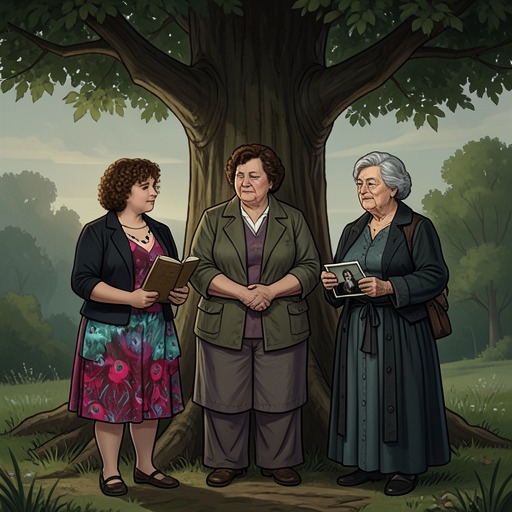
Kate MacKenna and Leah MacKenna
Slow BurnKate MacKenna and Leah MacKenna are bound by both affection and a consequential breach of trust: Leah becomes Kate’s business partner and supports the company while Kate studies in Boston, but after Leah’s death Kate discovers that her mother signed loan papers using family assets, including the company, as collateral. The discovery makes their relationship more than a story of bereavement. Kate must reckon with what her mother did while still recognizing the care, practical help, and family loyalty that had marked their life together.
Trust Made Practical
When Kate’s candle business began to outgrow its early arrangements, she made Leah a partner. By the time Kate graduated, orders were arriving from across the country, and Kate had decided to return to school in Boston for a master’s degree. Leah’s role was concrete: as a partner, she could sign checks and make deposits while Kate was away, helping keep the enterprise running in her absence. The arrangement joined family trust to business necessity; it was not simply a gesture of affection, but a way to give the company continuity while its founder was elsewhere.
That partnership later carried greater weight because Leah’s authority had not been limited to routine tasks. Kate explains that she had set things up this way when she was underage, and that the arrangement remained convenient during her time in Boston. Leah could act on Kate’s behalf. What had once allowed Kate to study and build the business therefore also gave Leah the authority that would make the later loan papers possible. The same practical trust that supported Kate’s independence became part of the exposure she faced after her mother’s death.
Distance, Illness, and Interrupted Plans
Kate’s time in Boston was already marked by financial constraint: she put profits back into the company and lived with her college roommate and best friend, Jordan Buchanan. Although Kate managed to grow the business while away, Leah’s illness changed the direction of her life. When her mother became gravely ill, Kate put her ambitions on hold and returned home to be with her. A long, sad year passed after Leah’s death; during it, Kate completed her graduate degree and made plans to expand the company. The sequence places professional advancement alongside loss, without suggesting that one simply replaced the other.
The family also had a specific arrangement for Leah’s household bills. When Leah became gravely ill, she set it up for Tucker Simmons, the family’s accountant, to handle those bills for one year after she was gone. Leah insisted that Kate could not manage them from Boston, despite Kate’s offer to take them on herself. The arrangement shows Leah anticipating a period when her daughters would have to manage without her, and trying to provide continuity. Yet it also left the financial picture incomplete from the daughters’ perspective: Leah had kept her budget private, and Kiera recalls that whenever she asked about money, their mother answered, “We’re doing just fine.”
The Discovery in the Papers
After dinner, with her sisters away from the house, Kate began sorting through the papers the accountant had sent. A large envelope from Summit Bank and Trust surprised her: she had not known her mother had done business with that bank, since Kate’s household account was at a local Silver Springs bank. Among the documents were invoices, copies of a loan application, and a letter from senior loan officer Edward Wallace. Kate initially thought the papers might concern a pension. Their contents instead forced her to confront a debt and a signature she recognized as her mother’s.
Kate’s first response is disbelief, followed by recognition. She reads the letter and loan papers, whispers, “No,” and tells herself that what she is reading must be wrong. The signature makes denial harder: she knows it is Leah’s. Her question, “Mother, what did you do? What did you do?” carries both the shock of the financial discovery and the intimacy of addressing the person she has lost. The papers change how Kate understands the partnership—not by erasing its earlier usefulness, but by revealing that Leah’s authority had also been used to place the company at risk.
Anger Without Disowning Her Mother
When Kate later explains the discovery to her sisters, she recalls the bank letter as saying their mother had signed away everything, including Kate’s company. The breadth of that loss sharpens the conflict: the company was not an abstract family asset, but the business Kate had built and intended to expand. She tells her sisters she was stunned and furious, and that she was not thinking clearly at first. Her anger is explicit, but so is her attempt to regain control of the situation and prevent the company from being taken away.
Kate also resists letting anger become the only account of Leah. When Isabel tries to understand or defend their mother, Kate acknowledges the thought that Leah had done the best she could. That recognition does not excuse the consequences or restore what the loan papers endangered; it allows care and injury to remain present at once. Kate’s later plans for products named Leah, Kiera, and Isabel further connect her work to her mother and sisters, even as the financial crisis exposes the cost of the authority Leah held. Their relationship therefore remains divided between inheritance as something lovingly carried forward and inheritance as a problem Leah left Kate to face.