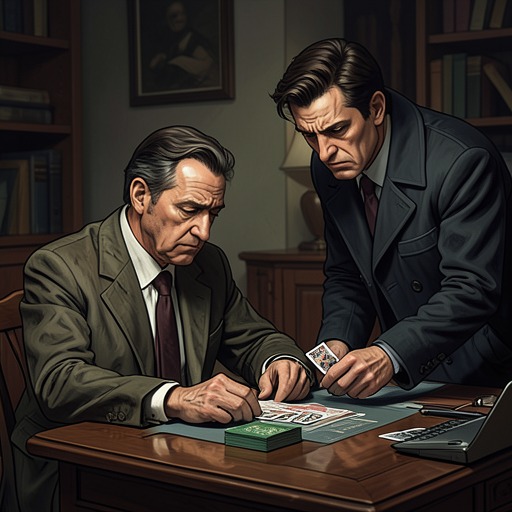
Roger MacKenna and Jackman's criminal partnership
Slow BurnRoger MacKenna and Jackman's criminal partnership joined Roger’s planning of the bombings to Jackman’s access to the criminal connections needed to carry them out. Their arrangement was shaped by Roger’s debt: Jackman helped because recovering the money Roger owed him depended on it. The investigation eventually identified Roger as the planner and Jackman as the intermediary, but the case against Jackman remained less conclusive than the case against Roger.
Debt and division of roles
Nate Hallinger identifies Roger as the person behind the attacks, describing him as their planner and saying that he had help. Jackman’s role was practical rather than equal: he had the connections to obtain what Roger needed. The relationship was coercive as well as collaborative. According to Nate, Jackman had little choice but to assist, since helping Roger was the way he might recover the money owed to him. The debt thus supplied both the leverage and the purpose binding the two men’s criminal arrangement.
The evidence gives a concrete measure of that arrangement in Roger’s notes. One entry recorded that Jackman had obtained the baskets, with $200,000 written alongside it. Investigators took the sum to be the amount paid for the explosives. The note supports Jackman’s role in sourcing the bombing materials, while its wording leaves the broader division of labor clear: Roger planned; Jackman used his connections to procure.
The bombing evidence
The investigators had determined that an explosive was placed inside a flower basket. It was left on the ground in front of a table toward the back of the gallery-event tent, at Kate MacKenna’s table. Kate recalled seeing the flowers but had not seen who delivered them; she had been inside the gallery briefly and found the basket when she returned. These details connect the attack’s method to Roger’s later notation about Jackman and the baskets, but they do not identify the person who physically delivered the bomb.
Roger’s annotated calendar supplied a wider pattern of preparation. It contained the address of Carl Bertolli’s estate, the date and time of the gallery party, and the warehouse address. Two dates were heavily circled, and investigators recognized them as the dates of the explosions. The calendar also included flight numbers for Kate’s trips to Boston and her return home, showing that Roger had tracked her schedule. This information makes the planning appear sustained and specific; it does not, by itself, establish which of the calendar’s entries Jackman supplied or authored.
Exposure and evidentiary limits
The calendar was found in the kitchen beside the phone and was covered in fingerprints. Investigators noticed two distinct handwritings and sent it to the laboratory for analysis, so the notes could not all safely be treated as Roger’s. Jackman had been arrested and was waiting for his attorney in Las Vegas, but Roger’s notes were not expected to hold him for long. Nate said investigators still needed stronger evidence against him.
Roger’s death sharpened that distinction. He did not confess to the police; he killed himself. His records nevertheless gave investigators a path from the attacks to Jackman, including the note about the baskets and the sum associated with the explosives. Dylan Buchanan, examining Roger’s papers and handwritten notes, understood the material as a tidy set of clues: enough to connect Jackman to the operation, but not hard evidence sufficient to convict him.
What the partnership leaves unresolved
The investigation had also not established who was behind the camera when Compton Thomas MacKenna recorded his farewell address. Nate said the nephews were not suspected of filming it, since Compton did not trust them or want them to know his plans; investigators were instead looking at other possible participants, including the housekeeper and Compton’s attorney. That unresolved inquiry is distinct from the evidence tying Roger and Jackman to the bombings, and it underscores that Roger’s death did not automatically settle every question surrounding the wider case.
The partnership is therefore revealed through an uneven trail: Roger’s planning notes identify targets, dates, and Kate’s movements, while one terse entry points to Jackman’s procurement of the baskets. Roger’s debt explains why Jackman became involved, but the same notes that expose their connection also mark its evidentiary limit. Roger is named as the planner; Jackman is linked through access and supply, yet investigators still need proof beyond Roger’s conveniently suggestive records.