Roger MacKenna’s Death
Slow BurnRoger MacKenna’s death is presented first as a suicide and then as a scene that refuses to fit that explanation. Papers arranged for investigators, a missing suicide note, and a fingerprint match to Ewan MacKenna turn the apparent resolution into a deeper mystery; Dylan Buchanan ultimately accuses Nate Hallinger of killing Roger and manipulating the evidence to frame Ewan.
Discovery and the Apparent Suicide
Roger’s death is reported to Dylan by an agent, who says Roger killed himself rather than confessing. The detective assigned to watch him had seen him enter his high-rise apartment but did not hear the gunshot. After a woman called to report hearing one, the detective went inside and found Roger dead. The report initially gives the investigation a seemingly straightforward answer, but the circumstances leave room for doubt from the start.
The detective also found incriminating material laid out in plain sight. Roger had left no suicide note, yet the documents seemed to point toward Jackman and his role in Roger’s affairs. Agent Joel Kline believes Roger may have wanted the police to find that connection. Jackman’s involvement has a practical basis: he had the connections needed to help Roger, and, as Kline explains, he had reason to do so because Roger owed him money. But a set of papers that points toward a suspect is not the same as proof against him.
The Papers and the Crime Scene
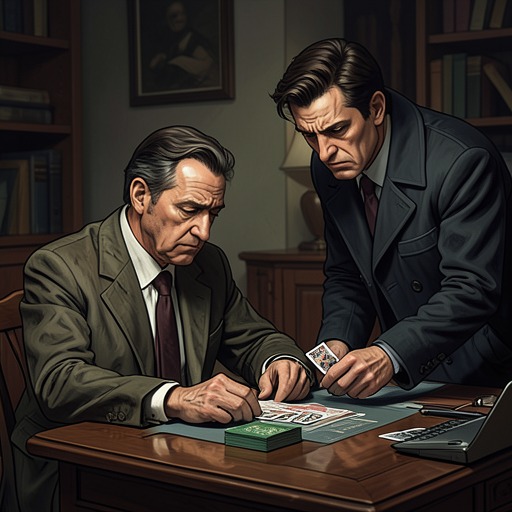
The apartment complicates the image of a deliberate, neatly arranged farewell. It is described as disorderly, with overflowing ashtrays, empty whiskey bottles, and damaged furniture. Against that background, the coffee table stands out as the only clean surface. The papers on it are organized. Their careful placement is a visible contrast with the rest of the room, and it makes the evidence look prepared for discovery rather than incidental to Roger’s life.
The papers seem to offer a tidy route to Jackman, who has been taken into custody in Las Vegas. Yet Kline acknowledges that Roger’s notes may not be enough to keep him there. Investigators are also trying to identify who filmed Compton Thomas MacKenna’s farewell address. They rule out Compton’s nephews as the person behind the camera because he did not trust them or want them to know what he was doing. The housekeeper, after making a substantial bank deposit, and Compton’s attorney become people of interest. These unanswered questions widen the investigation beyond the documents in Roger’s apartment.
Dylan’s examination of those documents produces more questions rather than a settled account. He notices Reece Crowell’s name among Roger’s notes and wonders why it was included. He also questions the absence of a suicide note, the availability of another gun, and the apparent orderliness of evidence left by someone whose life was anything but orderly. The scene’s neatness becomes a clue in itself: each item may be meaningful, but the arrangement may also be directing investigators toward a conclusion.
Doubt and the Changing Theory
Dylan tells Kline that the scene does not feel right. He objects to how conveniently the information has been laid out, as if the papers themselves were pointing investigators toward their interpretation. Kline initially allows that circumstances can converge neatly, but Dylan’s skepticism changes the question from what the papers say to why they have been presented this way. He suspects the scene may have been staged, without yet knowing who staged it or what the intended misdirection is.
A later laboratory result sharpens that suspicion: fingerprints on a calendar belong to Ewan, who is now missing. Kline revisits the possible routes by which the plot could have unfolded. In one theory, someone trusted by Compton filmed the address, made an extra copy, and sold it to Roger. Roger then involved Jackman because he needed Jackman’s connections. In another, Ewan obtained the video and brought Jackman in, while Roger knew nothing and was set up to take the blame. Kline does not resolve these alternatives; their existence shows how far the investigation has moved from the initial assumption of suicide.
The calendar result does not settle the case, and Dylan continues to question the timing of Roger’s death. His conclusion is direct: he does not believe Roger killed himself. That judgment remains a suspicion at this stage, pending evidence, but it gives the earlier irregularities a new shape. The missing note, the conspicuously arranged documents, and the unexplained questions about the gun now suggest not simply an untidy investigation, but a possible attempt to manufacture one account of Roger’s death.
The Framing Plot
At the later confrontation with Nate, Dylan points to Roger’s notes as an example of deliberate over-signaling. He argues that putting Reece’s name on the paper was unnecessary unless it was meant to distract investigators or serve as a clue. He accuses Nate of killing Roger and planting evidence to frame Ewan. The accusation connects the staged appearance of Roger’s death to the wider plot against Kate and Ewan: Dylan says the final bomb was intended to kill them, failed to go off, and forced Nate to intervene personally. Kline adds that Ewan’s gun and phone were found in Nate’s pocket. Nate does not immediately accept the charge; he says he can explain.
The scene’s meaning therefore changes in stages. Roger is first reported as having taken his own life; his carefully arranged papers then seem to implicate Jackman; the fingerprint evidence puts Ewan into the investigation; and Dylan’s later accusation identifies Nate as the person who killed Roger and used the crime scene to redirect suspicion. The apparent clarity of the papers proves misleading. Their order is not proof of a simple solution but part of the reason Dylan recognizes that the scene may have been constructed.