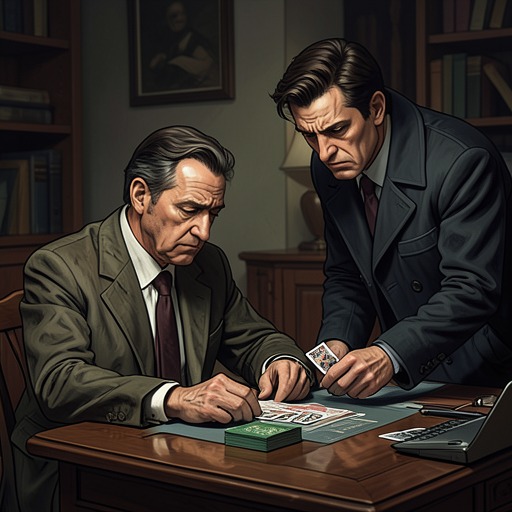
Roger Threatened by Johnny Jackman over His Gambling Debt
Slow BurnRoger Threatened by Johnny Jackman over His Gambling Debt transforms Roger MacKenna’s expected inheritance from a distant promise into an urgent wager on time. Johnny Jackman has enabled Roger’s gambling and profited from it; when the debt reaches $700,000, he demands payment within thirty-one days and threatens to mutilate Roger if the money does not arrive. Roger’s panic sends him home to Savannah, not to reform his life but to find out how soon his uncle Compton Thomas MacKenna may die.
The Debt and Its Machinery
Roger’s crisis has been built through a cycle of easy companionship and calculated exploitation. His so-called casino friends befriended him at the gaming table, helped him spend his winnings, and, once his luck turned, introduced him to Johnny Jackman. Roger was already more than $200,000 in debt at fifty percent interest when those same companions coaxed him back to gamble and lose more. Their friendship operates as part of the trap: they draw him toward the tables while Jackman’s loan turns each loss into a larger obligation.
Other sharks in town leave Roger alone because they expect him to inherit millions when his uncle dies. Jackman, however, has made Roger an investment of his own and keeps a crew following him. He does not want Roger to recover from his addiction: when Roger becomes infatuated with Emma, who persuades him to attend a Gamblers Anonymous meeting, Jackman intervenes. Emma is taken out of town the next evening and later leaves after Roger visits her in hospital. Told she had been in an automobile accident, Roger sees her bruised and swollen face, then returns to the casino; his guilt and relief at her departure help him abandon the prospect of meetings. The episode shows how Jackman’s control extends beyond the loan itself, undermining a possible interruption to Roger’s gambling.
By July, Roger owes an even $700,000. The debt has to be paid to the casino by September 1, or Jackman will be responsible for it. That deadline makes the expected inheritance essential to Jackman’s calculation as well as Roger’s: Jackman needs the money, but Roger’s uncle may not die on a schedule that fits the debt.
Jackman’s Ultimatum
Jackman takes Roger to dinner at Emerald’s, lets him drink a bottle of expensive wine, and tells him to find a way to repay every dollar, with interest, within thirty days. The dinner’s indulgence gives way to a threat: Jackman says he will take body parts as collateral, beginning between Roger’s legs. The deadline is not a request for a payment plan. It is a declaration that Roger’s body will become the security for a debt he cannot discharge through further play.
Roger tries to bargain for time and offers the possibility of a bonus, while still imagining that he might win big at the tables. Jackman refuses both the plea and the premise. Roger’s credit is exhausted, and he is no longer welcome at any table until the debt is paid in full. Jackman restates the thirty-one-day limit and describes what his associates will do if Roger fails: take him into the desert, hold him down, and mutilate him without allowing him alcohol to dull the pain. His finger-scissors gesture makes the threat physical even as he speaks.
Jackman’s authority rests on a reputation Roger believes. Staring into his cold, flat eyes, Roger suspects that an actual shark has more feeling and has no doubt that Jackman is not bluffing. The scene closes off the distinction between intimidation and likely action: Roger hears not an empty performance but a credible threat from a man with the power and associates to carry it out.
Roger’s Panic and Return to Savannah
The threat produces an immediate bodily response. Roger hyperventilates, overturns his chair as he bolts from the table, and reaches the corridor before vomiting. Jackman follows, laughing, and demands to know whether Roger will get him the money. Roger says that he will. The answer is less a plan than submission under pressure; Jackman then grabs his arm, pulls him back, and asks whether Roger’s uncle is going to die very soon.
Roger begins to cry and confirms that he is. His answer exposes the dependency beneath his promise: he has no stated means of raising the money, and his hope rests on the timing of Compton Thomas MacKenna’s death. Two hours later he takes a cab to the airport and flies home on a red-eye. He is too frightened and sick to drink, and knows he must be clear-headed. In Savannah, he intends to visit his uncle, assess how far gone the old man is, and reassure himself that the inheritance will arrive soon.
Stakes and Narrative Function
The confrontation binds Roger’s gambling debt to the family inheritance without making the inheritance a certainty. It is money Roger expects eventually, not money he can use to satisfy Jackman’s immediate demand. The gap between those two time scales—thirty-one days on one side, an uncle’s uncertain remaining life on the other—drives Roger out of the casino and back toward his family.
The scene also reverses the apparent protection offered by Roger’s anticipated fortune. His expected millions have kept other lenders from acting against him, but they do not free him from Jackman; instead, they make Roger valuable enough to watch and keep gambling. By the end, the inheritance is no longer merely a future windfall. Under Jackman’s threat, it becomes the only hope Roger can see, while his return to Savannah puts that hope under a brutal deadline.