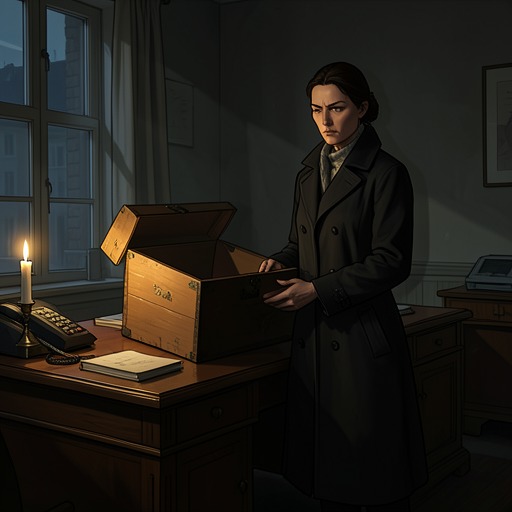
The fraudulent loan papers
Slow BurnThe fraudulent loan papers are both a record of Leah MacKenna’s financial desperation and the key evidence that her daughter’s company was improperly added to the collateral. Their importance rests on a decisive distinction: Leah did sign a loan pledging her assets, but the bank’s original file shows that the provision naming the Kate MacKenna Company was added afterward. When Kate exposes the alteration, paperwork that once seemed to condemn her mother instead helps reveal a scheme against the family.
The Loan and Its Stakes
The documents emerge after Kate discovers that her mother left no pension, trust, insurance money, or savings. Leah had taken out a three-year loan with a balloon payment of almost three hundred thousand dollars, due in four weeks. She had put everything she owned up as collateral, leaving each asset vulnerable to seizure if the debt went unpaid. The papers therefore make the threat immediate and concrete: among the assets at risk are Kate’s company and her name.
At first, the papers seem to show the scope of Leah’s obligation rather than a crime. They bear her distinctive signature, and Kate rereads them alongside a banker’s letter, struggling to accept what she believes her mother did. That signature matters because the later discovery does not erase Leah’s real loan or the collateral she genuinely pledged. Instead, it makes the boundary between her act and another person’s addition central to understanding the documents.
A Change in What the Papers Mean
Kate’s understanding shifts when she examines the loan papers with hospital bills and receipts. Leah’s limited insurance had run out, and her medical expenses were enormous. In desperation, she signed away her assets so that her daughters would not be saddled with her debt. The papers thus acquire a painful double meaning: they record the severe financial risk Leah accepted, but they also sit beside evidence of the illness and bills that drove her to borrow.
That context changes how Kate reads her mother’s decision. The papers initially make Leah’s signature look like an act that endangered Kate’s business; the hospital records help Kate see that Leah was trying to protect her daughters from the debt. This does not make the loan harmless. It clarifies the circumstances behind it, while leaving the separate question of who added the company to the collateral list to be answered through comparison with the bank’s records.
The Bank-File Comparison
Kate brings the file to a meeting arranged with the new bank president, Andy Radcliffe. Present are Edward Wallace, the loan officer; Tucker Simmons, Leah’s former accountant; Tucker’s wife, Randy Simmons; and Chief Drummond. Kate gives Radcliffe the papers Leah signed and asks him to compare them with the original kept at the bank. Her method turns the meeting away from claims and toward the two versions of the document.
The difference is specific: the bank copy includes the Kate MacKenna Company among Leah’s assets, but Kate points out that the addition is not in her mother’s handwriting. Radcliffe reads the inserted wording aloud, confirming that there is no question it was added. Wallace admits that he added the company, claiming he had discovered Leah was a partner and had advised her of the change. The papers make the disputed action visible rather than leaving it as a general accusation.
Wallace’s explanation fails under the date he wrote on the document. He says Leah was told by phone and stopped by to initial the change. Kate observes that the recorded conversation took place three weeks after her mother died. That contradiction turns the notation into evidence against Wallace’s account: the date offered to support his claim instead makes the claimed conversation impossible. Kate accuses him of exploiting Leah when she came to the bank for help with medical bills, and says he brought her together with Tucker and Randy as part of a planned effort.
Tucker’s response further sharpens the scene. He asks to inspect the papers, reads the fine print and Wallace’s notations, then tries to signal Wallace to stop speaking. Wallace does not heed him. He insists that he advised Leah and that she initialed the addition, elaborating on a story the document’s date contradicts. The papers are therefore not merely displayed as proof; the characters’ different reactions to them expose the pressure of what the record shows.
Documentary Proof and the Larger Plot
The loan papers belong to a wider pattern in which the investigation depends on testing documents and timelines instead of trusting a tidy account. In a separate inquiry into Roger MacKenna’s death, Dylan Buchanan doubts the apparent order of the papers and clues left at the scene, suspecting that the arrangement may have been staged. Fingerprints on Roger’s calendar point to Ewan MacKenna, forcing investigators to consider competing explanations for the plot involving Roger, Jackman, and the video. Those materials are distinct from Leah’s loan file, but the contrast underscores the need to ask who created each record and whether its apparent coherence can be trusted.
Timing also exposes Nate Hallinger in a separate confrontation. Dylan recalls Nate saying that he had heard Kate turned down the inheritance, then checks that knowledge against Vanessa’s departure and the time of a call to Anderson. Anderson’s memory and the phone logs contradict Nate’s explanation, strengthening Dylan’s suspicion that he learned the information from Vanessa. As with Wallace’s date on the loan papers, a small chronological detail changes the meaning of a confident account.
Significance
The fraudulent loan papers connect private loss to public evidence. Leah’s signature records a real loan taken under the pressure of medical costs; the altered bank copy reveals that her signature was made to support a further claim she could not have approved. Kate’s comparison of the documents challenges the apparent authority of the bank’s file without denying the debt or her mother’s circumstances.
The papers also give Kate a way to act on what she has learned. In Radcliffe’s office, she does not begin with a greeting or an introduction; she hands over the file and asks for the original. The decisive force lies in that comparison: the added company, the mismatched handwriting, and the impossible date. What began as a frightening account of what Leah had signed becomes evidence that the record itself was manipulated, and a means for Kate and her sisters to confront those who sought to benefit from it.