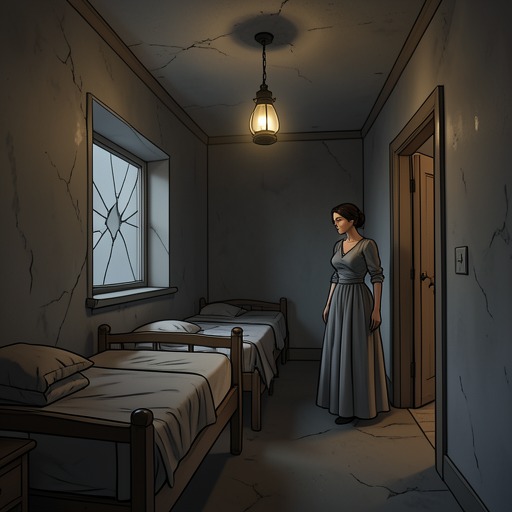
1925–1961
Small Things Like TheseThe period 1925–1961 is given as the span during which 796 babies died at the Tuam home in County Galway, a discovery historian Catherine Corless made public in 2014. The dates turn the book’s account of a fictional convent girl into a point of contact with documented institutional history: the story is not based on any particular individual, but its questions about confinement, infant separation, and social silence belong to a much wider record of harm.
Historical Referent
The dates belong specifically to the finding about Tuam, not to a stated chronology for every institution discussed in the book. The closing note reports that 796 babies died there between 1925 and 1961. It also describes a broader history of Irish mother-and-baby homes, where thousands of infants died or were adopted out, and of Ireland’s Magdalene Laundries, where girls and women were concealed, incarcerated, and made to labour.
The note distinguishes the scale of what is known from what remains uncertain. Ten thousand is described as a modest estimate of the number of girls and women confined in Magdalene laundries; thirty thousand is said to be probably more accurate. The exact number is unknown, as is the number of infants who died in the institutions or were adopted from mother-and-baby homes. A report by the Mother and Baby Home Commission found that nine thousand children died in eighteen of the institutions it investigated.
Records and Delayed Acknowledgment
The account makes the condition of the historical record part of the history itself. Most records from the Magdalene laundries were destroyed, lost, or made inaccessible, while the work of the women confined there was rarely recognized. Missing documentation limits what can be established about individual lives and institutional practices; it also helps explain why public knowledge and acknowledgment came late.
The note supplies two markers of that delay. Ireland’s last Magdalene laundry did not close until 1996, and the Irish government did not issue an apology for the Magdalene laundries until 2013, when Taoiseach Enda Kenny did so. Corless’s public disclosure in 2014 brought a specific number and date range into view, but the wider account continues to emphasize how much remains uncounted or unrecoverable.
Relation to the Fiction
The novel’s local talk about the convent moves between competing explanations: its training-school girls are said to be students, girls being reformed through laundry work, or unmarried mothers hidden away after giving birth. Rumour alone does not settle what occurs there. The closing note gives readers a separate historical frame in which the fiction’s concerns can be understood, while explicitly stating that the story is based on no individual or individuals. The distinction matters: the fictional events do not constitute testimony about a named survivor, but the note refuses to let uncertainty about the invented characters erase the documented history of the institutions.
The narrative’s moral conflict is also sharpened by the contrast between public religious ideals and the treatment of vulnerable people. Its epigraph invokes the 1916 Proclamation’s promise of equal rights and of cherishing all the nation’s children. Against that promise, the historical note records confinement, forced labour, infant deaths, and separation. In the story, Bill Furlong’s belated remorse turns on his failure to ask the convent girl about her baby and his decision to leave her there; the endnote makes clear that such a private moment sits within a broader history, not outside it.
Significance of the Date Range
1925–1961 gives the account a bounded, verifiable interval while pointing toward consequences that extend beyond those dates. It identifies a particular finding at Tuam, but the note’s other figures, missing records, and chronology of institutional closure and apology show why that finding cannot stand in for a complete history. The range therefore functions both as evidence and as a measure of what evidence can establish: a precise count for one home, alongside a much larger history whose full scale is still unknown.