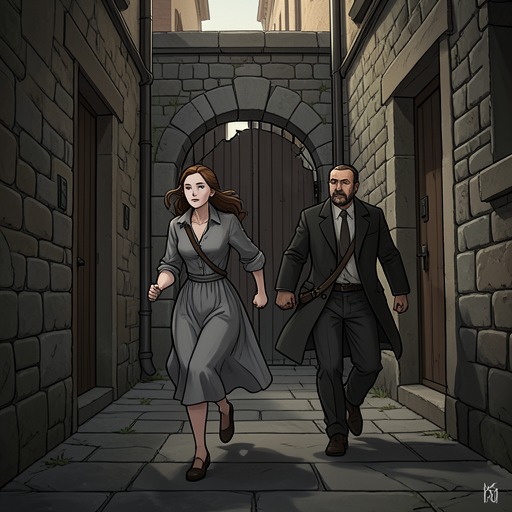
Bill Furlong
Small Things Like TheseBill Furlong’s life is shaped by two acts of care: the shelter Mrs Wilson gave his mother when she was pregnant and the help he later offers Sarah Redmond. A reliable coal merchant, husband, and father in New Ross, he has built a secure life from a precarious beginning. When he finds a girl suffering in a coal house at the Good Shepherd Convent, he must decide whether the security he has made will keep him silent. His choice turns a private memory of kindness into a public moral act.
Identity and Background
Furlong was born on 1 April 1946, after his sixteen-year-old mother became pregnant while working as a domestic for Mrs Wilson, a Protestant widow who lived at The Wilsons’ Mansion outside town. When his mother’s family disowned her, Mrs Wilson did not dismiss her. She let her remain in work, arranged for her to go to hospital when Furlong was born, and brought mother and child home. The circumstances of his birth therefore include both stigma and protection: his mother was rejected by her own people, while an employer chose to keep her close.
Furlong’s earliest surroundings were the kitchen and household of The Wilsons’ Mansion. He spent infancy in a Moses basket, then in a large pram beside a dresser, and grew familiar with serving plates, a hot black range, and a two-coloured tiled floor. That floor first belonged to crawling and walking; later he saw its pattern as a draught board, where pieces jumped over one another or were taken. The image gives his childhood landscape an austere order, but his life there was also made possible by a series of deliberate, practical accommodations.
Mrs Wilson, who had no children, took him under her wing, gave him small jobs, and helped him learn to read from her library. Her household was financially steady, supported by her pension and livestock, and relatively free of religious friction. On Sundays, she went to church while his mother and the child went on to the chapel; the household’s prayer books and Bible then rested together on the hallstand through the week. This ordinary coexistence offers a contrast to the hostility Furlong encountered elsewhere.
At school, other children jeered at him and once covered the back of his coat with spit. His connection to Mrs Wilson’s household gave him some protection, though it did not erase the humiliation. He attended technical school for a couple of years before starting work at the coal yard. His father’s name remained unknown: when he later obtained his birth certificate, the space for it contained only the word Unknown. The clerk handed it over with an ugly smile, making the blank record another occasion on which Furlong was made to feel the social judgment attached to his origins. Rumours that Mrs Wilson had helped him because one of her own relations was his father never resolved the question; Furlong never discovered who his father was.
Work and Family Life
Furlong worked his way up at the coal yard until he was running a business and employing men who did much the same work he once had. He had a head for business, was considered dependable, rose early, and had little taste for drink. The habits that made him a steady provider also helped him establish a life distinct from the uncertainty of his childhood. He lived in New Ross with his wife, Eileen Furlong, and their five daughters, concentrating on providing for them rather than dwelling on the past.
He met Eileen Furlong while she worked in the office of Graves & Co. He courted her by taking her to the cinema and walking with her along the towpath in the evenings. He was drawn to her black hair and slate-coloured eyes, as well as to her practical, agile mind. When they became engaged, Mrs Wilson gave him several thousand pounds to help him start up. Her support thus continued beyond his childhood, helping him establish the household and livelihood on which his own family would depend.
His attention to his daughters is practical as well as affectionate. They resemble their mother and are doing well at school. Kathleen, the eldest, helps with the books in the small prefabricated office on Saturdays, filing the week’s incoming records and keeping accounts; Joan has joined the choir. Both attend St Margaret’s School. These details show a father who takes pride in his daughters’ abilities and makes room for them within his working life, while also establishing what is at stake when he risks the security he has built.
Finding Sarah Redmond
Before dawn, Furlong looks down at the town and its reflection on the River Barrow. The quiet does not bring him peace. Soon he is at the convent’s coal house, where frost has stiffened the bolt. Opening the door, he first assumes there may be a dog inside; with a torch, he sees that a girl is there and judges from the floor that she has been kept there longer than a single night. His first response is not a plan or an argument but to take off his coat and try to put it around her. She cowers from him.
The scene concentrates the conflict between everyday duty and what he is beginning to understand. Furlong has spent much of his life outside doorways, waiting for them to open; now he stands at one that exposes another person’s confinement. The frozen bolt makes entry difficult, and the girl’s fear prevents his first gesture from being received as comfort. The coat cannot undo what has happened to her, but taking it off is an immediate, material response to the cold and vulnerability he finds. His instinct to help has to persist beyond the moment in which it is easy to act.
Decision and Relationships
Furlong returns to the coal house after imagining that it might be locked, that Sarah Redmond might no longer be there, or that he might have to carry her. He calls her by name and gives his own. This time she takes his coat and leans on him as he leads her out. He tells her she will come home with him. The change between the two encounters is small but decisive: the girl who cowered at his first approach now accepts his help, and Furlong moves from an impulse to protect her to taking responsibility for what follows.
On the way, he considers taking her to a priest’s house, but doubts that the priests are ignorant of what is happening; Mrs Kehoe has already given him reason to suspect they know. He continues with Sarah Redmond across the River Barrow and toward his own home. The river’s course toward the open sea becomes a contrast to the girl’s confinement and the constrained choices around her. Furlong, unlike the water, cannot proceed without confronting the consequences of his direction. He crosses with her anyway, carrying no certainty that his decision will be safe or welcomed.
Change and Narrative Significance
As they walk through town, Furlong asks himself whether life has any point without people helping one another, and whether someone can call himself a Christian while never finding the courage to oppose what is wrong. The questions mark a change in how he understands responsibility: Christian identity is no longer a matter of habit or respectable appearance, but of what a person does when helping carries a cost. His action places the religious authority and social quiet surrounding the convent in direct tension with the ethical demand he recognizes.
Mrs Wilson’s example returns to him as he walks. Her decision to keep his mother in work had altered the course of his own childhood; without it, his mother might have ended up in the same place from which he is now helping Sarah Redmond. The parallel does not make their circumstances identical, nor does it let Furlong know what will happen next. It gives his choice a personal history: he has received an unpublicized kindness whose consequences reached into his whole life, and now he acts for someone who has been denied comparable protection.
Furlong knows trouble is waiting behind his own front door, and fear outweighs his other feelings as he approaches it with Sarah Redmond and a box of shoes. Yet he also understands that the worst alternative—the help he might have withheld—would have remained with him. His happiness is unlike anything he has known, even the joy of holding his newborn daughters, because it comes with the knowledge that he has chosen courage rather than mere safety. The ending does not promise an easy outcome: it holds fear and hope together, with Furlong believing that he and Sarah Redmond may manage. His defining change is not that uncertainty disappears, but that he accepts its cost instead of allowing it to decide for him.