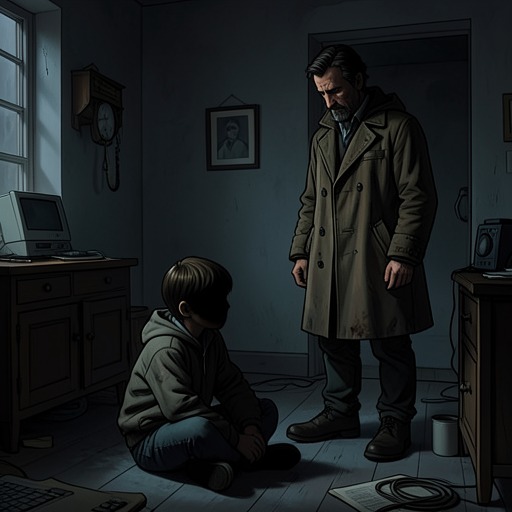
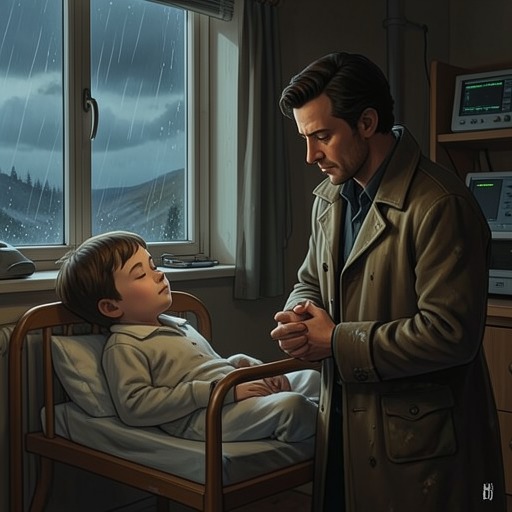
Bill Furlong and Sarah’s Mother-Son Relationship
Small Things Like TheseBill Furlong’s relationship with his mother joins the facts of his precarious beginnings to the tenderness of daily family life. She was sixteen, pregnant, and rejected by her own family when Mrs Wilson allowed her to remain in domestic service; she cared for Furlong until her sudden death when he was twelve. The memories he carries forward—of her practical affection, her small corrections, and the protection that made his childhood possible—later sharpen his recognition of what can happen to unmarried mothers and their children when help is withheld.
Beginnings and Protection
Furlong was born on April 1, 1946, after his mother became pregnant while working for Mrs Wilson, a Protestant widow who lived outside town. Once the pregnancy became known, her family made clear that they wanted no further connection with her. Mrs Wilson did not dismiss her: she let her keep her work and arranged for her to go to hospital when Furlong was born, then brought mother and child home. His earliest life therefore depended on a consequential act of practical protection at a moment when his mother had been refused support by her own people.
The household became the setting of their early life together. Furlong spent much of infancy in a Moses basket in Mrs Wilson’s kitchen, then in a large pram beside the dresser. He grew among serving plates, the black range, and the kitchen’s two-coloured tiled floor. His childhood was not lived in a separate household with his mother alone: Mrs Wilson took both of them into her home, and the resources and security there gave Furlong a degree of protection that his mother, as a young unmarried woman, could not easily have provided by herself.
Her Death and the Unknown Father
Furlong never discovered who his father was. Years after his mother’s death, he obtained a copy of his birth certificate at the registry office; the space for his father’s name contained only the word “Unknown.” The clerk handed it over with an ugly smile, turning the missing name into a fresh humiliation. The document could not resolve the question of his parentage, and his mother was no longer alive to answer it.
She died suddenly when Furlong was twelve, collapsing on the cobblestones while wheeling a barrow of crab-apples up to the house to make jelly. The doctors called it a brain haemorrhage. Her death cut short the relationship while he was still a child, leaving no later conversation to fill in the blank on the certificate. What remains in his recollection is not a complete account of her life but intimate, repeated scenes of her care and presence.
Daily Care and Remembered Intimacy
At Christmas, the scent of lemon could take Furlong back to his mother in Mrs Wilson’s old kitchen. She put the leftover lemon into one of the blue jugs with sugar, leaving it to steep overnight to make cloudy lemonade. The memory is bound to a familiar domestic routine: an ingredient saved, a jug set aside, and a drink prepared for later. Years on, the small sensory reminder brings the lost kitchen and his mother’s presence briefly close again.
He also remembers her holding him with a strong, freckled arm while turning the churn, and singing as she milked beside Ned in the evenings to help the milk come down. Her affection did not exclude correction. She sometimes slapped him for being bold, speaking out of turn, or leaving the butter-dish lid off; in retrospect, he regards those incidents as small beside the larger fact of being held and cared for. The relationship is recalled through this combination of bodily closeness, work, song, and ordinary discipline rather than through idealized perfection.
Inheritance and Moral Recognition
Furlong’s memory of his upbringing is complicated by the contrast between his mother’s vulnerability and the relative security Mrs Wilson’s support afforded them. When Eileen suggests that he had been raised far from hardship, the remark points to a protection he had received without necessarily understanding its full significance. The town’s talk about the girls at the New Ross Good Shepherd Convent includes claims that unmarried mothers were sent away after giving birth and that their infants were adopted out, sometimes overseas. Against that background, his own mother’s history makes the possibility of a young woman being hidden away more than distant gossip, even though he initially resists involving himself.
When a girl asks him to help her leave the convent, Furlong first steps back and says he cannot take her anywhere. Later, as he is about to return her to the institution, she asks him to ask about her baby, saying that the fourteen-week-old child may be hungry and that she does not know where he is. Furlong pauses beside her rather than simply going on. His response connects present care to remembered dependence: he had been a vulnerable infant, and his mother had been able to raise him because someone chose to help her. As he walks away with the girl, he thinks that, in an earlier time, it could have been his own mother he was saving. Her life does not give him a ready answer to every risk, but its remembered kindness helps him recognize that refusing to act is also a choice.