Chance, fate, and personal choice
Small Things Like TheseChance, fate, and personal choice shapes Bill Furlong’s movement from weary speculation toward a consequential act. His days seem governed by repetition and events he cannot control, while memories and inherited stories make life appear subject to accident or curse. But the novel’s closing questions turn that uncertainty into a test of responsibility: whatever has been left to chance, Furlong must still decide whether to act.
Repetition and the Sense of a Predestined Life
Furlong’s doubts begin in ordinary exhaustion. He rises in darkness, goes to the yard, makes deliveries through the day, comes home in darkness, tries to wash the black from himself, eats, and falls asleep before beginning the same routine again. The sequence feels less like progress than a circuit. He wonders what the work and worry are for, and whether the days will ever change into something new. Approaching forty, he measures his life against the possibility of making headway and finds himself uncertain that he is getting anywhere. His concern is not simply that he is tired: it is that a life can be filled with effort and still seem to lead back to its starting point.
A memory from a summer job at a mushroom factory gives that fear a precise image. At the end of the cutting line, after struggling to keep pace, the young Furlong looks back and sees new mushrooms already pushing through the compost where he has worked. The task renews itself as soon as it is done. His heart sinks at the thought of repeating it every day for the whole summer. The scene anticipates his adult sense of routine: labor does not necessarily make a person freer or bring him closer to a different life. Yet the memory is also a contrast between his younger helplessness and the decision he will later face. The mushrooms grow back without regard to his effort; the moral choice before him cannot be answered by simply repeating the usual pattern.
Contingency, Inheritance, and Imagined Alternatives
Furlong’s sense of contingency surfaces in a quiet domestic scene. After returning to a house where a woman pours hot milk over bowls of Weetabix for the children, he pauses over the peace of the plain room and imagines living there with her as his wife. The thought opens onto another life, elsewhere, and then onto a question about his own origins: perhaps his father had been one of those who suddenly took a boat to England. Furlong cannot settle what in a life is chosen and what is inherited. It seems both proper and deeply unfair that so much should be left to chance.
The imagined escape is not a firm plan, and the scene does not resolve the counterfactual. Instead, it reveals how readily Furlong can picture a life other than the one he has. The possibility of departure has a family dimension: his father might have left, and Furlong wonders whether that impulse is somehow in his blood. But inheritance does not settle his future. The thought of another life remains an opening rather than an explanation, leaving him between the life he has built and alternatives that cannot be known in advance.
The River’s Curse and the Weight of Memory
On the bridge over the River Barrow, Furlong recalls a local curse associated with monks who once built an abbey there and levied tolls on the river. According to the story, the monks grew covetous; the people drove them from town, and the departing abbot cursed the place to lose three lives each year, neither more nor fewer. The tale gives misfortune the shape of a rule, as if deaths could be counted and fate could be made predictable. Furlong’s mother believed there might be truth in it. She had told him of a cattle-dealer whose lorry went off the road on New Year’s Eve, making him the third person to drown that year.
The story is bound to the memory of his mother, not just to local folklore. He remembers her strong, freckled arm holding him while she turned the churn, and her singing as she milked with Ned in the evenings. He also remembers that she sometimes slapped him for misbehaving. Those acts of correction sit alongside ordinary tenderness; neither makes the other disappear. In recalling them, Furlong encounters a past made of small circumstances and choices, not only the force of a supposed curse. The river story may suggest that some outcomes are beyond human control, but his mother’s remembered care also belongs to the particular actions through which one life affects another.
Choice, Responsibility, and the Uncertain Future
Furlong’s walk also returns him to an earlier refusal. He thinks of Sarah Redmond, who had asked him to take her to the river so she could drown, and remembers that he would not do it. He recalls losing his way on the back roads afterwards and encountering an old man cutting thistles in the fog with a puckaun. The old man’s words about where the road might take him remain with Furlong as he approaches a new decision. In this sequence, chance is not erased: he has been lost, and the encounter was unexpected. But the story makes his response, rather than the accident of meeting, the crucial matter.
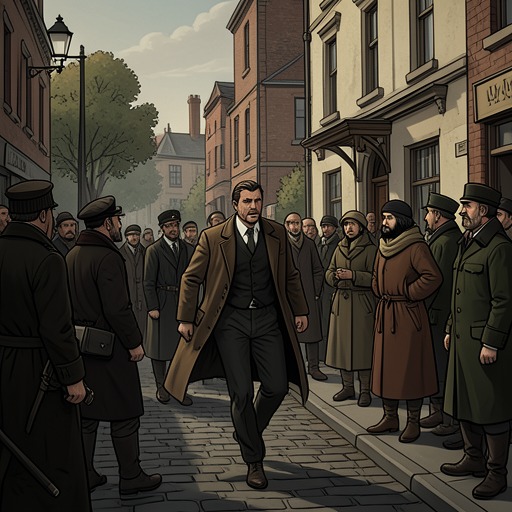
As Furlong walks with Sarah Redmond toward home, among people he knows and people he does not, his thoughts turn explicitly to mutual aid, courage, and Christian conduct. The question is whether a person can pass through an entire life without daring to go against what is established and still face himself as a Christian. The thought marks a change from his earlier wondering about whether life will develop into something else. He is no longer considering only what might happen to him; he is measuring the cost of refusing to act.
He expects trouble behind the next door, and his fear outweighs his other feelings. At the same time, he knows that the worst possibility has already been behind him: the thing he might have left undone, and then had to live with. The suffering awaiting him may be serious, but he recognizes that it is far from what Sarah Redmond has endured and might yet endure. Carrying her barefoot toward his own front door with the box of shoes, he hopes they will manage, though he cannot know what follows. The ending does not promise that courage controls events or cancels consequences. It locates freedom more narrowly, and more urgently, in the choice not to let uncertainty become an excuse for inaction.