Christmas
Small Things Like TheseChristmas is a recurring season in which public ceremony, household work, and Bill Furlong’s moral unease converge. Its familiar preparations offer warmth and order, but they also reveal unequal circumstances: the town’s festive abundance exists alongside hardship, and the pleasures of giving prompt Furlong to reconsider what he has kept for himself. The season’s significance lies in this unresolved contrast between communal goodwill and the choices that goodwill demands.
Public Ritual and the Town
As Christmas approaches, a Norway spruce is set in the Square beside a nativity scene whose figures have been freshly painted. Joseph’s bright red and purple robes draw complaints, while Mary, kneeling in blue and white, wins general approval. A brown donkey stands by two sleeping ewes and the empty crib, where the infant Jesus is to be placed on Christmas Eve. The details make the display both a religious image and a public object of discussion, watched and judged by the town.
The annual gathering takes place after dark on the first Sunday of December outside the Town Hall, when people come to see the lights switched on. Although the afternoon has been dry, the cold is bitter; Eileen makes the girls zip their anoraks and wear gloves. The pipe band and carol singers are already assembled, and Mrs Kehoe sells gingerbread and hot chocolate from a stall. Joan, who has gone ahead, distributes carol sheets with the choir, while nuns circulate among the families, supervising and speaking with some of the better-off parents. The gathering draws different parts of the community into one seasonal scene, though its distinctions of means and status remain visible within it.
When the cold drives the family away from the centre, they walk through side streets and shelter in Hanrahan’s recessed doorway. Eileen pauses over navy patent shoes and a matching handbag, then talks with neighbours and people from farther out who have come into town and brought news to share. Christmas here is not only a set of official customs: it creates occasions for encounters and exchanges among people who do not often see one another.
Household Preparation and Repeated Labor
At home, the season takes the form of coordinated work. Eileen brings out her Odlum’s recipe for the Christmas cake, and Bill creams a pound of butter and sugar in a brown delft bowl with a hand mixer. The girls grate lemon rind, weigh and chop candied peel and cherries, soak almonds in boiled water and slip them from their skins. They spend about an hour picking stalks from the sultanas, currants, and raisins. Meanwhile, Eileen sifts flour and spice, beats bantam eggs, and prepares the tin with grease, lining, brown paper, and twine.
Bill tends the Rayburn, feeding it small shovelfuls of anthracite and regulating the draught so the oven stays low and steady through the night. Eileen presses the mixture into a large square tin with a wooden spoon and bangs the base to settle it into the corners. The moment of shared amusement is brief: once the cake is in the oven, she takes stock of the room, tells the girls to clear down, and turns to the ironing. Christmas enlarges the household’s labor rather than suspending it; one preparation gives way at once to another.
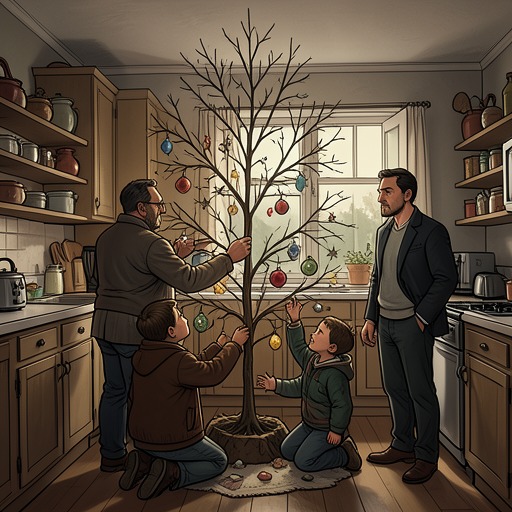
That pattern returns later in the month. After Mass, Bill puts up the tree while the girls string lights and hang decorations; he rethreads the small ornaments whose strings have broken. Grace tries to play “Jingle Bells” on the accordion, and Sheila watches an episode of All Creatures Great and Small. Bill wishes Eileen would sit down, but after washing up she begins the mince pies and icing for the cake. Kathleen makes and rolls the pastry; Loretta cuts rounds with an upturned tumbler, while Eileen and Joan separate eggs and beat the whites with sieved icing sugar. The cake, already covered in marzipan, is set on a silver board. Even the decorated tree and the family’s music do not bring the work to a close: Bill fetches anthracite and logs, then sweeps the floor.
Work, Gifts, and Unequal Comfort
Christmas week intensifies the demands on Bill’s yard. Snow is forecast, and the yard is expected to close for about ten days, prompting customers to make last-minute orders and complain that they cannot get through by telephone. The final shipment of the year is late and must be collected from the quay. With Kathleen, who is off school, minding the office, Bill makes out-of-town deliveries and collects what he can of the money owed. When he returns at lunchtime, she has organized the next loads and prepared the dockets so work can resume after he eats.
On Saturday, the last batch of orders is nearly complete when Kathleen hands him the dockets for a large order from the convent. Bill says he will go at once and tell them to prepare it before evening, then deliver it himself the next morning. The order makes the convent part of the season’s commercial rush, while the forecast closure and late shipment show how practical pressures continue beneath its rituals. Christmas brings the yard toward a pause, but first it demands that work be finished and accounts gathered in.
During the return drive from another delivery, a girl gives Bill a Christmas card and says her mother always called him a gentleman, adding that they knew he would come and save them the trouble of posting it. He reminds himself that people can be good, but the thought immediately unsettles him: the ease of balancing give-and-take, he recognizes, is itself a privilege. He wonders why he had not passed on sweets and other gifts received at some houses to people he had met elsewhere who were less well-off. His realization turns seasonal generosity into a question of distribution: receiving kindness is not the same as having shared it fairly.
The Season’s Moral Contradiction
The contrast persists when Bill returns to the yard. The Angelus bell has already rung, but the men are still in good spirits, sweeping and hosing the concrete and joking together. Bill records what remains, locks the prefab, covers the lorry’s bonnet with sacks against the expected weather, and padlocks the gates after the men wash at the tap and scrub the black from their boots. Their work ends in orderly tasks rather than a sudden festive transformation.
The yard pays for the men’s dinner at Kehoe’s. Mrs Kehoe, wearing a new festive apron, offers gravy, extra mash, sherry trifle, Christmas pudding, and cream. The men eat at leisure, linger over stout and ale, pass cigarettes, and use the little red paper napkins. Bill wants to go home, but stays because it feels proper to idle with them, thank them, and wish them well—making time for company he seldom makes time for. They have already received their Christmas bonuses, and before Bill settles the bill they shake hands. The meal gives the workers a share in the season’s plenty, but Bill’s earlier thought remains: Christmas can bring out both the best and the worst in people. Its rituals express generosity; its unequal circumstances and missed opportunities test whether generosity reaches beyond the people already close at hand.