Crows
Small Things Like TheseCrows are a recurring presence in the winter landscape of New Ross, where their movements connect the streets, the river, and the convent on the hill. They are not merely background decoration: their noisy scavenging and conspicuous gatherings make them part of the town’s ordinary life, while their appearances beside the convent’s immaculate grounds and enclosed spaces deepen the story’s atmosphere of unease. Their return in different scenes gives the birds a continuing place in Bill Furlong’s view of the world, without reducing them to a single fixed symbol.
A December invasion
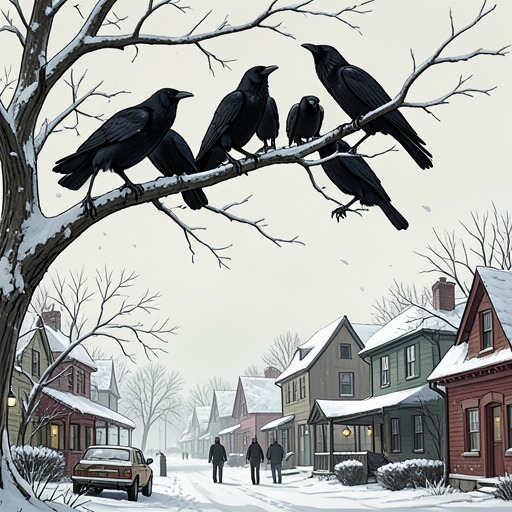
The birds arrive in unusual numbers in December. They gather in black batches on the outskirts of town, then come into the streets, walking among people and perching wherever they choose. Their behavior is both commonplace and brazen: they search for dead things and dive after anything along the roads that might be edible. At night they roost in the huge old trees around the convent. The description makes their presence difficult to overlook, and the townspeople’s remark that they had never seen so many establishes the gathering as an exceptional feature of that winter.
The birds’ daily pattern gives the setting a material, animal life independent of the human plot. They feed, move through the streets, and settle for the night; their activity follows its own practical rhythms. Yet their number and boldness also make them an apt presence in a town where much is visible in public and much else is only rumored. That resonance remains suggestive rather than explicit: the narrative shows the birds and the town’s talk side by side, but does not assign the Crows a single allegorical meaning.
The convent and its divided image
The Crows roost in the old trees around Good Shepherd Convent, a powerful-looking building on the hill across the river. The convent’s open black gates and shining windows face the town; its lawns, orderly shrubs, and square-cut hedges are maintained throughout the year. In the cold weather, frost dusts the yews and evergreens, and people compare the grounds to a Christmas card. Against this carefully composed scene, the birds are a conspicuous, less controlled presence, gathering in the trees beyond the formal order of the garden.
The contrast matters because the convent’s appearance stands beside sharply different accounts of its work. The Good Shepherd Sisters run a training school and a laundry whose reputation for returning clean linen draws business from restaurants, guesthouses, a nursing home, a hospital, priests, and wealthy households. But local reports describe the girls’ labor as exhausting and punitive; one account concerns a fifteen-year-old with varicose veins from standing at wash-tubs. Other rumors concern the nuns themselves, and accounts differ about what happens inside. The Crows do not reveal which stories are true. Their roosting in the trees around the convent instead places them at the edge of a setting whose neat public face and troubling rumors coexist.
The winter tableau is further unsettled by small details. People notice that the birds have not touched a single berry on the holly bushes, a fact also observed by the old gardener. Small fires sometimes send strange greenish smoke down over the river and across town, or toward Waterford, depending on the wind. Neither detail is explained through the Crows, but together they make the convent’s Christmas-card appearance feel less reassuring: the birds are present, yet the berries remain untouched, and the smoke carries the possibility of something hidden beyond the view from town.
Seen from the street
The next morning, Furlong sees the Crows again as he wakes and looks outside. The sky appears close and strange, with a few dim stars, and the pavement is frozen. A dog noisily pushes a tin can while licking at what is inside it; nearby, the Crows sidle along the street, giving short, hoarse caws and longer calls. One pins a pizza box down with its foot, pecks suspiciously at its contents, then flies away with a crust. These precise acts extend the earlier picture of scavenging: the birds are resourceful, wary, and at home among the scraps of human life.
Their walk also catches Furlong’s attention through its resemblance to a familiar human manner. With wings tucked in, some stride along and inspect the ground and their surroundings, bringing to mind a young curate who walks with his hands behind his back. The comparison turns casual observation into a moment of visual recognition, linking the birds’ movements to the measured habits of people without making them less animal. The Crows remain occupied with their own search through the town, while Furlong watches them from the threshold of his day.
Corvid imagery at the convent
Later, as Furlong drives up the avenue to visit Ned, headlights cross rooks and the nests they have built in the trees. Rooks are distinct from the Crows described elsewhere, but this neighboring image extends the book’s attention to corvids and nesting places. It accompanies Furlong’s sight of the freshly painted house, its front rooms lit, and a Christmas tree displayed in the drawing-room window. The scene joins birds and human dwellings in one sweep of light, bringing a familiar natural presence into a moment of changed domestic surroundings.
On a later nighttime walk around the convent, Furlong encounters a crow not in flight or among a flock but dead: a black cat is eating from its carcass, licking her lips. The cat freezes when she sees him, then flees through the hedge. The brief encounter reverses the earlier image of birds feeding on road scraps. Here a crow has become food for another scavenger, and the convent’s outer grounds hold a small, exposed instance of death and predation. Furlong continues around the walls, where broken glass tops the high boundary and the third-storey windows are blackened and fitted with metal grilles. The Crows’ presence across these scenes—from winter roosts to street scavenging to a carcass beside the convent—makes them part of the book’s unsentimental attention to what lives and dies at the margins of orderly human spaces.