Economic hardship and unemployment in New Ross
Small Things Like TheseEconomic hardship and unemployment in New Ross are presented not as a single crisis but as a spread of pressures visible in household bills, shuttered businesses, departing workers, and requests for credit. Against that worsening background, Bill Furlong tries to keep his family secure and his business going; the novel’s everyday exchanges reveal both the value and the limits of individual generosity.
Household precarity and visible need
Bill Furlong understands that a person could lose everything with startling ease. He encounters men unable to pay their electricity bills, living in houses as cold as bunkers and sleeping in their overcoats, while dole queues grow longer. On the first Friday of each month, women wait by the post office with shopping bags to collect their children’s allowances. These recurring scenes show hardship organized around the ordinary calendar: bills fall due, benefits are collected, and the struggle to keep a home warm continues.
In the countryside, deprivation takes other forms. A farmer leaves cows bawling because the man responsible for them has suddenly gone to England. A man from St Mullins tells Bill Furlong that his family sold their Jeep because they could not sleep knowing what they owed and that the bank was coming down on them. One morning, Bill Furlong sees a schoolboy drinking milk from the cat’s bowl behind the priest’s house. The details are sharply different in scale, but together they make poverty visible as debt, abandoned work, and hunger intruding into a child’s breakfast.
A town losing work and people
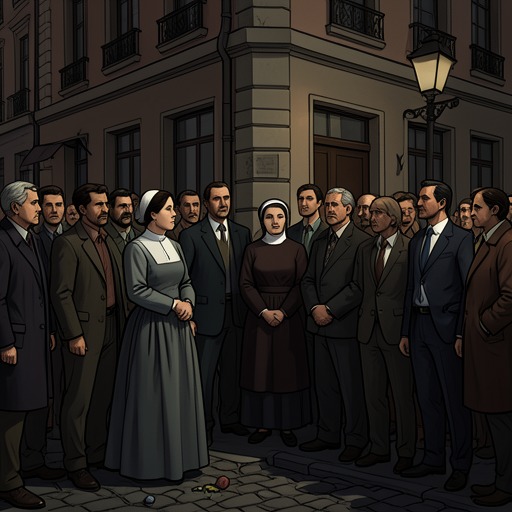
The economic strain extends beyond individual households. In New Ross, the shipyard company has closed, Albatros has made several redundancies, and Bennett’s has let eleven employees go. Graves & Co., where Eileen Furlong had worked, has also shut its doors after being part of the town for as long as anyone can remember. The auctioneer describes business as stone cold; Miss Kenny, the florist near the coal yard, boards up her shop window and asks one of Bill Furlong’s men to hold the plywood while she nails it in place. The closures are registered through familiar local places and people, making contraction a change in the town’s daily landscape, not merely a distant economic report.
The wider news supplies a parallel picture of departure and unease. In 1985, young people are emigrating to London, Boston, and New York. A new airport has opened in Knock, while the Taoiseach’s agreement with Thatcher over The North prompts Unionist marches in Belfast. Crowds at shrines in Cork and Kerry have thinned, though some still gather in hope of a moving statue. These events do not erase the town’s immediate job losses; they place them within a country marked by migration and political tension, where the future appears uncertain both at home and beyond it.
Bill Furlong’s security and responsibilities
Against this instability, Bill Furlong is determined to carry on, keep his head down, remain on the right side of people, and provide for his daughters. He wants them to complete their education at St Margaret’s School, which he regards as the only good school for girls in town. At home, Eileen Furlong recognizes that the family owes no money and credits that security to his work. Their position is therefore comparatively stable, but it is not detached from the town’s hardship: the security depends on continued labor and careful limits on what the family can afford.
The same limits appear in the household’s preparations for Christmas. Bill Furlong and Eileen Furlong go through their daughters’ requests and decide together what to buy, stretching their spending only as far as they can manage. The scene places family provision beside the larger recession without suggesting that their circumstances are identical to those of people seeking help. Their careful budgeting is one reason Bill Furlong can continue to provide; it also makes his relative stability visible against the needs he encounters on his rounds.
Credit, gifts, and the give-and-take of the town
On his Christmas Eve deliveries, Bill Furlong is asked quietly at six or seven houses whether what is owed can be put on the slate. Credit is not an abstraction: it is a request made at the door, dependent on the relationship between customer and coal seller. At other homes, the exchanges run in the other direction. People give him tins of Emerald sweets or Quality Street, parsnips, cooking apples, bottles of Bristol Cream or Black Tower, and a girl’s unworn corduroy jacket. A Protestant man presses a five-pound note into his hand and shares the news that his son’s wife has had another boy. Children run out as if Bill Furlong were Santa Claus bringing coal, and he sometimes leaves logs at the doors of customers who have supported his business when they could afford to.
These exchanges complicate any simple division between giver and recipient. The goods and money move through a community where some people are in arrears, some can offer a gift, and others have helped sustain Bill Furlong’s livelihood. A child who picks up a lump of coal is slapped by his older sister and told to put it down because it is dirty; she then hands Bill Furlong a Christmas card, saying her mother always called him a gentleman. The contrast makes the coal both a needed household fuel and something the child is taught to regard as unclean. Bill Furlong’s return journey brings another recognition: he has been given sweets and other gifts at some houses while meeting poorer people at others, and realizes he could have passed those presents on. His thought that people can be good is immediately checked by awareness that his own comfort shapes what seems like fair give-and-take.
Social obligation and the limits of security
The novel also shows how economic relations intersect with decisions about what can safely be ignored. After Bill Furlong witnesses what is happening at the convent, Eileen Furlong argues that the girls need a fire, that the nuns pay their bills on time, and that the matter has nothing to do with their family. Her response draws on the practical distinctions that govern local life: some customers pay promptly, while others leave debts on the slate until pressure has to be applied. The convent’s reliable payment is set against the hardship surrounding them, but financial reliability does not settle the moral question of what Bill Furlong has witnessed.
A later transaction at Mrs Kehoe’s shop carries that tension into ordinary conversation. As Bill Furlong hands over the notes, Mrs Kehoe draws him aside and asks whether she has heard that he had a run-in at the convent; his hand tightens around the change and his gaze drops. Money changes hands, but so does information, and the discreet question shows how quickly a private conflict can enter the town’s network of everyday relations. In this setting, economic security offers neither isolation nor a simple answer to responsibility. The pressure to provide, the habits of credit, and the circulation of gifts all bind people together, while Bill Furlong’s awareness of those worse off continually tests the comfort of calling that arrangement fair.