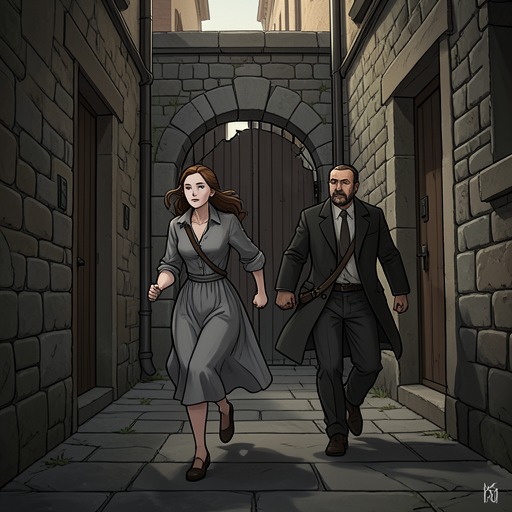
Furlong Refuses to Help the Laundry Girl Escape
Small Things Like TheseBill Furlong’s refusal to help a young woman leave Good Shepherd Convent is the first decisive test of whether he will act on what he has seen or shelter behind the limits of his role. The request is modest in its wording—help her reach the River Barrow or simply get through the gate—but its stakes are immense: the girl is confined, desperate, and separated from her infant son. Furlong initially declines, then carries the encounter with him; the action’s significance lies in the gap between that first retreat and his eventual choice to stand beside her.
The Convent and Its Public Reputation
The request comes against a background of sharply divided local talk. Good Shepherd Convent stands on a hill across the river, its orderly lawns, clipped hedges, tall windows, and polished appearance giving it the air of a respectable institution. The nuns run a training school and a laundry whose work is trusted by restaurants, guesthouses, the hospital, the nursing home, priests, and prosperous households. Washing sent there is said to come back immaculate. The laundry’s reputation is public and practical; what happens to the girls inside is much less certain to the town.
Rumours contradict one another. Some people say the girls are not students but young women being punished and reformed through work that lasts from dawn to night; a local nurse has reportedly treated a fifteen-year-old with varicose veins after prolonged standing at the wash-tubs. Other accounts claim that the nuns themselves perform exhausting work and live under severe restrictions. A further rumour describes the convent as a place where unmarried girls are hidden after giving birth, their babies adopted abroad for money. The narrator cautions that much of the town’s talk is unreliable. The uncertainty does not erase what Furlong witnesses directly, but it shows how gossip can circulate around an institution without becoming either proof or meaningful intervention.
The Plea and Furlong’s Refusal
Furlong encounters the girls after arriving at the convent with a load before it is due. Finding no one at the front, he goes around by the coal house, opens a heavy door, and enters an orchard heavy with red and yellow apples and pears. His attempt to take a pear is interrupted by geese that chase him back. He then reaches a small, lighted chapel, where more than a dozen girls and young women are on their hands and knees, polishing the floor with rags and tins of lavender polish. They wear black socks instead of shoes and grey shifts; one girl has a stye, and another’s hair has been roughly cut. Their appearance is not a rumour but a sight he cannot unsee.
One girl approaches and asks for help. She asks him to take her as far as the river, then offers the gate as an alternative. Furlong steps back. He says he cannot take her anywhere and gestures with open, empty hands, making his refusal seem like an absence of power rather than a choice. When she asks to be taken home instead, promising to work for him, he answers that he already has a wife and five daughters. The girl replies that she has nobody and says she wants to drown herself. Her plea turns a possible act of assistance into an encounter with immediate danger, but Furlong still does not take her away.
The girl drops to her knees and resumes polishing when a nun appears. Furlong turns toward the nun and explains that he has brought logs and coal. Once she recognizes him, her attention shifts to the delivery and to the geese he had disturbed. She checks the docket and the load, goes inside, and later comes out to pay him. Furlong considers raising the girl’s situation, but the impulse fades. He writes the requested receipt and leaves without mentioning her. The routine exchange—goods checked, payment counted, receipt handed over—offers an orderly exit from the morally unsettled scene.
Evidence That Follows Him
Outside, details of the convent’s security return to Furlong’s mind. He remembers a padlock on the inside of the door between the orchard and the front, broken glass along the wall separating the convent from St Margaret’s School, and the nun locking the front door after coming out to pay. These physical barriers sharpen the meaning of the girl’s request: leaving is not simply a matter of choosing a road. As he drives away, he realizes he has missed his turn and is heading in the wrong direction. He has to tell himself to settle down, while picturing the girls polishing the floor and recalling their condition.
That night, he considers not telling Eileen Furlong what he witnessed, but tells her. She responds rigidly that the matter has nothing to do with them and that they cannot act. She points to the convent’s need for firewood and to the nuns’ habit of paying their bills on time, unlike customers who leave debts on the slate. Her reasoning ties the household’s livelihood to the institution’s custom: concern for the girl threatens to become, in practical terms, a risk to the family business. Eileen also tells him that he was raised far from hardship and reminds him that he knows girls can get into trouble. The conversation brings the social distance between his own secure family life and the young women’s vulnerability into the open, without resolving it.
The girl’s circumstances become more concrete when Furlong later has an opportunity to leave her at the convent again. He waits with her in the cold on the front step and considers taking her to a priest’s house or bringing her home. Yet the ordinary impulse to be rid of the situation returns, and he presses the bell. Before they go in, she asks him to inquire about her baby. The child is fourteen weeks old, has been taken from her, and may be hungry; she does not know where he is. The revelation changes the meaning of her earlier desperation: she is not asking only for release from the convent but for a chance to reach the child from whom she has been separated.
Reversal and Significance
Furlong’s eventual response grows out of small decisions rather than a sudden erasure of his earlier fear. At a later encounter, the convent authority gives him an envelope for Christmas after discussing the number of girls who need places. He accepts the payment, but when he is escorted through the kitchen he sees the young woman sitting in a daze at the table, with nothing before her, while a younger nun prepares food. The convent representatives expect him to continue on. Instead, he pauses beside the girl and offers help. She looks toward the window, takes a breath, and begins to cry. Her reaction registers how unfamiliar kindness has become: the offer produces tears because she is unaccustomed to receiving it.
By the time Furlong walks beside her, he asks himself whether a life can be lived without helping others, and whether someone can call himself a Christian while never being brave enough to oppose what is happening around him. He feels a happiness he has never known, even when his infant daughters were first placed in his arms, and understands that this choice may cost him. The ending therefore does not make his first refusal disappear; it gives that refusal a consequence and a contrast. He had seen the girl, returned to the safety of business routine, and tried to leave the matter outside his home. In the end, he walks with her toward it. The episode makes the difference between public sympathy and practical help visible in a sequence of specific acts: a request, an evasion, a remembered locked door, a child’s absence, and finally a willingness to stand beside someone whom the institution has left without support.