Furlong Takes Sarah Back to the Convent
Small Things Like TheseFurlong Takes Sarah Back to the Convent is a return that looks at first like rescue but ends with Sarah Redmond once more inside the institution that has confined her. On a cold, dark Sunday morning, Bill Furlong finds her locked in a coal shed and gets her to the convent door. There, her account of a missing fourteen-week-old baby meets the Mother Superior’s minimizing explanation. Furlong does not take Sarah away, but he stays, listens, offers a way to contact him, and leaves only after hearing the door locked behind him. The episode makes the difference between removing someone from immediate danger and freeing her from the system that holds her unmistakable.
Discovery and Immediate Rescue
Before entering the shed, Furlong has been looking down at New Ross and its reflection in the river. The town appears different at a distance, and the quiet is interrupted by singing whose source he cannot identify. This suspended, uncertain pre-dawn scene gives way to a stark discovery: the bolt on the coal-house door is stiff with frost, and what he first takes for a possible dog proves to be a girl. From the state of the floor, he judges that she has been there longer than the night.
Furlong’s first response is physical and immediate. He takes off his overcoat and tries to put it around her, but she cowers; he explains that he means no harm. His flashlight, needed because he cannot see inside, also exposes the conditions she has endured, including the excrement on the floor. He puts the light away, calls her out, and helps her stand. Outside, he sees a girl barely able to remain upright, with roughly cut hair. When he shines the torch at her feet, he notices long toenails blackened with coal. The details make the shed not an accidental hiding place but a space in which she has been left without ordinary care.
He asks how she came to be there, but Sarah does not answer. Furlong searches for something comforting to say and finds none; instead, after a pause, he takes hold of himself and helps her across the gravel to the front door. His routine habit is to carry on even while wondering what he is doing. Yet pressing the bell makes him flinch, and the young nun who opens the door gives a small cry and quickly shuts it. The first response from inside is not an explanation or welcome but a refusal to receive them.
The Baby and the Convent’s Account
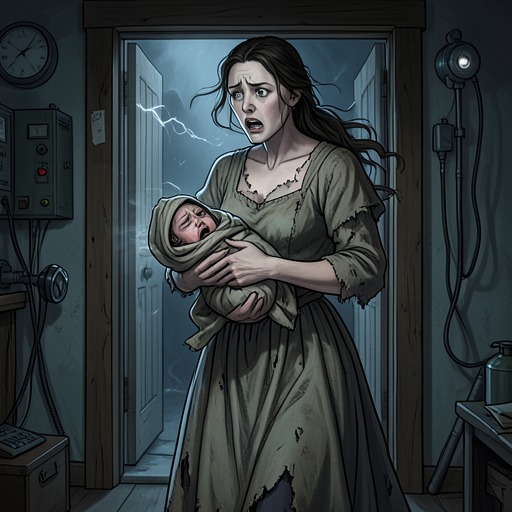
They wait on the front step in the cold. Furlong knows he could take Sarah elsewhere, perhaps to a priest’s house or to his own home, but her withdrawn state and his own wish to get home pull him toward leaving the matter behind. The turn comes when Sarah asks him to ask about her baby. She says the child must be hungry and asks who is feeding him. He learns that the baby is fourteen weeks old, has been taken from her, and may still be somewhere in the convent; she does not know where. The immediate problem is no longer only that Sarah was locked in the shed. She has also been separated from an infant whose whereabouts she cannot establish.
The Mother Superior opens the door wide and greets Furlong by name, presenting his early Sunday coal delivery as a kindness. She says she is sorry he encountered the situation, then turns to Sarah and says the convent had only just discovered she was not in bed and was about to call the Gardaí. Furlong states plainly that Sarah was locked in the shed all night and asks, in effect, how she came to be there. The Mother Superior responds by describing Sarah as a confused girl who cannot tell night from day, while also saying she does not know how they will care for her. Her words acknowledge that Sarah needs attention even as they displace responsibility for her confinement.
A Story Recast as Play
Inside, the Mother Superior offers Sarah tea and cake and makes a show of placing the jug and sugar within reach. Sarah picks fruit from the cake and drinks hot tea, struggling to put down the cup. After chatting about the news and other unimportant matters, the Mother Superior asks why Sarah was in the shed and who put her there, assuring her she is not in trouble. Sarah freezes. Her frightened gaze moves around the room, briefly touches Furlong, then drops to the crumbs on her plate.
Sarah says they hid her. Asked how, she says they were only playing; when pressed, she repeats that it was just playing. The Mother Superior supplies hide-and-seek as the explanation, asking whether no one thought to let Sarah out when the game ended. Sarah looks away and sobs. The Mother Superior calls it a fright and a mistake, then asks whether it was all nothing. That version collides with what Furlong has seen: the frost-stiff bolt, the shed floor, and a girl barely able to stand. Sarah’s account is brief and constrained, but her distress is visible; the convent’s account is more fluent and uses that fluency to turn a night of confinement into a harmless game.
Furlong Stays, Then Leaves
The Mother Superior tells the young nun to fry something for Sarah, take her into the kitchen, let her eat her fill, and leave her idle for the day. Furlong watches Sarah being led away and understands that the Mother Superior wants him gone. His own impulse to leave changes into a contrariness that keeps him seated. As daylight comes and the bells for first Mass are expected to ring, he holds his ground rather than treating the incident as a completed delivery. The narrator notes his awareness that he is a man among women in the room; his presence gives him a position from which to resist, for a while, the convent’s effort to close the matter.
The Mother Superior eventually takes an envelope from her pocket, says she will expect an invoice for what is owed, and gives him something for Christmas. At the kitchen door, however, Furlong pauses beside Sarah rather than simply going on. A young nun stands at a frying pan, breaking a duck egg beside two rounds of black pudding, while Sarah sits in a daze with nothing before her. Furlong asks whether he can do anything for her. Sarah looks toward the window, takes a breath, and begins to cry. Her response makes the offer of attention consequential: after the shed and the guarded questioning, even this ordinary offer of help meets her as an unfamiliar kindness.
A Name and a Locked Door
When Furlong asks her name, Sarah glances at the nun and says that in the convent she goes by Enda. The distinction suggests how little room she has to present herself freely in that kitchen. She tells Furlong she comes from out past Kildavin. When he asks how she came to be there, the nun at the cooker coughs and shakes the pan roughly; Furlong understands that Sarah can say no more. The scene does not establish the full circumstances of her arrival, and Furlong does not force her to continue.
Instead, he gives her his name and tells her he works at the coal yard near the quays, where she can come or send for him on any day but Sunday. Then he leaves and pulls the door closed. He remains on the front step until he hears someone inside turn the key. His offer creates a possible connection beyond the convent, but the final sound is still the locking of its door. The return has brought Sarah out of the shed and into warmth, tea, and the prospect of food; it has not brought her out of the institution or reunited her with her baby. Furlong’s departure therefore carries both practical assistance and an unresolved limit: he has challenged the convent’s account by staying and listening, but Sarah remains inside, and the child’s location remains unknown.