Ireland
Small Things Like TheseIreland in Small Things Like These is rendered through the close scale of family and town life and the wider history of institutions that concealed and confined women and girls. The novel’s setting joins the ordinary work of raising children and making a living to a national record of hardship and abuse, while its closing note distinguishes its fictional characters from the real history that informs the book.
Family and Everyday Geography
The novel’s local world is anchored in New Ross, where Bill Furlong works and raises his daughters with Eileen Furlong. At home, Sheila and Grace trace and colour maps of Ireland, learning its counties and rivers alongside multiplication and long division. Their map-making offers a domestic view of the country: a place learned through schoolwork and shared family time, even as the adults around them know it through work, money, and unequal prospects.
The family’s routine also connects the town to its religious institutions. Sheila and Grace take accordion lessons at the convent after school, while the girls attend St Margaret’s School. For Bill, seeing his daughters manage small daily courtesies and religious observances brings a private happiness; their childhood is something he can protect and provide for. That sense of security is sharpened by his awareness that it is not equally available to everyone.
Economic Strain and Emigration
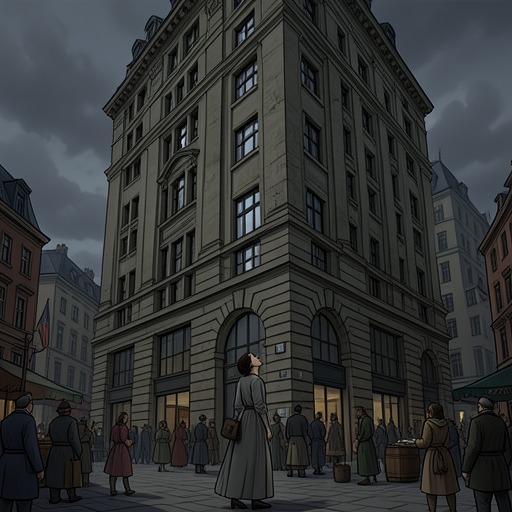
The Ireland of 1985 is marked by dwindling work and people leaving. Bill hears that young people are emigrating to London, Boston, and New York. In New Ross, the shipyard has closed, Albatros has made redundancies, Bennett’s has dismissed eleven employees, and Graves & Co., where Eileen had worked, has shut its doors. Miss Kenny, the florist near the coal yard, boards up her shop window; the town’s auctioneer describes business as virtually impossible.
The economic pressure extends beyond the town’s shops and factories. Bill has seen longer dole queues, men unable to pay electricity bills living in cold houses, and women waiting at the post office for children’s allowances. A farmer from St Mullins tells him that the family sold its Jeep because debt had become unbearable. On another morning, Bill sees a schoolboy drinking milk from a cat’s bowl behind the priest’s house. These particular encounters make hardship visible without turning it into an abstraction: poverty appears in unpaid bills, shuttered businesses, migration, and a child’s hunger. Bill responds by concentrating on keeping his business going and his daughters in education.
National news places these local troubles beside political and religious events. A new airport opens in Knock, while the Taoiseach signs an agreement with Thatcher concerning The North; Unionists march in Belfast to protest Dublin’s involvement. Crowds in Cork and Kerry have thinned, though some people still gather at shrines hoping to see a statue move. The details register a country in which economic uncertainty, political division, and religious hope occupy the same public landscape.
Religious Institutions and Social Silence
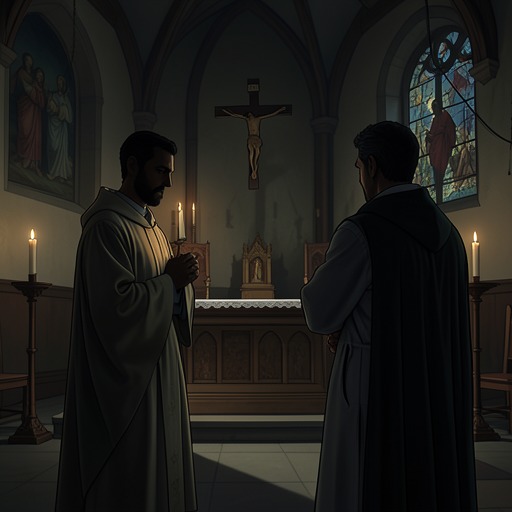
Across the River Barrow from New Ross, the convent stands on a hill facing the town. Its ordered lawns, clipped hedges, and shining windows make it look almost like a Christmas card in frost. The Good Shepherd Sisters run a training school for girls there and operate a laundry whose customers include restaurants, guesthouses, a nursing home, a hospital, priests, and wealthy households. Its reputation for returning spotless washing is public; what happens to the girls is less openly known.
Town talk offers conflicting accounts. Some people say the girls are made to do penance by washing linen from dawn until night; a nurse has reportedly treated a fifteen-year-old with varicose veins caused by prolonged standing at wash-tubs. Other stories claim that the sisters themselves do exhausting work and live under restrictions. Further rumors describe unmarried girls sent to the institution after giving birth, their babies adopted overseas, and the placements treated as a source of income. The narrative marks these as claims circulating in town, not as equally verified reports. That uncertainty is itself part of the setting: gossip and dismissal coexist with signs of suffering, while the convent’s commercial respectability makes its laundry familiar to the community.
Bill’s conversation with Eileen exposes how unevenly hardship is understood. She tells him he was not raised amid the same difficulties as girls who get into trouble. His concern for his daughters and his awareness of local poverty do not erase the divide between his secure family life and the vulnerability of girls whose circumstances can bring them under institutional control. When the Mother Superior remarks that there are so many girls and it is no easy task to find a place for everyone, the exchange makes that vulnerability sound like a problem of institutional accommodation rather than individual lives.
Historical Record and the Novel’s Frame
The note at the end of the book states that the novel is fiction and is not based on any individual person. It then sets that fiction against the history of Ireland’s Magdalene Laundries and Mother-and-Baby Home System. The note says that Ireland’s last Magdalen laundry did not close until 1996 and that the number of girls and women concealed, incarcerated, and forced to work is unknown. It gives ten thousand as a modest estimate and thirty thousand as probably more accurate, adding that records were destroyed, lost, or made inaccessible and that the women’s work was rarely acknowledged.
The note also records the loss of children and lives. It says many women lost their babies and some lost their lives or the lives they might otherwise have had; the number of infants who died or were adopted from mother-and-baby homes is likewise unknown. A Commission report cited in the note found that nine thousand children died in eighteen institutions it investigated. Separately, it reports that in 2014 historian Catherine Corless made public evidence that 796 babies had died at the Tuam home in County Galway between 1925–1961. The note identifies the Catholic Church and the Irish State as having run and financed these institutions together, and records that the Irish government did not apologize for the Magdalene laundries until 2013, when Taoiseach Enda Kenny did so.
By placing this historical account after a story set in a recognizable Irish town, the book refuses to let local respectability or uncertainty about rumor settle the question of responsibility. Ireland is not presented only as landscape or national history: it is also the community in which institutions operate, families make choices, and suffering can be seen yet left unspoken.