Irish mother-and-baby homes
Small Things Like TheseIrish mother-and-baby homes are institutions of concealment and separation in Small Things Like These: unmarried girls could be hidden away after giving birth, while their infants were taken from them and placed elsewhere. The novel moves from townspeople’s uncertain talk to a young mother’s direct account, then widens its focus in the closing note to the documented scale of confinement, adoption, and child deaths. That progression makes the homes not just a subject of rumor, but part of the social and institutional history the book asks readers to face.
Definition and Local Rumor
In New Ross, the homes enter the story through talk about the nearby New Ross Good Shepherd Convent. The convent’s training school and laundry are publicly familiar, but what happens to the girls there is less visible. Some townspeople claim that unmarried girls are sent away after giving birth and that their babies are adopted by wealthy Americans or sent to Australia. They also allege that the nuns profit from arranging these placements. The account is explicitly presented as rumor, not as verified knowledge about the convent: the narrator notes that much of what people say cannot be believed. That uncertainty, however, sits alongside the community’s limited willingness to look closely at what may be happening.
The rumors give the homes a local meaning: they are places where families and institutions can remove unmarried girls from public view, and where a mother’s relationship with her child may be cut off. In the same conversation, the girls are described as having “got in trouble,” a phrase that assigns blame to them while leaving the conditions of their confinement and separation largely unspoken. The difference between what is known and what is dismissed as gossip becomes part of the book’s portrait of social silence.
Separation and the Novel’s Human Encounter
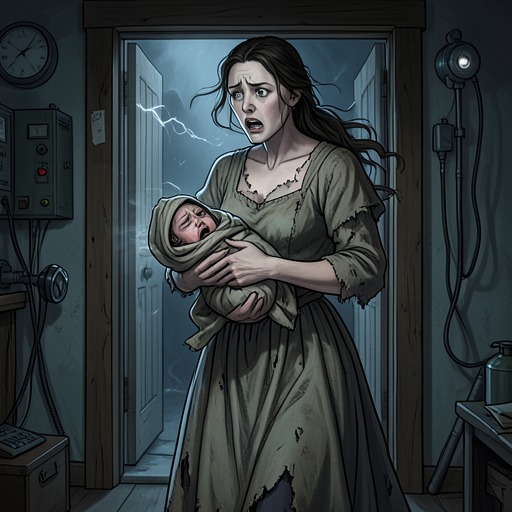
The possibility of infant separation becomes immediate when a young girl asks Bill Furlong to ask after her baby. She says that her son is fourteen weeks old, that he has been taken from her, and that she does not know where he is. Her question about who is feeding him conveys the practical urgency of the separation: she is not asking only for information, but expressing concern for an infant whose care has been placed beyond her reach. The scene does not establish that she has been sent to a mother-and-baby home; rather, it brings into the story the same vulnerability and separation associated with the homes.
Furlong initially faces the choice of whether to leave the girl at the convent or take responsibility for helping her. His hesitation gives way when he sees her sitting dazed at the table with nothing before her, while a young nun prepares food nearby. Though those in the convent expect him to continue on, he stops and asks whether he can do anything for her. She begins to cry. Her response marks the force of a small act of attention in a setting where her need for help has not been met by the people controlling her circumstances.
Family, Authority, and Complicity
Furlong’s wife, Eileen Furlong, urges him not to involve himself. She argues that the matter has nothing to do with them, points to the girls’ need for a fire, and stresses that the nuns pay their bills promptly. Her response links compassion to household livelihood: the convent is a customer, and challenging its conduct might threaten a dependable business relationship. The book does not reduce her position to indifference; it shows how ordinary obligations and economic dependence can help keep institutional harm at a distance.
The power to conceal and separate mothers and infants is also shaped by unequal social positions. The young girls are spoken of as unmarried and in trouble, while the people who send, house, or make decisions about them have greater authority. Furlong’s own reflection on the hardship from which he was raised connects his response to the protection he received as a child. The story places the young mother’s limited choices beside the forms of support that can make a different life possible, without suggesting that individual kindness alone can undo an institution.
Historical Record and Significance
The closing note distinguishes the fictional story from the real history that gives its subject weight: the novel is not based on any individual. It states that the number of girls and women concealed, incarcerated, and made to labour in these institutions is unknown. It gives ten thousand as a modest estimate and says thirty thousand is probably more accurate, while noting that many institutional records were destroyed, lost, or made inaccessible. It also records that many girls and women lost their babies, and that some lost their lives or the lives they might otherwise have had.
The note describes the scale of infant death and adoption as uncertain, but cites a Commission report finding that nine thousand children died in eighteen investigated institutions. It also records historian Catherine Corless’s 2014 publication of her discovery that 796 babies died between 1925 and 1961 in the home in Tuam, County Galway. These figures make the absence of reliable records consequential: the history is not only one of separation and death, but also one in which the full number of those affected cannot be established.
Finally, the note states that the Catholic Church and the Irish State ran and financed these institutions. This places responsibility beyond individual families and local gossip, identifying powerful institutions as participants in the system. The book’s dedication to women and children who suffered in Irish mother-and-baby homes and Ireland’s Magdalene Laundries reinforces that historical frame. Its central ethical contrast is between a community’s reasons for not intervening and the concrete obligation to respond when another person’s need becomes visible.