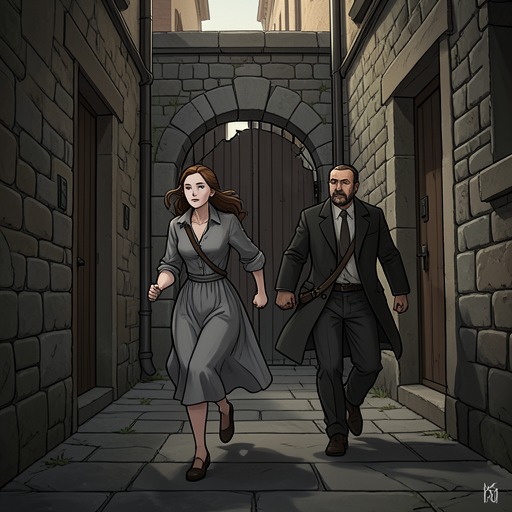
Sarah Redmond
Small Things Like TheseSarah Redmond is a young mother held at the Good Shepherd Convent, separated from her fourteen-week-old baby and known inside the institution as Enda. Her plea for help turns the convent’s circulating rumors into an immediate human crisis: she does not know where her child is, and Bill Furlong ultimately leads her out and takes her home. Her brief, guarded presence exposes the cost of a system that the town can discuss at a distance while continuing to use its services.
Identity and Confinement
Sarah first appears to Bill in the convent’s coal-shed area, where she is sitting in a daze while a young nun prepares food. The contrast is pointed and concrete: an egg and black pudding are being cooked, but Sarah has nothing before her. When Bill offers help, she begins to cry, a response the narration connects to someone encountering kindness after a long absence. Her distress is visible before she can explain the circumstances that have brought her there.
Asked her name, she says that in the convent she goes by Enda. Bill remarks that it is a boy’s name, then gently asks for her own. She identifies herself as Sarah Redmond and says her people are from beyond Clonegal. The two names distinguish her identity beyond the institution from the name by which she is known within it; the scene does not explain who chose Enda or how long she has been called that.
Sarah’s most urgent concern is her baby. On the convent’s front step, while Bill is still weighing whether to take her away or leave her with the priest, she asks him to ask about the child. She says the baby is fourteen weeks old, has been taken from her, and might be allowed to feed again if he is still there. She does not know where he is. Her appeal is not framed as a general complaint: it is a specific attempt to find and feed an infant whose whereabouts have been concealed from her.
The Convent and the Town’s Stories
The Good Shepherd Convent stands prominently on a hill across the River Barrow, its lawns, clipped hedges, and bright windows giving it the appearance of an orderly, almost picturesque institution. The Good Shepherd nuns run a training school for girls as well as a laundry. The laundry is openly valued by local businesses and households, whose washing is said to return in excellent condition. Sarah’s confinement sits behind this respectable public function, in a place closely connected to the town’s ordinary commerce.
The town’s accounts of what happens inside are contradictory. Some people say the so-called training-school girls are not students but girls being reformed through penance and work at the wash-tubs; one report concerns a fifteen-year-old with varicose veins from standing so long. Other stories describe the nuns themselves as overworked, restricted, and poorly fed. Still others claim that unmarried girls are hidden there after giving birth and that babies are adopted by wealthy Americans or sent to Australia for money. The narration cautions that much of the town’s talk is unreliable. Sarah’s testimony nevertheless gives the rumors a particular point of contact: her baby has been taken, and she does not know where he is. Her case does not verify every story told about the convent, but it prevents the uncertainty from making her separation less real.
The institution’s scale also surfaces in the Mother Superior’s remark that there are so many girls nowadays and that finding a place for everyone is no easy task. The comment treats placement as an administrative difficulty, while Sarah’s request makes clear what such arrangements mean to one mother. The difference between the convent’s language of provision and Sarah’s lack of knowledge about her own child sharpens the imbalance between institutional authority and the person subject to it.
Encounter with Bill Furlong
Bill does not immediately act. On the front step he considers taking Sarah to the priest’s house or bringing her home, while an ordinary impulse urges him to be rid of the trouble and return to his own life. Her question about the baby interrupts that hesitation. Once he learns that the child has been taken and may be somewhere in the convent, he begins thinking afresh about what to do. The Mother Superior opens the door before he has resolved the question, greeting him as a visitor who has come to spare the convent his time.
Their later conversation gives Sarah room to name herself. When she says Sarah Redmond, Bill recognizes Sarah as his own mother’s name. This is a coincidence, not a family relationship, but it makes the exchange intimate: he answers her name with a personal association and asks where she comes from. Sarah’s tears and halting replies show how difficult it is for her to speak in a setting where a nun is present. Bill’s gentleness offers a limited opening for speech; it does not erase the authority surrounding her.
The Mother Superior gives Bill an envelope for Christmas and says that she expects an invoice for what is owing. He is reluctant to accept the money but takes it. The exchange underscores how readily the convent and Bill’s business can remain within familiar transactional routines even as Sarah sits nearby without food and separated from her child. His willingness to accept payment does not settle his decision about her; the decisive act comes later, when he returns to the convent.
Escape and Narrative Significance
On Christmas Eve, Bill walks around the convent’s high rear walls, topped with broken glass, and sees that the third-storey windows are blackened and fitted with metal grilles. From outside, he cannot see in. The contrast between these barriers and the carefully maintained front garden makes the convent’s two faces visible in a single walk: the public, picture-like entrance and the enclosed spaces that conceal those inside. He circles back through the open gates and reaches the coal-house door. After hesitation, he slides the bolt, calls Sarah by name, and gives his own.
Sarah takes his coat and seems glad to lean on him as he leads her out. Bill tells her she will come home with him. He helps her down the drive and hill, past the houses and across the River Barrow. As they walk, he considers taking her to the priest, but concludes that the priests already know about the situation; his thought recalls what Mrs Kehoe had told him. The decision to continue home therefore carries the risk of acting without the reassurance of religious authority. Sarah’s departure changes her immediate circumstances: she is no longer inside the convent, and she is accompanied by someone who has accepted responsibility for bringing her into his household.
Sarah’s role in the novel is not defined by a full account of her past, which the evidence leaves largely unspoken. Instead, her short appeals, the name she gives, and her dependence on Bill make visible the consequences of separation and confinement. The town can dismiss its stories as gossip and continue to benefit from the convent’s laundry; Sarah’s uncertainty about her baby cannot be reduced to rumor. Her rescue is also a turning point for Bill, whose earlier impulse to avoid involvement gives way to a costly, public act of care. Through Sarah, the moral question becomes concrete: whether compassion will remain a feeling or become the decision to open a locked door and accompany someone out.