St Margaret’s School
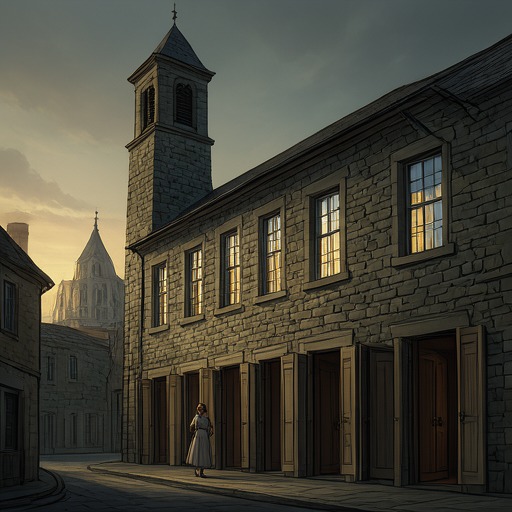
Small Things Like TheseSt Margaret’s School is the only good school for girls in New Ross, and the place where Bill Furlong hopes his daughters will complete their education. The novel gives the school a modest but consequential presence: it is part of the girls’ ordinary routines and public life, yet stands immediately beside a convent whose walls and disputed practices make that proximity morally charged.
Setting and educational role
In 1985, as businesses closed and unemployment sharpened the town’s economic uncertainty, Furlong kept his attention on providing for his family and enabling his daughters to finish their education at St Margaret’s School. He regarded it as the town’s sole good option for girls. His determination gives the school significance beyond its classrooms: education is among the futures he can actively work to secure for his children amid a period when young people were emigrating and local livelihoods were disappearing.
The two eldest daughters, Kathleen and Joan, attend secondary school there. The other three are also described as promising students, though the narrative does not specify that they have yet reached secondary school. St Margaret’s is therefore the clearest common destination in Furlong’s plans, rather than a detailed institutional portrait: the text establishes its importance to his family and the town without describing its curriculum, governance, or physical interior.
The Furlong daughters and school life
Kathleen, the eldest, shows practical ability as well as academic promise. On Saturdays she accompanies her father to his prefabricated office, where she helps with the books, files the week’s incoming work, and keeps an account of most things. Joan has a good head on her shoulders and has recently joined the choir. Their activities suggest different kinds of competence, both visible within the family’s everyday life, while their attendance at St Margaret’s places them on a shared educational path.
Sheila and Grace, born eleven months apart, can recite multiplication tables, perform long division, and name the counties and rivers of Ireland. They sometimes trace and colour those maps at the kitchen table. Both are musically inclined and take accordion lessons at the convent on Tuesdays after school; the lessons are a separate activity from their schooling, but show how education and organized pursuits overlap in the girls’ week. Loretta, the youngest, is shy with people, earns gold and silver stars in her copybooks, reads Enid Blyton, and wins a Texaco prize for a drawing of a fat blue hen skating across a frozen pond. These individual details make the family’s educational promise concrete, even though the novel does not assign every daughter the same school status.
The school also enters the town’s seasonal public life through music. At the first-Sunday-of-December Christmas-light gathering, Joan is already ahead of her family, handing out carol sheets with other choir members. Her role makes the choir a visible part of the town’s celebration and presents St Margaret’s students not only as pupils but as participants in communal events. Later, while walking through the town at Christmas, Furlong notices a girl in a St Margaret’s uniform seated in a house. Since it is not a school day, he wonders whether she has come from choir practice; the possibility links the uniform to a life of activities extending beyond lessons, though his thought remains conjecture.
The convent next door
St Margaret’s is separated from the convent by a wall. The convent stands on the hill across the River Barrow, a powerful-looking institution with broad open gates, high windows, clipped grounds, and a laundry that serves local businesses and households. It also runs a training school for girls. That training school is not St Margaret’s: the distinction matters because the town’s disturbing talk concerns the convent’s girls and work, not the school’s pupils.
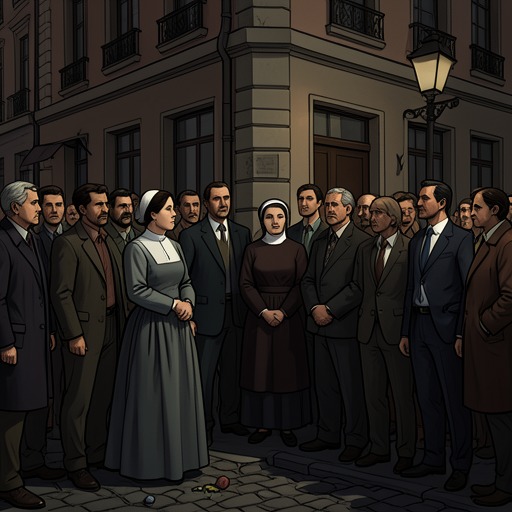
Rumours about the convent range from claims that its training-school girls are made to wash laundry from dawn to night, to stories that unmarried girls are concealed there after giving birth and that their children are adopted abroad. The account presents these as competing reports and gossip, not as verified facts about St Margaret’s. Furlong’s own observations intensify his unease: he remembers girls on their hands and knees polishing a floor, a padlock on a door between the orchard and the front, broken glass atop the high wall adjoining the school, and the convent’s front door being locked by a nun. The physical boundary thus becomes more than a line between two institutions. It separates the education Furlong wants for his daughters from a place whose operations are obscured by walls, locked doors, and contradictory local stories.
Education, protection, and social position
The closeness of the institutions shapes Furlong’s sense of responsibility. Mrs Kehoe reminds him that he has worked hard, raised a fine family of girls, and that only a wall separates the convent from St Margaret’s. She also argues that girls from the area who have done well have generally passed through those halls. Her words connect education to social opportunity while making the nearby convent impossible to treat as an unrelated concern. The daughters’ place at school is a source of pride and hope; the wall beside it draws attention to girls whose circumstances may be radically different.
The novel reinforces this contrast through repeated glimpses rather than a formal account of school life. Joan distributes carol sheets among the choir; a uniformed girl appears in a home during the holiday period; and, before dawn near Christmas, Furlong hears singing and wonders whether it comes from St Margaret’s boarders, the convent’s training-school girls, or nuns practising for Mass. He cannot establish its source. The uncertainty keeps the institutions distinct while showing how, in the town’s physical and moral landscape, their sounds and lives seem to meet at the boundary.
St Margaret’s consequently represents a plausible route to education and advancement for Furlong’s daughters, not an uncomplicated guarantee of safety or success. His hopes for Kathleen, Joan, Sheila, Grace, and Loretta are rooted in their different talents and in his resolve to keep them learning. Set directly beside the convent, the school also sharpens the novel’s question of who is protected, educated, and allowed a future—and which neighboring lives a community can leave unseen.