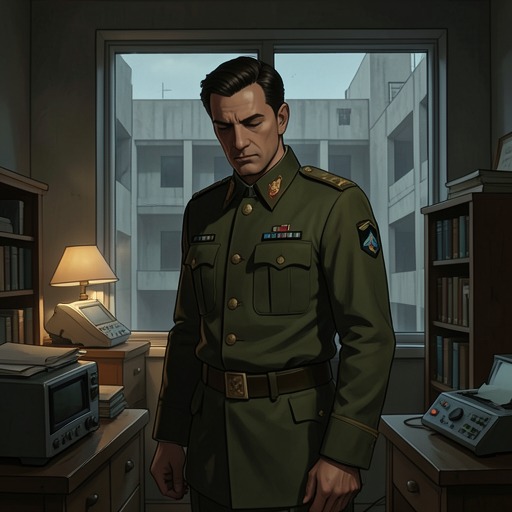
Benedicte Clahn
Smilla's Sense of SnowBenedicte Clahn is a translator and codebreaker whose work in postwar Germany connects an intercepted wartime-era correspondence to later expeditions in Greenland. In Smilla Jaspersen’s investigation, Clahn’s recollections supply a crucial bridge between the 1946 deciphering operation, Johannes Loyen, and the corporation’s Greenland ventures; her expertise also gives her an unusually precise ear for how language preserves a speaker’s history.
Identity and Introduction
Clahn enters Smilla’s inquiry through the corporation’s accounts. In a record of the 1991 expedition, Smilla finds a fee paid to someone of Clahn’s name. The former accountant recalls another entry from 1966: a translator’s fee of 267 kroner. Clahn had been an acquaintance of the director and had lived in Germany. The accountant suspected that Clahn and the director had known each other in Berlin in 1946, when the Allies negotiated over the division of aluminum supplies and corporation personnel were frequently there.
Smilla later introduces herself to Clahn as Smilla Jaspersen and presents the mechanic as Captain Peter Fojl, Ph.D. Clahn laughs at the mechanic’s apparent credentials and asks whether he is a historian as well. The brief exchange shows her alertness and social ease, but her importance to the investigation lies in the historical knowledge she can recover from memory.
The 1946 Codebreaking Operation
Clahn recalls arriving in Hamburg in July 1946 to work on intercepted letters. At first, her group decoded about two letters a day, usually love letters. In August the correspondence changed: many letters came from the same writers, and the group received a new censor, a German who had worked for von Gehlen. His name was Holtzer. Clahn describes him as kind and gentle, but gradually understood that he possessed particular knowledge of the case the group was investigating.
The other members of the team did not tell Clahn what the case was. Instead, they repeatedly asked her about specific phrases, and their questions allowed her to piece together the nature of the work. One word drew particular attention: “Niflheim.” She looked it up and found that it meant “world of mists,” the outermost part of Hell and the realm of the dead. By the end of August, the investigators had narrowed their focus to letters exchanged by the same four people. They never saw the envelopes and knew the correspondents’ names but not their addresses. The initial batch consisted of eight letters, with about two new ones arriving each week.
The code was both hurried and difficult to break. Its construction was sloppy, Clahn says, yet it did not follow ordinary language: it depended on a series of agreed-upon metaphors and appeared, on its surface, to concern the transport and sale of goods. Johannes Loyen joined the group while working in Germany as a forensic medicine expert involved in the closure of concentration camps. Clahn remembers him as handsome and vain, a personal impression that sits beside the more consequential fact of his participation in the decoding effort.
Reconstructing the Greenland Connection
Clahn’s knowledge was sought again in 1966. Loyen was then working for a company organizing a trip to Greenland and brought the group together to reconstruct information from the 1946 letters. The material they tried to recover concerned routes and, in particular, anchoring conditions. Despite spending considerable time on the task, they were unsuccessful. Clahn thinks she may have received a fee for this work, matching the unexplained translator’s payment later found in the company’s records.
The payment entries give Smilla a material trail, while Clahn’s recollections supply the human sequence behind them: the secret letters, Loyen’s involvement, and the subsequent attempt to extract practical information for a Greenland journey. Clahn also remembers the corporation’s director as an acquaintance and places her own earlier connection with him in the context of postwar Berlin. Her testimony does not solve every uncertainty: when Smilla asks about further work in 1990 and 1991, Clahn bites her lip and brings up Helen, Loyen’s jealous wife. The hesitation marks a limit to what this remembered account can establish.
Language, Memory, and Character
Clahn’s gift for linguistic analysis appears again when she listens to a recording and infers a speaker’s background from his voice. She explains that each utterance carries the sum of a person’s linguistic past. From the speaker’s accent and sociolects, she correctly infers that he grew up in or north of Thule, had one or two Inuit parents, and came to Denmark at about seven to eleven years old, after acquiring Greenlandic but while still young enough to learn another language with particular ease. She also hears traces suggesting schooling in Gentofte or Charlottenlund, a North Sealand accent, and a later influence from West Greenlandic. Smilla confirms that Clahn’s deductions are essentially right.
That scene echoes the larger pattern in Clahn’s recollections: language is evidence, but the evidence is never simply a transparent record. The codebreakers could not read the intercepted letters by treating them as ordinary speech; they had to infer the shared metaphors that organized them. Clahn likewise reads a voice through its layered history rather than reducing it to a single place or identity. Her expertise makes the past legible to Smilla while also revealing how much depends on interpretation, reconstruction, and what can no longer be recovered.
Clahn’s memories therefore give the investigation more than a name attached to an old payment. They connect the corporation’s records to a specific postwar operation and to Loyen’s later attempt to recover route information for Greenland. Her work is a hinge between languages, institutions, and decades: the letters conceal their meaning in metaphor, the accounts compress a person’s labor into a fee, and Clahn’s recollection restores the human and historical connections those records alone cannot show.