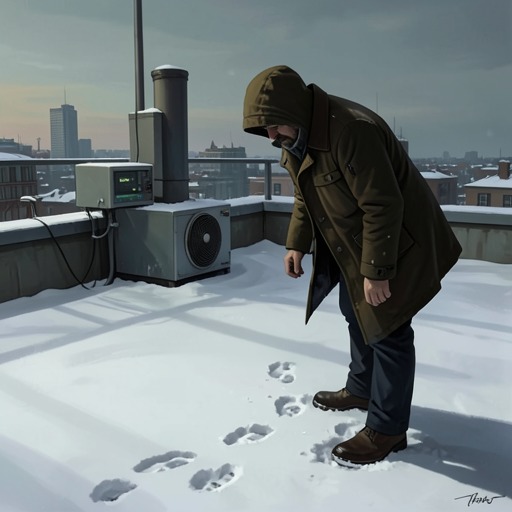
Isaiah's fatal fall from the roof
Smilla's Sense of SnowIsaiah’s fatal fall from the roof is first reconstructed by Smilla as a pursuit in which a frightened child’s resourcefulness turns a warehouse roof into a trap. The later confrontation aboard the ice forces Tørk to admit that he followed Isaiah there, and shows how Smilla challenges his claim that the boy simply jumped. The death is not presented as an isolated accident: it is linked to Isaiah’s having seen something in a glacier cave and to Tørk’s effort to recover a cassette tape and contain what the boy knew.
The pursuit and the roof
Smilla’s account begins with Tørk bending toward Isaiah as if to lift a small doll onto a seat. He briefly lets go, miscalculating the boy’s vitality and his practiced ability to run over packed snow. Isaiah bolts. Tørk cannot catch him on the snow-covered ground, and the pursuit shifts from the building to the street and then to the warehouses, where Tørk blocks the boy’s path.
At first, Smilla says, Isaiah appears to have stopped thinking. Yet an inner engine keeps him moving after his strength is nearly spent. With Tørk behind him, Isaiah climbs the scaffolding. His terror of the man outweighs his fear of heights; knowing he is going to die, he continues up to the roof and runs forward. Tørk stops and watches. The sequence turns on a stark reversal: the roof is not a route to safety but the last place Isaiah can run while the pursuer remains close behind.
A death presented as a choice
From the roof, Isaiah runs along the edge, looking for a way down. Smilla emphasizes the difference between the child’s narrow, immediate view and the adult’s wider awareness: Isaiah probably does not understand the whole situation or even where he is, and sees only a few yards ahead. Tørk, by contrast, moves toward him and waits. At the edge of the snow he stops, unwilling to leave tracks and still hoping he will not have to act.
The waiting carries menace because Tørk’s presence itself seems, to Smilla, to exert control. She considers several possibilities about his intention: perhaps he wanted the fatal outcome from the start; perhaps the idea occurred to him only on the roof; perhaps that was where he first recognized what he was prepared to do. She identifies the possible motive as eliminating a threat—preventing Isaiah from telling anyone what he had seen in a cave on a glacier somewhere in Davis Strait. This is Smilla’s reconstruction, not a scene she claims to have witnessed firsthand; Ravn quietly challenges its certainty, telling her she is guessing.
Tørk’s explanation and its omissions
Later, as Smilla, the mechanic, and Tørk face one another on the ice, Smilla asks why Isaiah died. She already knows what happened as surely as if she had been on the roof, but says she is asking partly for the mechanic and partly to stop time. Tørk answers that Isaiah jumped. Pressed to explain, he says that he wanted the cassette tape back, that Isaiah ran because it was dark and he did not recognize him, and that they got onto the roof without Isaiah seeing him.
Tørk’s version makes the death sound like the outcome of panic and mistaken recognition. Smilla counters with a specific contradiction: there were tracks, and Isaiah turned around. Tørk says he shouted and that Isaiah turned around without seeing him. Smilla then points to the boy’s hearing impairment: Isaiah could not have heard a thing. The disagreement is more than a dispute over whether Isaiah noticed his pursuer. It undermines Tørk’s explanation of the encounter and returns the focus to the fear and pursuit Smilla has already reconstructed.
The death’s return on the ice
The account of the warehouse roof is spoken into an immediate confrontation on ice. Smilla walks toward Tørk as she talks, and the frozen ground makes her movement resemble Isaiah’s flight away from him. She feels as if she is Isaiah, but returning along the same route to do something differently and find out whether there might have been an alternative. The remembered pursuit thus becomes a present physical approach: the woman confronting Tørk occupies the path once taken by the boy escaping him.
The scene’s interruptions sharpen the danger. The radio signal disappears and returns as the mechanic works the dials; Tørk’s attention is divided between Smilla and the mechanic, and he is preparing his weapon. The exchange about Isaiah therefore unfolds not as detached testimony but amid an active standoff. Tørk’s admission that he followed the boy does not settle every uncertainty about the final instant, but it leaves the death bound to his pursuit, his demand for the cassette, and the threat posed by what Isaiah had seen.