Isaiah, the boy
Smilla's Sense of SnowIsaiah, the boy is the child found dead in the snow outside the Copenhagen warehouses, an image that begins Smilla’s inquiry and returns to define its stakes. He is also more than its victim: his distinct fears, self-possession, and history in Greenland resist the explanations imposed on him, while his death becomes the point around which Smilla recovers a sense of purpose.
Identity and Introduction
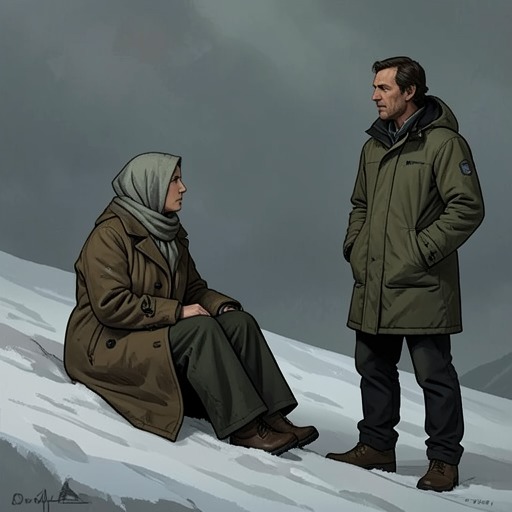
Isaiah first appears to Smilla as a child sitting on the stairs, and their introduction is almost a challenge. She tells him to go away; he answers, in Greenlandic, that she should go away herself. She recognizes in his direct gaze a quality that she believes they share, a capacity to look another person in the eye without evasion. The encounter establishes a bond not through a conventional exchange of confidences but through mutual recognition.
The mechanic later calls him “the Baron,” a nickname that grows out of his dignity and self-sufficiency. When Isaiah arrives in Denmark, Juliane finds him patent-leather shoes, a stylish choice in Greenland. His fan-shaped feet will not fit the pointed kind, so she finds a pair with rounded toes. The detail locates him between places: the shoes carry a Greenlandic idea of style into a Danish setting, while their shape must accommodate his actual body. To the mechanic, the nickname captures the boy’s composure and the smallness of what he needs from the world to be happy.
Fear, Courage, and Everyday Life
Isaiah is afraid of heights, but that fear is specific rather than a general incapacity. He will race up to the second floor, then climb the stairs toward the fourth with his eyes closed and both hands gripping the banister. The ascent takes five minutes; sweat beads on his forehead, and his knees buckle. Juliane tried to secure a ground-floor apartment before they moved in, but, as Smilla observes, a Greenlander dependent on welfare has little power to choose housing. The building makes his fear a repeated physical ordeal, intensified by a housing system that does not offer his mother a practical alternative.
His fear also makes the circumstances of his fatal fall difficult to explain. Smilla emphasizes that Isaiah could barely proceed up a stairway without closing his eyes, yet somehow went onto the roof. He had overcome no ordinary reluctance: Smilla says that even a hydraulic lift or a Hercules crane would not have moved him up the scaffolding. The unresolved contrast—his established terror of heights against his presence above ground—becomes one of the questions that keeps her investigating.
The child is also shown in a state of terror that adults around him cannot immediately interpret. The mechanic remembers finding him huddled beneath the stairs, shaking and holding the knife Smilla had given him. Isaiah continues to shake even after he realizes the intruder is only Petersen, the custodian. The mechanic takes him onto his lap for the first time, brings him upstairs, and stays awake beside him as he sleeps on the sofa. Every fifteen minutes Isaiah bolts upright, crying and trembling. The episode gives the boy’s fear a domestic, intimate form and helps the mechanic understand that something has frightened him deeply.
Greenlandic Experience and Belonging
The novel places Isaiah’s Danish life alongside Smilla’s memories of Greenland and her account of its practices and histories. In a story Smilla relates about Inuit creation, two sorcerers create children after one transforms his body so that he can give birth. She also describes historical accounts of women hunting as men did, and her mother’s life across roles conventionally assigned to women and men: she gave birth, cleaned skins, and cared for social life, but also shot, paddled a kayak, and hauled meat. These passages do not directly recount Isaiah’s actions; they establish the cultural knowledge and lived experience through which Smilla understands him and resists reducing Greenlandic life to external classifications.
Smilla’s memories of hunting sharpen that distinction between description and lived knowledge. After a day of hunger, she catches three birds in a net, then releases them when she imagines the chain of living creatures extending from their young to a narwhal pup. Elsewhere, she insists that understanding another culture requires living within it, being tolerated as a guest, and learning its language; explanation can create distance from what it claims to clarify. Isaiah’s significance in her life is bound up with this attention to particular lives and meanings, rather than with a ready-made account of Greenlandic identity.
The contrast between Greenland and Denmark is also made through space. Smilla recalls that there are no prisons in Greenland and contrasts fines there with imprisonment for comparable offenses in Denmark. In her memory, her childhood was spent almost entirely outdoors, and remaining in one place for a long time was unthinkable to her mother. She describes spatial freedom as something she cradles and worships. This account helps frame the locked room as a specifically European form of punishment, and clarifies the material difference between a life organized around movement and a society that confines.
The Expedition and the Cause of His Death
Late in the investigation, the story connects Isaiah to the 1991 Gela Alta expedition. Tørk says the boy accompanied his father on the expedition and ran away from the ship in Nuuk; Loyen found him and sent him home. That history makes the boy’s presence on the expedition more than a passing fact. He was close to the events whose consequences Smilla is trying to reconstruct, and he encountered the adults involved before his death in Copenhagen.
In the final confrontation, Smilla asks why Loyen examined Isaiah. The answer is linked to what happened in the water and ice cave: Isaiah jumped into the water, and the expedition members had to bring him into the cave because he was afraid of heights. When his father collapsed near the surface, Isaiah wanted to go to him. Smilla distinguishes the boy’s fear of heights from a fear of water: he was not afraid of cold water and swam in the sea. Loyen arranged to keep him under observation because the worm was beneath Isaiah’s skin, not in his intestines; Isaiah never felt it. This explanation accounts for the muscle biopsy taken after his death: Loyen wanted a final sample to learn what happened to the parasite when its carrier died.
Smilla’s account of the roof episode likewise frames Isaiah’s death as the result of a threat, not as a simple expression of his fear. She imagines Tørk behind the boy, driving him forward as he had driven a woman, rather than stopping him. When Ravn answers that the woman was his daughter and that Tørk pushed her, the parallel between the two encounters gains terrible force. Tørk’s own brief explanation of Isaiah’s fall is that the boy jumped and panicked. The competing accounts leave the circumstances charged with coercion and fear, while Smilla’s reconstruction connects the child’s recognition of Tørk to what he had witnessed during the expedition.
Death, Memory, and Narrative Significance
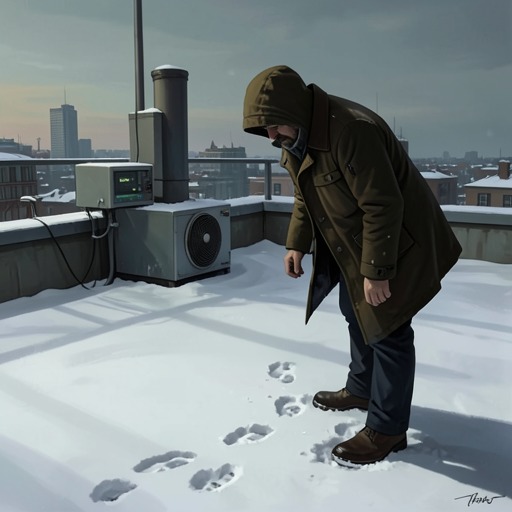
Smilla reaches Isaiah’s body before the ambulance. He lies with his legs tucked beneath him, face in the snow, hands around his head as if shielding himself from the spotlight. The snow beneath the warehouses has been packed hard by people and machines, and a police officer lets Smilla stand beyond the cordon. The scene is at once starkly physical and difficult to interpret: the small body has been made visible to the city, but the experience that brought him there remains hidden.
Smilla calls the body in the snow a violation. While Isaiah was alive, she says, he brought purpose and meaning; only after he was gone did she understand how important he had been to her. Her investigation therefore has two connected aims: to determine why he died and to penetrate the fact of his death without turning it into an abstraction. The child who once answered her directly becomes the center of a search in which institutions, witnesses, and scientific explanations repeatedly threaten to speak over him.
A photograph deepens the link between the boy and his father. In it, Isaiah’s father sits laughing triumphantly in the foreground of an immense ice cave, wearing down pants and kamiks. Smilla finds the image among papers and photographs, alongside a rough draft of a letter written in pencil and crossed out. The picture places a family presence inside the expedition’s extraordinary landscape, while the concealed draft suggests an account that has not been fully spoken. Neither detail resolves Isaiah’s experience, but together they make the expedition’s history intimate rather than merely scientific.
The novel also lets the boy’s significance open outward into a creation story. At the first Inuit Circumpolar Conference, Smilla recalls learning that Arctic peoples shared the raven creation myth: the raven begins in human form, fumbling blindly until he discovers who he is and what his purpose is. She wonders whether Isaiah has given her something similar—the sense of meaning that a child can bring, a movement both vast and fragile passing through them. His death violates that movement, but it also gives Smilla a purpose: understanding why he died. Isaiah thus remains present not as a solved mystery or an emblem detached from his life, but as the person whose particular fears, history, and absence compel her to keep looking.