Isaiah’s fatal fall from the warehouse roof
Smilla's Sense of SnowIsaiah’s fatal fall from a warehouse roof is the apparent accident that sets Smilla’s investigation in motion. The scene initially offers the familiar outline of a fall, but the evidence in the snow and Isaiah’s profound fear of heights make the circumstances increasingly difficult to accept as self-explanatory; a later discovery of a postmortem muscle biopsy turns the death into a question of what happened before and after it was officially understood.
Discovery and the Scene
On a December evening, Smilla notices a yellow light at the base of a warehouse near Knippels Bridge. Snow reflects it sharply. A police car’s blue light revolves by the building, where tape marks off a small dark shape in the snow. Smilla reaches the scene several minutes before the ambulance. Isaiah lies with his legs drawn up, his face in the snow and his hands around his head. The image does not establish what he experienced in his final moments, but it becomes the first, unresolved picture through which Smilla confronts his death.
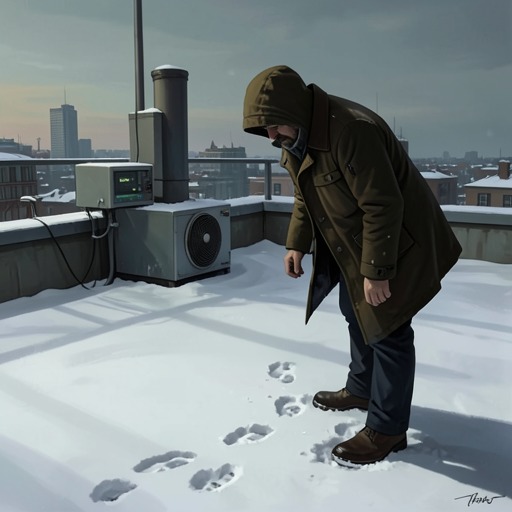
The roof preserves a route across the snow. Isaiah’s worn basketball shoes leave identifiable prints: he steps out onto the roof, walks diagonally, follows its edge, turns inward, and then runs toward the point from which he fell. The tracks stop at the edge; there are no other footprints on the snowy surface. On the adjoining warehouse, steep glazed tiles offer no foothold. Smilla’s reconstruction therefore establishes that Isaiah approached the edge alone, but it does not explain why he did so.
The Question of the Fall
The apparent physical cause is given as the fall. When Smilla asks the examiner what Isaiah died of, he answers in those terms; pressed to explain physiologically, he treats the answer as obvious. The gap between a cause stated in the simplest possible form and an account of the circumstances becomes central to the investigation. The fall identifies how the death occurred, not what brought Isaiah to the roof or whether anything happened to him before it.
Smilla points out the contradiction she cannot set aside: Isaiah was terrified of heights. He could manage the stairs to the second floor, but above that he crawled with his eyes closed, gripping the banister. His mother had tried to secure a ground-floor apartment, but, as Smilla notes, her family’s circumstances as Greenlanders dependent on welfare constrained what housing they could obtain. Against that history, Isaiah’s presence on a warehouse roof—and especially his movement toward its edge—demands an explanation. The footprints offer a precise account of his route while leaving its motive unknown.
Evidence After Death
The most consequential challenge to a routine account emerges during the postmortem examination. The examiner recalls that the police were not present because the death was initially treated as routine. While inspecting Isaiah’s rain pants, he noticed a perforation near the thigh and found a corresponding hole in the tissue. The absence of bleeding and tissue contraction indicated that the puncture had been made after Isaiah’s heart had stopped beating.
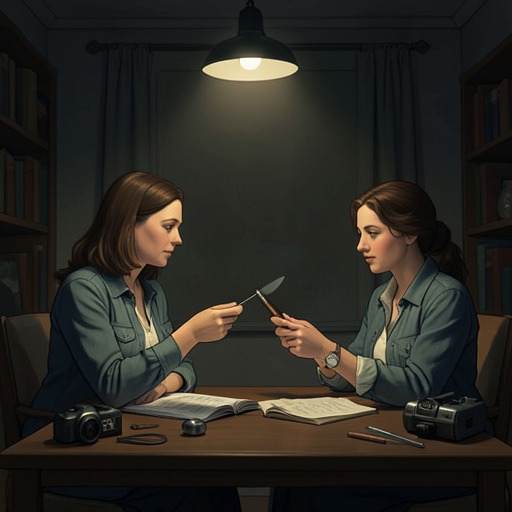
A circular indentation around the hole suggested the use of a biopsy instrument. The examiner compared its shape with the mark such an instrument could leave and concluded that someone had probably taken a muscle sample after Isaiah’s death, apparently in haste. This finding changes the meaning of the death scene: the fall remains the stated cause of death, but it cannot account for an intervention made afterward. Isaiah’s body had been examined and sampled in circumstances that the ordinary procedure did not explain.
Investigation and Significance
The fall is not narrated as a fully solved event. Smilla’s evidence narrows some possibilities—the footprints show no other person crossed the roof’s snow, while the biopsy establishes a separate postmortem act—but neither clue reveals why Isaiah went up or who took the sample. The investigation moves from a visible death to the concealed actions around it, and the apparent simplicity of the fall becomes precisely what requires scrutiny.
That inquiry also unfolds against a disparity in how Isaiah’s life is understood. His fear of heights is not a vague characterization but a practical limit that shaped how he moved through an ordinary apartment building. The difficulty his mother faced in seeking a ground-floor home connects that intimate knowledge to the family’s constrained position in Denmark. The death thus gathers together a physical puzzle and a social context: official description can name the fall, while the details that make it troubling emerge through Smilla’s knowledge of Isaiah and her attention to evidence others might leave unexplained.