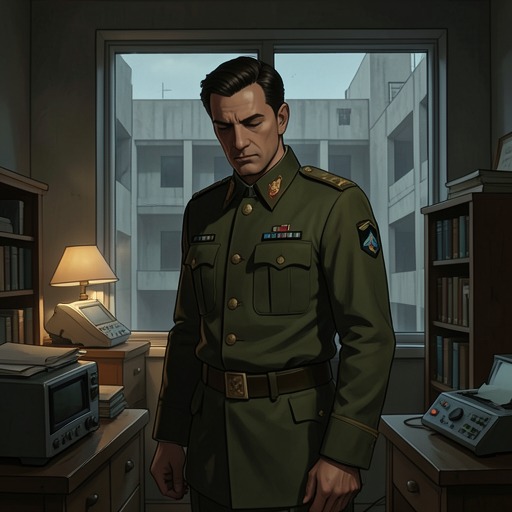
Johannes Loyen, autopsy chief
Smilla's Sense of SnowJohannes Loyen, autopsy chief, is both a forensic pathologist and a senior medical administrator whose authority reaches across the investigation of Isaiah’s death. When Smilla questions him, he gives her the official conclusion—that Isaiah died from the fall—and defends the thoroughness of the examination. His office, institutional position, and controlled explanation make him a representative of the systems that classify Greenlandic deaths, while the novel’s reflections on language and cultural attrition expose the broader history surrounding those systems.
Identity and Institutional Position
Loyen’s office announces his rank before he appears: a sign identifies Professor J. Loyen, and the route to his “real office” passes through a passageway, a cloakroom, and a chilly room where two secretaries sit beneath photostats of icebergs. His own expansive office is arranged to project authority, with books covering two walls, picture windows over the city and Fælled Park, a built-in safe, gold-framed paintings, a microscope on a light table, and a gilded mask in a glass case. The formal setting makes forensic judgment feel inseparable from institutional status.
When Smilla asks about the organization overseeing Greenlandic autopsies, Loyen explains that the center is only three years old. Previously, the district attorney in Godthåb had to contact the Institute of Forensic Medicine in Copenhagen whenever an autopsy was needed. The new department is temporary, with its planned transfer to Godthåb the following year. Loyen identifies himself as head of the Institute for Arctic Medicine, originally a forensic pathologist, and the autopsy center’s acting director during this transitional period. His several titles place him at the junction of medical expertise and administrative responsibility.
Examination of Isaiah’s Death
Smilla asks whether Loyen examined Isaiah. He confirms that he did. When she asks what killed the boy, Loyen answers that it was the fall. The brief conclusion is the official medical explanation of the death, but Smilla’s questioning makes clear that she is seeking more than a cause of death: she wants to know what the examination could establish and what the institutions responsible for it have chosen to disclose.
Loyen initially rebuffs her inquiries into the reports, asserting that she would not understand them and would not like what she did understand. He then explains that the reports belong to the police, who formally request autopsies and determine when burial may take place after signing the death certificate. He distinguishes criminal cases from civil administrative matters to deny her a route to the records. His answer does not simply invoke professional expertise; it describes a chain of official control over the evidence and even over the timing of burial.
On the question of possible molestation, Loyen insists that the examination was thorough. He says that such an assault would be virtually impossible to carry out without leaving marks: fingerprints, torn clothing, or skin cells beneath a defending child’s fingernails. He states that the examination found none of these. He also invokes the police report, saying the footprints showed that Isaiah was alone on the roof when the fall occurred. The scene presents his conclusion as carefully supported by forensic and police evidence, while also showing how firmly he controls the terms on which that evidence is explained to Smilla.
Smilla’s Challenge and the Limits of Authority
Loyen is not accustomed to being interrogated, and Smilla’s questions unsettle his composure. At one point he briefly loses self-control, then immediately restores it and returns to a soothing, authoritative manner. He compares their exchange to a game approaching its finish; after his account of the absence of physical evidence and the footprints, Smilla gets up and puts on her gloves. The encounter ends without her obtaining access to the reports, but it reveals the boundary she has reached: Loyen can provide an official account while the police retain formal control of the record.
Smilla’s own position complicates the interview. When she asks whether Loyen is Greenlandic, she says that her mother was from Thule. The exchange links her personal and cultural background to the medical authority before her without dissolving their institutional opposition. Loyen’s professional experience enables him to recognize something about her, but the available scene does not turn that recognition into an equal exchange: she remains the person asking for an explanation, and he remains the official who decides what can be said.
Language, Assimilation, and Narrative Significance
The novel places the encounter with Loyen within a sustained account of Greenlandic language loss. Smilla compares the deterioration of a language to corrosion: on Disko Island, carabiners used on glacier safety lines looked reliable after exposure to sea fog, yet could be pulled apart with a fingernail. She uses that failed appearance of strength to describe how a mother tongue can weaken gradually, even when it still seems intact.
Her account traces that attrition to schooling and political assimilation. After her family moved from the village school to Qaanaaq, teachers who did not know Greenlandic and did not plan to learn it presented Danish education as the route to a degree and a way out of Arctic hardship. The policy environment of the 1960s officially designated Greenland “Denmark’s northernmost county,” while Inuit were supposed to be called “Northern Danes” and educated to the same rights as other Danes. In Denmark, Smilla describes how ordinary Greenlandic words become difficult to retrieve, and how she later tries, without decisively succeeding or failing, to relearn her language.
That history gives Loyen’s institutional role a wider context without making him a simple emblem of it. He oversees a newly established Greenlandic autopsy center, yet its records remain subject to police authority and its structure is still temporary. Elsewhere, a man on a tape demonstrates how language carries traces of a speaker’s past; Smilla recognizes the analysis as essentially accurate. Together, these details make language and forensic interpretation parallel forms of reading: both seek evidence in what remains, and both raise the question of who has the authority to interpret it. The text does not establish that Loyen’s stated findings are false; it shows instead how expertise, procedure, and the unequal history surrounding Greenland shape the encounter in which those findings are given.