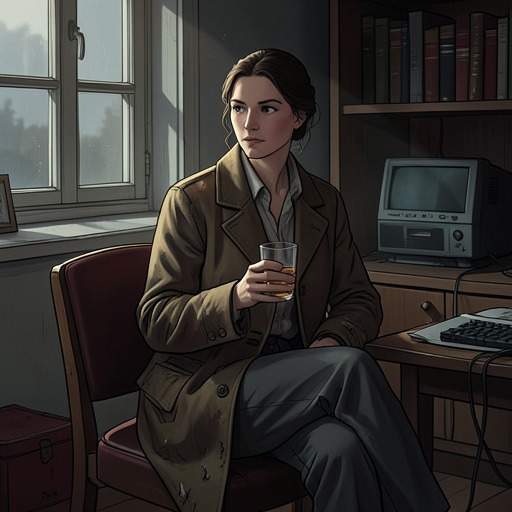
Juliane Christiansen's alcoholism
Smilla's Sense of SnowJuliane Christiansen’s alcoholism shapes her everyday life and her relationship with Smilla, but it is not presented as a simple source of comfort: drinking seems to release Juliane from inhibition even as it places her health at risk. In the aftermath of Isaiah’s death, the condition also forms part of the material and emotional setting in which Smilla searches for what may have been overlooked. Juliane’s apartment, her willingness to let Smilla rummage through it, and her reliance on selling prescribed pills reveal how grief, surveillance, and economic precarity have narrowed the boundaries of her private life.
Drinking and its apparent effects
Smilla describes Juliane as stiff, silent, and inhibited when sober, but lively and happy when drunk. The contrast gives alcohol an apparent curative power in Juliane’s life: it seems to change not only her mood but the ease with which she can show affection. Yet that improvement is compromised by the circumstances of her drinking. After returning from the hospital, Juliane has taken disulfiram and continued drinking; Smilla understands the transformation as occurring through the veil of the resulting poisoning. Juliane says she feels markedly better and tells Smilla she loves her, so the scene holds her emotional warmth beside the evident danger to her body rather than treating one as proof that the other has disappeared.
Smilla places Juliane’s drinking within a broader experience of alcohol in Greenland. She rejects the familiar claim that people there drink a lot as an understatement, describing the scale instead as colossal. This shapes her own relationship to alcohol: when she feels drawn to something stronger than herbal tea, she remembers the period before voluntary liquor rationing in Thule. Juliane’s condition therefore sits within a social context that Smilla knows intimately, although the account does not reduce Juliane’s individual circumstances to that context alone.
Isaiah’s death and the apartment
After seeing Isaiah’s small figure in the basement morgue, Smilla leaves without looking at Loyen. The next time she enters Juliane’s apartment, she does so because she feels responsible for checking whether someone has missed something. She has visited before, but those visits kept to the kitchen and coffee; now she crosses that boundary and searches the home. Juliane lets her do as she pleases. Smilla connects this permission both to Juliane having bought apple wine and to her long exposure to welfare authorities, which has left her with little expectation that anything can remain private.
The apartment carries the signs of accumulated domestic life, while Isaiah’s room preserves the particular objects of his childhood. Smilla finds a bed, a low table, a wardrobe, and a cardboard box; among the small things are two sticks, a hopscotch marker, a suction cup, and a model car. In the wardrobe, his clothes are crowded together, and his hospital belongings remain in a clear plastic bag on the bed. Juliane stands in the doorway crying and explains that the diapers were the only things she threw away. Her words make the room’s retained belongings legible as part of her mourning, not merely as evidence for Smilla’s search.
Isaiah had worn diapers for a couple of days about once a month when his fear of heights worsened. Smilla had bought them for him herself on one occasion. The detail links Juliane’s grief to the care that Isaiah needed and to Smilla’s own participation in that care. It also gives the discarded diapers a particular significance: among the possessions still kept in the room, they alone have been removed.
Dependence, privacy, and Smilla’s search
Juliane’s permission to search is not an uncomplicated expression of trust. Smilla notes that Juliane has been on welfare and under the authorities’ close scrutiny for so long that she has stopped imagining she can keep anything private. In the same apartment, Smilla takes cod liver from the refrigerator and half a bottle of Juliane’s Halcion pills from the bathroom. The fish liver comes to Juliane free from a friend at the fish market when it is split; the pills have been prescribed recently, but Juliane sells them and uses the money to buy her own medicine, which customs officers charge duty on.
These transactions show a household economy built around limited resources and medication moving between prescribed use and resale. Smilla says Halcion is marketable among drug users and notes that, for a first-time user, half a tablet can cause deep unconsciousness. She also recalls a West Greenland story about a sleepless bogeyman who must keep watch forever, then connects that tale to the drug’s sleep-inducing effect. The reference brings a folk image into the same practical field as Juliane’s pills, without turning the prescription or resale into a cure for her drinking.
Narrative significance
The account presents alcoholism through contrasting states and concrete consequences rather than through a diagnosis or a single explanatory cause. Drinking appears to loosen Juliane’s reserve, but the scene makes clear that the apparent improvement occurs alongside disulfiram and overall poisoning. Her grief is visible in the room she has preserved for Isaiah and in her tears over the one category of his belongings she discarded; her vulnerability is also visible in the welfare scrutiny and the sale of prescribed medication to obtain other medicine.
Smilla’s actions bind these strands together. She first withdraws from the morgue after seeing Isaiah, then returns to Juliane’s private space because she believes something has been overlooked. Juliane lets her search, and Smilla takes food and pills, while neither action erases the unequal pressures surrounding the apartment. Alcoholism is thus part of a larger portrait of a bereaved mother whose life is exposed to official attention and economic constraint, and of a relationship in which care and intrusion occupy the same space.