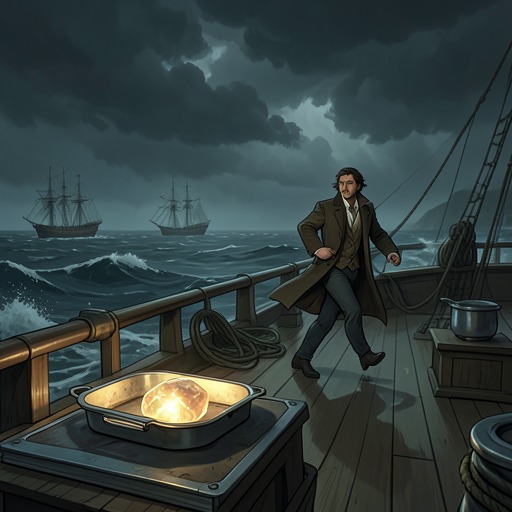
Kronos sea container drop test
Smilla's Sense of SnowThe Kronos sea container drop test is a carefully staged rehearsal for secretly placing heavy cargo in the sea. A cement-filled container is lowered from the ship, released astern, and fitted with flotation balloons; the later discovery that it contains only cement changes the apparent meaning of the operation. What seems to be a delivery is instead a test of equipment, positioning, and crew coordination before a more valuable shipment.
Background and purpose
The test takes place within a charter whose secrecy has already been built into its paperwork. Birgo Lander explains that a ship’s formal contract records its destination and cargo, while a private side contract can conceal what the voyage is really for. When Smilla says the destination is Greenland’s west coast, Lander points out that the route is traceable: a vessel bound for Greenland must meet ice-class and inspection requirements. Secrecy, in other words, depends not just on what the ship carries but on the legal and logistical trail that makes its movement legible.
The ship’s identity is also part of the investigation. Calling Lander from a phone booth, Smilla asks him to check the name Kronos. Lloyd’s Register lists five vessels with that name; she and her companion settle on the last two, the general-cargo ships registered in Piraeus and Panama. This search establishes the ship through an ordinary record system even as the voyage itself relies on confidential arrangements.
The overnight operation
The test interrupts the ship’s established nighttime rhythm. Smilla wakes to boots, slamming doors, loudspeaker announcements, and the distant sound of hydraulic winches. She goes toward the bridge and sees that the forward cargo hold has been opened and ringed with a railing. Two wires run down from the forward cranes, and a heavy blue hawser lies across the rail. The activity is organized around a specific piece of machinery and a designated opening in the deck, not an improvised disposal.
From the hold, Smilla glimpses Verlaine sitting on the lid of a large metal container roughly thirty feet below deck level. White fiberglass holders sit at its corners. The operation is conducted under direction from above: orders transmitted over the intercom tell the crew when to hoist, lower, and release. The timed countdown marks the drop as a controlled sequence, with the crew acting in coordination rather than simply throwing cargo overboard.
Once the container reaches the sea, it floats about fifteen feet from the stern, apparently riding a bow wave. A blue hawser still connects it to the ship, while crew members use a long boathook to keep it clear of the hull. Two narrow inflatable strips run along its sides. When the container is released, it drifts farther astern and begins to sink. Then five fiberglass shells are cast off, and five self-inflating gray flotation balloons spread across the water above it. The test thus includes both the controlled release and the deployment of equipment intended to keep the submerged container identifiable or recoverable.
Discovery of the dummy cargo
The meaning of the operation changes when a crewman explains that he has secretly opened the container. The ship’s cargo-area keys are kept on the bridge for use if cargo shifts, and he borrowed them while on watch. Inside, he found hundreds of 100-pound sacks of Portland cement. He searched further, even moving the sacks and probing them with a barbecue skewer, but found nothing concealed beneath them. His search turns the cement from an apparent cover story into evidence that the container was not carrying the valuable cargo he had suspected.
The crewman’s suspicion had been sharpened by the voyage’s secrecy and extra pay: the sailors had been told neither where they were going nor what they were carrying, yet the container appeared to be ordinary cement. The geography raised another doubt. The ship had come from a Hamburg shipyard and had been in Danish waters for two weeks, making a delivery far out in the Atlantic seem implausible. His inspection provides a concrete answer to one question—what was in this particular container—while leaving the larger purpose of the voyage unresolved.
Rehearsal for a larger shipment
The crewman interprets the drop as a dry run rather than a smuggling delivery. Heavy cargo must be placed at precise coordinates, kept clear of the propeller, and lowered without swinging dangerously in wind and rough water. The ship cannot simply stop and ease it overboard: a change in speed would be recorded and could draw the attention of customs authorities over VHF radio. The rehearsal therefore tests whether cargo can be dropped discreetly while the ship continues moving.
The operation also tests the system surrounding the container: flotation balloons, transmitting equipment, the boom, the winch, and the forward guy wire. Just as important, it gives the deck crew a chance to practice their movements. The cement-filled container is a dummy, but the procedure is real. Its release at a point where the ship is believed to be beyond radar range serves as a preview of the later operation the crewman expects the vessel to undertake for more valuable goods. He suspects drugs, but the passage presents that as his conclusion, not as a confirmed identification of the future cargo.
Route, infrastructure, and significance
The ship’s route reinforces the scale of the plan without resolving its destination. When asked where the vessel is headed, Captain Lukas points to a chart of South Greenland overlaid with a clear plastic sheet marked with ice concentrations, visibility, and iceberg positions. The plotted course runs north along the coast, rounds Cape Thorvaldsen, then turns north-northwest and stops at a point near Vestland in the open ocean. Lukas says that this is all he knows, underscoring that even the captain is kept on a short leash.
The test makes the ship’s infrastructure legible as a connected system: contracts and registries conceal or reveal the voyage; charts and ice reports guide the route; cranes, winches, wires, hawsers, flotation devices, and communications coordinate the drop. Elsewhere, Lukas contrasts the authority of older captains with the controlled conditions of an offshore oil complex, where access ashore is restricted and supplies are delivered through managed systems. Against that wider context, the test is more than a suspicious cargo maneuver. It shows how a carefully coordinated technical operation can move goods while limiting what the crew knows—and how close inspection of an apparently ordinary container can expose the difference between rehearsal and delivery.