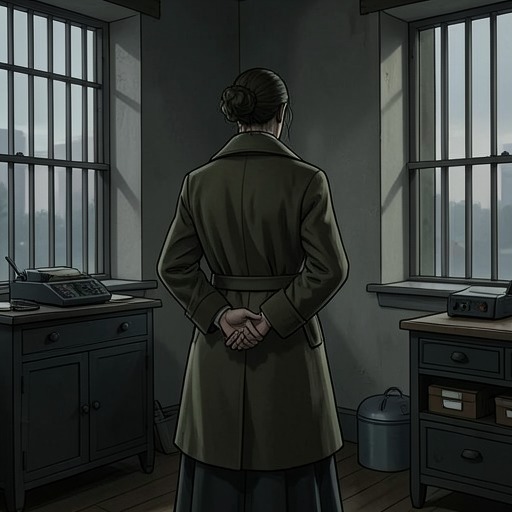
Kronos's sealed chamber
Smilla's Sense of SnowKronos’s sealed chamber is a hidden, purpose-built space whose vault-like hatch opens onto a deep steel tank equipped with an adjustable platform, drainage, and environmental controls. Its architecture makes the ship’s concealed cargo system materially visible: what first appears to be an unexplained compartment is revealed as a carefully controlled mechanism for handling a sealed container, and its technical precision contrasts with the opaque decisions governing the voyage.
Discovery and Access
Smilla encounters the chamber while Jakkelsen leads her through the ship. After climbing fifty-six steps to a landing against a bulkhead, they find a circular hatch about five feet across, fitted with two compression wheels. The hatch looks conspicuously newer than the surrounding ship, which Smilla associates with the Kista Dan, the first large diesel ship she encountered as a child in the early 1960s. The contrast makes the opening seem less like an ordinary feature of the vessel than a later insertion, designed for a particular concealed purpose.
The hatch is only loosely closed. Jakkelsen turns each wheel half a revolution and pulls it open; a heavy, three-ply black rubber flange forms the seal around the door. Beyond it, a narrow platform projects over darkness. Jakkelsen finds a large battery lantern nearby, and Smilla takes it to examine the space. The heavy seal and the unusual access point establish the chamber’s separation from the ship’s everyday interior before its function is clear.
Interior and Equipment
The lantern reveals a room whose depth initially feels greater than it is. Echoes have already suggested distant walls, while the floor lies about thirty or forty feet below the entrance; the hatch itself is roughly fifteen feet above the platform. The lower floor is made of stainless-steel grating and slopes toward a drainage outlet. The walls are polished steel, turning the chamber into a hard, enclosed volume rather than a conventional cargo hold.
Eighteen downward-pointing fittings, resembling shower heads, project from the walls: a series of them on one side and matching fittings opposite. Each wall also contains three built-in grilles, positioned at the middle, top, and bottom, each measuring twenty by twenty inches. Together, the repeated nozzles, grilles, sloped grated floor, and drain make the room look engineered for controlled conditions and the management of liquid or airflow, rather than for ordinary storage. The narrative describes their arrangement but does not identify the precise substance or process they handle.
A control panel stands beside the platform. It has four lights, a power switch, meters marked OXYGEN and nix PRESSURE, a thermostat ranging from +68°F to -76°F, and a hygrometer. The labels and wide temperature scale indicate that the chamber’s atmosphere can be monitored and adjusted. The room is not merely sealed against the outside: its interior conditions are built into the ship’s machinery and displayed for an operator to observe.
The Movable Platform and the Cargo Test
Jakkelsen explains one crucial change in the chamber’s arrangement: when the container was inside, the platform was higher; now it is lower. That detail links the room’s adjustable floor to the container-handling system rather than leaving its depth as a visual puzzle. The chamber’s height, sealed access, and instrument panel all belong to an apparatus that can accommodate a load at a different level and then lower it.
The connection becomes legible during the ship’s cargo-drop test. Smilla hears the orders to tighten and slacken the lines, followed by a countdown from five to zero. A light reveals the container floating about fifteen feet behind the stern, held away from the hull by a blue hawser running along the ship’s side. People at the railing keep it clear with a long boathook, while two narrow inflatable white strips run along its sides. The observed test gives practical context to the chamber’s movable platform and technical fittings: the ship can handle a container through a controlled sequence, although the described evidence does not establish every step by which the container moves between the chamber and the water.
Concealment and Control
The chamber’s door is only part of the arrangement. After leaving it, Smilla tries Jakkelsen’s key in a white door in the adjacent wall, but it will not open. She infers that the space beyond contains a panel like the one inside the tank, together with control buttons. The inaccessible second door suggests that operation of the chamber depends on equipment and access points beyond the view available during her inspection; her conclusion about what lies behind it remains an inference, not a confirmed inventory.
The ship’s secrecy is also embedded in its commercial arrangements. Birgo explains that a discreet charter can use a front contract that leaves the destination as “the entire world” and the freight “unspecified,” while a private side contract carries the sensitive details. When Smilla says the vessel is bound for Greenland’s west coast, he points out that this makes the charter easier to trace: a ship going there must meet ice-class requirements, undergo regular inspections, and, since the previous year, have a double hull. The chamber thus sits within a broader system in which cargo, ship design, paperwork, and access are all managed as parts of the same voyage, even as the legal contract can obscure its stated destination and freight.
Narrative Significance
The chamber converts suspicion into physical evidence. Its recent-looking hatch interrupts the older ship around it; its rubber seal, distant floor, repeated wall fittings, and labeled gauges expose a level of specialization that ordinary shipboard space would not require. The slow inspection makes the machinery legible piece by piece, but not fully transparent: Smilla can read its architecture and connect the raised and lowered platform to the container without being able to inspect every control or establish every operation.
That partial revelation mirrors the voyage itself. The Kronos’s route is kept from its captain, and its commercial paperwork can separate the official account from confidential arrangements; meanwhile, the sealed chamber gives secrecy a literal, engineered interior. It is both a practical part of the ship’s cargo system and an image of knowledge under restriction: the door can be opened, the instruments read, and the mechanism partly reconstructed, while crucial information remains behind another locked door or outside the limits of what Smilla can see.