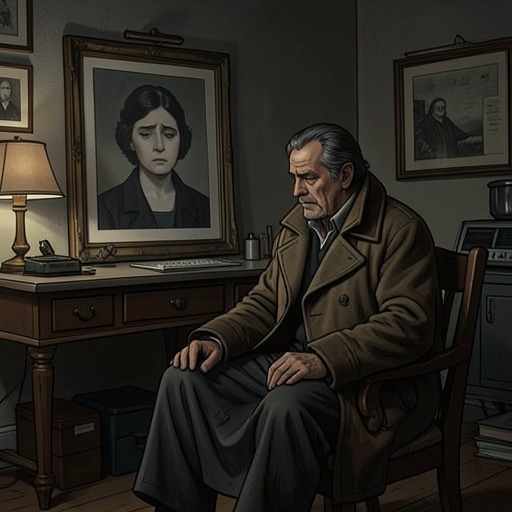
Moritz Jaspersen's grief over Ane
Smilla's Sense of SnowMoritz Jaspersen's grief over Ane is not a single response to her disappearance but a force that reorganizes his life: it draws him back toward the woman he could not keep, then makes Smilla the surviving link to what he has lost. The narrative presents his attachment through a repeated movement between departure and return, and later through the painful recognition that his daughter has become a vessel for his memory of Ane.
Before Ane Disappears
Moritz came to Greenland in his early thirties and met Ane there. Though he initially imagined North Greenland as a brief posting in a remote, windblown place, he stayed for four years. His devotion was strong enough that he tried to persuade Ane to move onto the American base, but she refused; rather than make her live there, he followed her to the barracks where she lived. His willingness to abandon the comforts associated with his former life shows the strength of his attachment, even as it leaves him living in a place he hated.
The account of their household complicates any simple picture of a shared family life. Ane had Smilla and her little brother, while Moritz remained present without being able to take much part in the family. Smilla depicts him as caught between an intense love for Ane and the hostility produced by dependence on her as his sole source of happiness. When Smilla was three, he left in a state of pent-up anger; longing then drew him back. Their departures and returns suggest a bond that neither settled into security nor broke cleanly.
A Father Defined by Absence
Moritz's presence in Smilla's early memories is fragmentary and material: Latakia tobacco, the autoclave in which he sterilized his instruments, and his golf clubs. She remembers him occasionally taking up a stance and hitting balls across the new ice, but remembers just as strongly the unsettled mood he brought into the household. Those details give his grief and attachment a domestic shape: he is remembered less through ordinary acts of parenting than through objects, habits, and the emotional climate surrounding Ane.
Ane, by contrast, is described as the parent who stayed. She set out nets and braided Smilla's hair, while Moritz moved between the extremes of merging with his beloved and putting the North Atlantic between them. Smilla admits that she cannot know what part Ane played in the deterioration of the marriage, and that her recollections may have been colored by later retelling. Her uncertainty matters: the account records the pattern she remembers without pretending to settle the private causes of their estrangement.
Disappearance and the Life of Memory
After Ane disappeared, Moritz brought Smilla to Denmark because she was the one person who could remind him of what he had lost. His grief attaches itself to memory rather than hope of reunion. Smilla understands that he looks for traits she shares with her mother, and that enduring her hostility allows him occasional relief in recognizing those resemblances. His care for her is therefore bound up with bereavement: he has brought his daughter close, but also sees her through the absence she evokes.
The account makes the loss's scale legible through a contrast in worlds. Smilla recalls Moritz in Greenland before Ane's disappearance as someone whose unpredictable moods could coexist with gaiety and warmth. Afterward, she imagines that Ane vanished with the colors of his world, leaving him imprisoned in black and white. This is Smilla's retrospective interpretation, not a claim that she can fully know his inner life; it expresses how the disappearance seems to have changed the father she remembers.
Confrontation and Recognition
Years later, a confrontation in a parking lot brings their old tension into the open. Moritz raises his hand as if to strike Smilla, but she moves away, and they circle one another. He then stops, tells her she is like her mother, and begins to cry. His words connect Smilla's resemblance to Ane with the grief he has carried, while his tears interrupt the familiar pattern of anger and distance.
Smilla recognizes in that moment both what she has lost and what she had not fully remembered. She recalls that before Ane's disappearance Moritz's volatile moods had sometimes contained a warmth and joy in life; she now sees him as having been left in a world stripped of those colors. The two return to the emergency room, where Moritz's wound is bandaged. The practical aftermath does not resolve their history, but the encounter gives Smilla a glimpse of the bereaved person beneath the anger.
Grief, Place, and Freedom
Moritz's grief is inseparable from the family rupture that precedes and follows Ane's disappearance. His earlier departures from Greenland arose within a relationship marked by intense attachment and resentment; his later move to Denmark keeps him near Smilla, but also makes her a reminder of the missing woman. The result is a painful asymmetry: she is both his daughter and, in his gaze, a connection to someone who is gone.
Smilla's account also sets Moritz's attachment against her own need for spatial freedom. She remembers that, for Ane, being cooped up was intolerable, and describes herself as similarly protective of freedom of movement. In her understanding, Greenland's locked room represents a form of confinement unlike the European idea of punishment by imprisonment. That contrast helps frame the distance between Moritz's impulse to hold on through memory and Smilla's determination to preserve her independence.
The narrative does not offer Moritz's grief as a simple explanation that excuses his volatility or repairs the damage between father and daughter. Instead, the parking-lot encounter revises Smilla's view of him: his anger remains part of their history, but it no longer exhausts what she can see. Her recognition of the warmth he once possessed, and of the loss that seems to have taken it from him, allows the relationship to be understood as a bond shaped by bereavement, distance, and an imperfect return to mutual recognition.