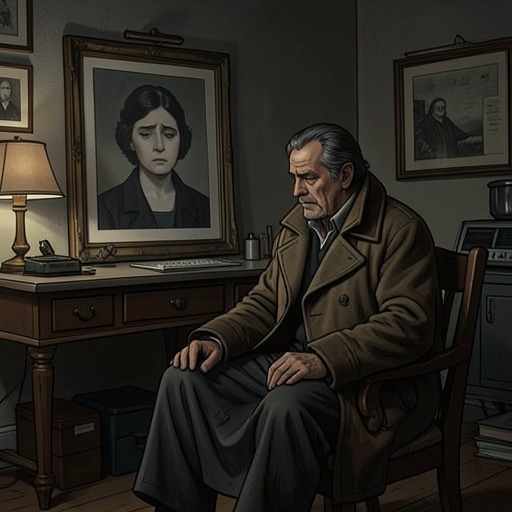
Moritz Jaspersen, Smilla's father
Smilla's Sense of SnowMoritz Jaspersen, Smilla’s father, is a prominent anesthesiologist whose precision and international reputation stand in stark contrast to his daughter’s refusal of intimacy with him. Their relationship is marked by an imbalance: he tries to draw her into his world, while she sees through the effort and comes to him for information about Johannes Loyen, not for reconciliation.
Identity and Background
Moritz is a physician who made his career in anesthesiology. Smilla describes a man who has kept his private life guarded, but whose public record is readily available: he became chief of staff at thirty, held Denmark’s first chair in anesthesiology when it was established, and left the hospital system five years later to enter private practice. His wealth came from giving injections, and his reputation brought him into the company of the famous and the powerful.
His work took him far beyond Denmark. He was responsible for anesthesia during the first pioneering heart transplants in South Africa and traveled to the Soviet Union with an American medical delegation when Brezhnev was dying. Smilla has heard the claim that her father delayed Brezhnev’s death in his final weeks, wielding his long syringes. The anecdote captures the scale of Moritz’s professional authority, though it reaches her as something she has heard rather than as a private confidence from him.
Moritz’s public distinction coexists with a deliberately rough appearance. He resembles a longshoreman and sometimes encourages that impression by letting his beard grow. Now gray, it was once blue-black; even so, he shaves twice a day with a straight razor to look presentable. The image is one of controlled contrast: a cultivated professional appearance achieved through the performance of ruggedness.
Meeting Ane and Raising Smilla
Moritz was in his early thirties when he went to Greenland and met Smilla’s mother, Ane Qaavigaaq. Smilla’s official biography identifies her parents as Ane, a hunter, and Dr. Jorgen Moritz Jaspersen, a physician. The brief account places Moritz’s family life across the divide between his Danish medical career and Smilla’s Greenlandic birth and childhood; the supplied episodes do not detail how the relationship with Ane developed or how the family came apart.
The Visit and the Plea for Affection
When Smilla visits him, Moritz displays his comfortable success in the setting of his home. The white house has a shale roof, cement seashells, rosebeds on a steep slope down to Strand Drive, and a backyard large enough for a nine-hole practice course. He has recently acquired golf balls designed not to travel as far, after having trouble with the neighbors. His house and the small domestic spectacle of the golf practice make visible the prosperous world he has built.
Moritz’s gestures toward Smilla are more vulnerable than his status suggests. She understands that the show is for her benefit and reads beneath it as a little boy’s plea for love. Her response is absolute: she has no intention of giving him that love. The judgment is presented from Smilla’s perspective, not as an explanation of Moritz’s inner life; the scene’s force lies in the gap between his attempt to reach her and her refusal to meet it.
During another visit, Moritz talks about his new paintings, the memoirs he is writing, and the piano he is practicing. Smilla recognizes the conversation as a delay: he is preparing for the blow of her actual purpose, which has nothing to do with him. She lets him talk, and he is grateful for the time, but neither mistakes this courtesy for closeness. She then asks him about Johannes Loyen, redirecting the encounter from family feeling to the investigation that brought her there.
Narrative Role and Significance
Moritz is chiefly presented through Smilla’s sharp, unsentimental attention. His professional biography and the details of his house establish a figure of considerable privilege and accomplishment, while her account of his performance exposes the emotional need underneath that composure. The contrast also sharpens Smilla’s own distance from the class and social world he inhabits: she remarks that Denmark’s population appears overwhelmingly middle-class to her, while many of the poor she has known are Greenlanders.
The visits do not resolve the estrangement. Moritz’s efforts to hold Smilla’s attention and her decision to use the meeting to ask about Loyen coexist without becoming reconciliation. He matters to the narrative both as her father and as a source of access to the medical world surrounding Loyen, but the scenes preserve the difference between practical contact and affection.