Northern Light
Smilla's Sense of SnowThe Northern Light is a restored three-masted sailing ship whose gleaming finish and staged Inuit display first present it as an object of maritime and cultural exhibition. At Svajer Wharf, that polished façade gives way to a scene of murder, confinement, arson, and escape: the ship becomes a locked space that carries Smilla from the harbor into a fire and then forces her into the freezing water. Its final image, a black skeleton burning at the harbor entrance, turns the vessel’s beauty into evidence of the danger hidden inside it.
Appearance and Exhibition
At Svajer Wharf, the Northern Light stands apart from the industrial desolation around it. The road opens onto a basin ringed by low yellow warehouses, its water frozen beneath a low winter sky; beyond small fishing boats with blue hulls, the tall ship occupies the outer edge of the harbor. Its gilded name is set on the stern. A carved figurehead holds a torch above a shiny black hull more than a hundred feet long, while the masts rise with the imposing effect of a church. Tar and sawdust mingle in the ship’s smell, and the recent renovation has plainly cost a fortune.
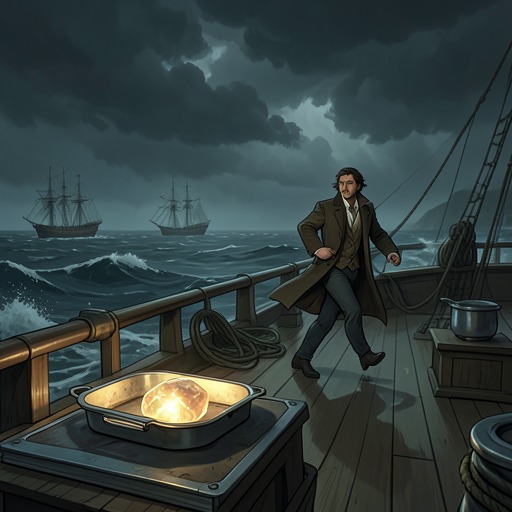
The first approach emphasizes careful order rather than activity. Smilla boards over a gangway with a thick coir mat and polished bronze knobs. Large crates marked FRAGILE, stacked planks, and paint cans fill the deck, but every rope is coiled neatly, the wood shines beneath layers of lacquer, and the white enamel is polished to a glasslike gleam. The air carries the shimmer of polish, two-component epoxy, and joint paste. No crew appears; the ship seems deserted, its labor visible only in the immaculate surfaces and renovation materials.
Below the deck, a narrow ladder passes between crates to an unlocked lacquered double door and a companionway descending into darkness. The lower hall has been opened up by the removal of its dividing walls, creating a broad space roughly eighty feet long and as wide as the vessel. There, a fiberglass Inuit figure stands with a harpoon, dart thrower, high kamiks, and an inner coat of bird skin. Its alert face is carefully painted, and its lifelike appearance makes it an exhibit that initially blurs the boundary between person and mannequin.
The scene’s display continues behind a screen made from hide stretched between two whalebones. A partially wrapped kayak and a glass counter resembling an empty 800-gallon aquarium lie in the way. Behind the screen, at a desk, sits the curator, Andreas Licht, whose appearance resembles the mannequin’s, though he is thirty years older. The ship thus stages an image of Greenlandic life through objects, costume, and a human curator, presenting cultural representation as part of its carefully designed interior.
The Ship’s Hidden Interior
When Smilla returns, the same wharf has changed in precise, unsettling details. Snow covers the surface; the sign remains wrapped in plastic, with the small tear she left in it, while the dock, gangway, and part of the deck have been cleared. Some crates have been shifted to make room for a pallet of red barrels. The ship is dark, and the tracks of a car lead toward the harbor without a visible return track. These small alterations make the Northern Light seem less abandoned than actively prepared.
A faint light leads Smilla back to the desk. Andreas sits beneath a reading lamp, smiling broadly, but his posture is not voluntary: his hands are bound to the chair with thin copper wire. He is warm, yet Smilla can find no pulse or heartbeat. Cotton plugs both his ears. The discovery changes the ship from an uncanny exhibition space into a crime scene, while the quiet restraint of the body makes the violence more disturbing than any visible struggle.
The trap closes without warning. The hatch above the stairs shuts calmly and is locked from outside; then the light goes out. Smilla understands that the room’s dimness had suited a blind person, but the realization comes only after she is enclosed with the dead curator. The ship’s carefully arranged darkness, once part of its atmosphere, becomes an instrument of confinement. Its elegant doors and companionways now serve the same purpose as a locked cell.
Arson and Escape
As the Northern Light slowly swings away from the dock, the engine’s thudding grows into a roar when Smilla looks through a porthole. From shore, a firecracker arcs toward the ship and explodes above her. The flash blinds her; at the same instant, a fire draws the oxygen from the air. Smilla understands that gasoline has been poured over the vessel. Outside, the barrels ignite, explosions sound across the deck, and the burning ship fills with the acrid heat of epoxy paint.
The fire changes the room’s darkness into an almost overwhelming brightness when the coverings over the skylights burn away. The ship, once presented through controlled polish and display lighting, is now illuminated by an uncontrolled blaze. Andreas’s office chair rolls with the ship’s movement; the dead curator crashes against a bulkhead, passes through what had been his bedroom, and plunges into the water. Smilla strips off her clothes and discovers that the fire has burned away the top of her hat and singed the crown of her head. With the dock about two hundred yards away and the fire blocking the other side, she jumps into the harbor.
The escape is a physical contest with cold as much as with fire. The water is below 42°F, and Smilla calculates that survival lasts only minutes, depending on condition. She swims almost vertically, keeping only her lips above the surface, and feels her body begin to shake as its temperature falls. When the shaking stops, apathy and fatal hypothermia are close. The thought of that danger carries her through the final distance: on her eighth additional stroke she strikes her head against a tractor tire hung as a berth bumper and manages to pull herself onto a platform.
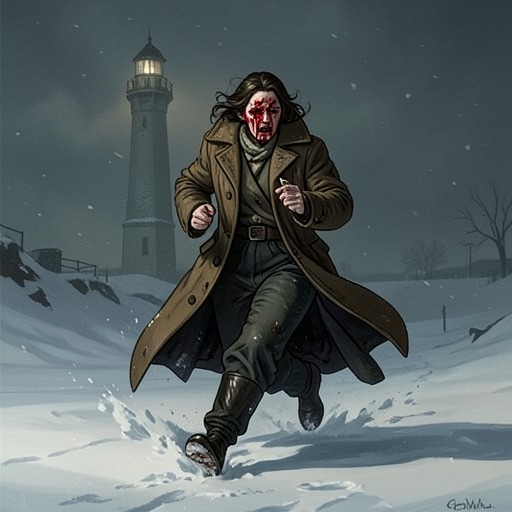
On shore, the air feels unexpectedly mild because of the blaze. The Northern Light burns at the harbor entrance, a coal-black wooden skeleton inside a white ball of fire. The dock is empty. Smilla, naked, burned, and near collapse, lies in the fire’s warmth before crawling up the stairs and walking away through fragmented hallucinations. The ship’s destruction has bought her escape, but only by forcing her through the danger the vessel itself has become.
Meaning and Contrast
The Northern Light’s most consequential contrast is between immaculate surface and concealed violence. Its coiled ropes, expensive lacquer, glass-bright enamel, and carefully arranged Inuit display suggest control; the copper wire around Andreas’s hands, the locked hatch, and gasoline across the ship expose what that control masks. The vessel is simultaneously exhibition, murder scene, prison, and weapon. As its fittings and carefully maintained surfaces burn, the material object ceases to function as a refined setting and becomes an immediate threat to life.
The Inuit figure and the curator’s resemblance to it also connect the ship’s display to Smilla’s resistance to treating culture as a detached exhibit. Elsewhere, she reflects that another culture can be understood only by living within it, learning its language, and accepting that genuine understanding may remain wordless; explanation can create distance. The Northern Light offers the opposite arrangement: a kayak, animal-skin screen, harpoon, and mannequin are assembled for viewing inside a renovated European vessel. Its apparent authenticity is therefore inseparable from the act of staging and display.
That tension does not make the ship merely a symbol. Its physical details govern the action: the open lower hall permits the exhibit, the companionway and hatch enable confinement, the porthole reveals the ship’s movement, the fuel-fed fire destroys its interior, and the berth’s tractor tire gives Smilla a point from which to climb out of the water. The Northern Light’s transformation—from polished cultural spectacle to sealed trap to burning wreck—turns those details into a sequence of reversals, in which the space that first invites inspection finally demands escape.