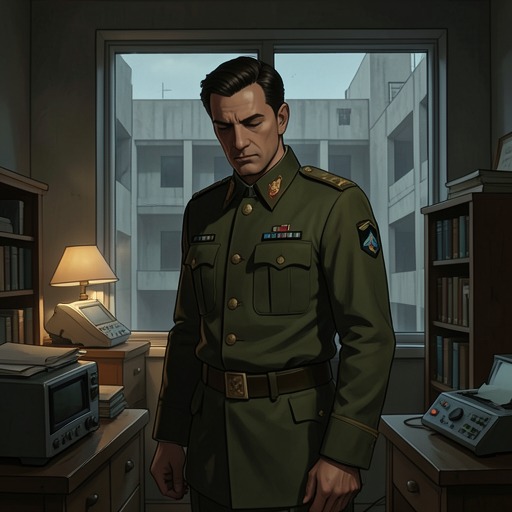
Operation Niflheim
Smilla's Sense of SnowOperation Niflheim was a postwar Allied intelligence operation to decipher a clandestine correspondence network whose letters concerned finding a ship and sailing it to Greenland. Reconstructed by Benedicte Clahn decades later, it resolves the mechanics of the code while leaving the expedition’s purpose unknown: the route can be read, but the reason for the voyage remains sealed within the past.
The decoding group in postwar Germany
In 1946, Clahn was working in Blankenese, on the Elbe River, in a mansion taken over by the British. Forty people worked in the house, mostly British and Americans, divided among groups whose tasks were kept separate. Clahn’s small group initially comprised herself, an English mathematician, and a Belgian teacher of choreographic notation systems. They worked on coded letters and telephone conversations, mainly letters. Unlike at an earlier posting in Rahlstedt, where the workers had shared information informally, the Blankenese operation was deliberately compartmentalized.
At first, the assignments appeared unimportant. The group often broke two letters a day, usually love letters. In August, the correspondence changed character: many letters came from the same people, and a German censor named Holtzer joined the group. He had worked for von Gehlen and possessed particular knowledge of the case, though Clahn says she never understood why the British and Americans had taken over parts of the German intelligence apparatus. Holtzer’s presence, and the other workers’ repeated questions about specific phrases, gradually revealed that the letters belonged to a coordinated case rather than an assortment of routine messages.
Niflheim and the code
One word recurred in the material: Niflheim. Clahn looked it up and found that it meant the world of mists, the outermost region of Hell and the realm of the dead. By late August, investigators had narrowed their attention to letters exchanged by the same four people. The team never saw the envelopes and knew names but not addresses. Eight letters were in hand at first, with roughly two more arriving each week.
The code was at once crude and difficult. It seemed hastily learned, yet did not rest on ordinary language; instead, it used a series of agreed metaphors. On the surface, the correspondence concerned the transport and sale of goods. Johannes Loyen joined the group as a forensic-medicine consultant, having come to Germany to take part in the closure of concentration camps. The letters did not require a medical adviser, but Loyen knew German well and worked on an equal footing with the others. Clahn suspected that he might have been to Greenland, though he never told the group.
The breakthrough came at the end of September. A letter gave a supposed forecast of bean prices for the current week: the figures rose slightly each day and reached a peak on Friday. Clahn consulted an almanac her mother had sent her and noticed that Friday was a full-moon night. Having sailed the English Channel in her father’s Colin Archer boat, she thought the numbers resembled tide tables. The group checked the British fleet’s large almanacs and identified the figures as the ebb and flow of the Elbe. Once that key was found, the team spent three weeks working backward through the letters.
What the letters disclosed—and withheld
The decoded correspondence was about finding a ship and sailing it to Greenland. The operational details included negotiations to obtain a vessel during a state of emergency, the possibility of sailing to Kiel and then north through Danish waters, which passages had been swept for mines, and the British blockade of the Elbe and the Kiel Canal. These particulars make the letters a practical record of passage through a restricted and dangerous postwar maritime landscape, not merely a coded statement of destination.
But the correspondence did not disclose why the voyage was being organized. When asked what the operation was for, Clahn could offer no answer; she did not think the others knew either. The writers themselves understood the purpose, which was precisely why they never named it. The decoded text therefore supplies a concrete itinerary and a continuing absence at its center: the ship and route can be inferred, while the intended object of the expedition stays unspoken.
The later return to the letters
In 1966, Loyen worked for a company organizing a Greenland trip and asked Clahn to meet with him to reconstruct information from the 1946 letters. Their effort focused mainly on route descriptions and included a great deal about anchoring conditions, but they were unsuccessful despite spending substantial time on it. Clahn remembered that she may even have received a fee. The later attempt shows that the decoded correspondence retained practical value, but that its recovered details were not enough to restore a usable route with certainty.
Clahn is asked whether the letters were revisited again in 1990 or 1991, but the conversation does not establish that they were. Her recollection instead leaves Operation Niflheim suspended between a solved cipher and an unsolved history. The episode’s retrospective form preserves both kinds of knowledge: the reader learns how the code yielded to tides and almanacs, yet shares Clahn’s limits about the mission’s purpose. Its central mystery is not a failure to decode the words but the silence the decoded words still contain.