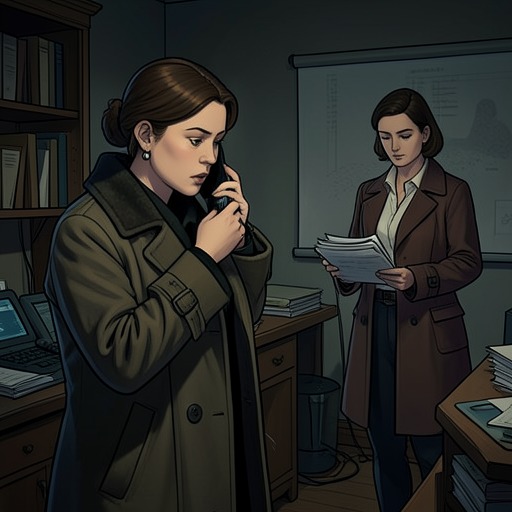
Ravn, the investigator
Smilla's Sense of SnowRavn, the investigator, is a district-attorney investigator who first approaches Smilla in connection with her complaint about Isaiah’s death, then reveals himself as a figure able to surveil and threaten her. His watchful reserve, his claim to exceptional access, and his eventual promise of imprisonment turn a possible investigative contact into a confrontation with institutional power.
Identity and first encounter
Ravn visits Smilla while the workers are at lunch, leaving the roof deserted. It is a bright day, and across the Sound lies the shipyard at Limhamn in Sweden; there is no snow, although tracks in snow are the evidence that matters to Smilla. The scene places his formal authority against her close attention to the physical clue he has come to discuss.
His appearance makes him memorable without making him easy to read. He is short, no taller than Smilla, but a heavily padded gray coat broadens his shoulders until he resembles a child dressed for a musical about Prohibition. His face is gaunt and dark, compared to lava and a mummy, while his sand-colored eyes remain alert. He says that he has merely stopped by. Smilla answers with a pointed question about whether he usually calls on people concerning complaints; Ravn says such cases normally go to the local board, and attributes his visit to the nature of this case and her thought-provoking letter.
Ravn is not unsettled by Smilla’s silence. She lets it work on him, but his eyes remain fixed on her without embarrassment or visible flinching, and he appears willing to stand there as long as necessary. The exchange establishes a defining contrast: his unusual patience is not warmth or reassurance, and Smilla cannot easily tell what his attention means.
The investigation and the missing name
Ravn tells Smilla that he has spoken with Professor Loyen, who reported that she had visited him and believed the boy was afraid of heights. By bringing Loyen’s account into their conversation, Ravn shows that he is already gathering information about her inquiries. Smilla does not trust him, in part because of his position in the world, but she is willing to disclose one part of what troubles her: the tracks in the snow.
That exchange gives Ravn a practical place in the investigation while leaving his motives uncertain. He knows about Smilla’s visit to Loyen and the specific possibility she raised about Isaiah’s fear of heights; she, in turn, offers him a concrete clue but not her confidence. Their contact is therefore neither simple cooperation nor an outright refusal to communicate. It is a guarded negotiation, with each party measuring how much the other knows and how much to reveal.
A later attempt by Smilla to reach Ravn at the Copenhagen district attorney’s office fails in a more disorienting way. She looks up the office on Jens Kofods Street, intending to tell him that she has not been duped or given up and that she is keeping an eye on him. Instead of being put through to Ravn, she hears a cold woman say that no one by that name works there. Smilla is prepared for an answer, but not for this one; she sits down and breathes gently into the receiver to gain time. The denial does not explain Ravn’s status. It makes his identity and access harder for her to verify, and leaves her with the unsettling possibility that ordinary institutional channels will not provide a straightforward account of him.
Access, surveillance, and threat
In a later meeting, Ravn appears in a dark office with Venetian blinds, from which the lights, docks, water, and Iceland Wharf are visible. The room is otherwise nearly bare. When he switches on the light, Smilla sees a man already waiting in the corner: sinewy, closely cropped black hair, distant blue eyes, a harsh mouth, and meticulous clothes. Ravn sits behind the desk and introduces Smilla to him as Captain Telling. The scene gives Ravn control of the setting and of the meeting’s introductions, while the waiting man’s presence signals that the encounter involves more than a private conversation between investigator and complainant.
Ravn’s position has changed by the time Smilla recalls the promise he made when he was still working for the district attorney of Copenhagen. Addressing her gently as Miss Smilla, he tells her that she can be thrown in jail at any time, placed in solitary confinement, or put in an isolation tank whenever his side chooses. He adds that no judge would hesitate after seeing her dossier. The softness of his delivery sharpens rather than softens the threat: imprisonment is presented not as a remote possibility but as an available means of stopping her.
The threat is supported by a demonstration of reach. Ravn wants Smilla to understand that he can obtain information she sent to Greenland’s government and the military, follow her movements, and access any archives. He has also summoned an intelligence officer at six o’clock in the evening at Christmastime. These are not merely claims about abstract authority: together, they show the breadth of the surveillance and institutional access he says he commands. Ravn’s aim in the meeting is to establish that he can act on Smilla and that she has no reliable boundary between her investigations and the machinery watching her.
Conflict and narrative significance
Smilla recognizes that the meeting is about authenticity: Ravn is making his power tangible so that she will not doubt his ability to confine her. The demonstration succeeds. She understands that he can have his way, and that knowledge changes the terms of her resistance. What began with an investigator asking about a complaint and a clue has become an explicit effort to control the complainant herself.
Ravn remains difficult to place in a simple opposition between helpful investigator and open adversary. He does discuss the case, knows what Smilla told Loyen, and listens when she mentions the tracks. But he also participates in an encounter designed to make surveillance and confinement credible. That contradiction is central to his role: the same investigative world that might pursue answers about Isaiah can also be used to discipline the person seeking them. His calm appearance, patience, and gentle address coexist with the capacity for coercion, leaving Smilla to confront not only what happened to the boy but the power of those who can decide whether she is permitted to keep asking.