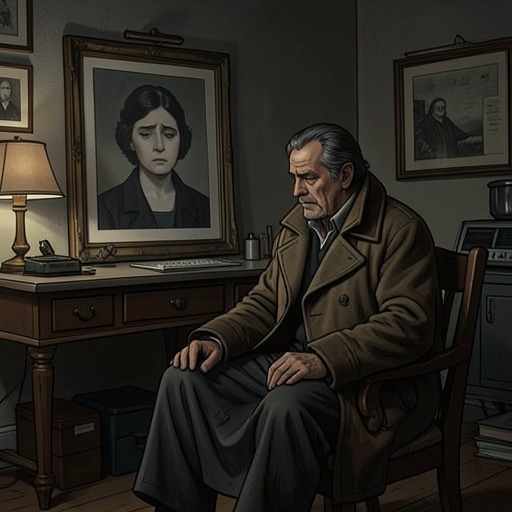
Smilla Jaspersen—Moritz
Smilla's Sense of SnowSmilla Jaspersen—Moritz is a relationship of distance and enduring concern: Smilla’s father is at once a source of unresolved hurt and one of the few people who can still offer her shelter. Their estrangement is repeatedly tested by departure, but when Smilla faces arrest, Moritz chooses to help her escape. His action does not erase their history; it reveals how love, regret, and the wish for freedom persist alongside it.
Family History and Distance
Moritz came to Greenland in his early thirties and met Smilla’s mother there. Smilla’s reflections on Inuit stories and practices give this family history a cultural frame distinct from the Danish institutions that later surround her investigation. She describes a tradition in which identity and social roles can contain opposites, while also noting the limits placed on people who cross those roles. Her mother, in Smilla’s account, combined work conventionally associated with women and men. These reflections help establish the contrasting worlds through which Smilla understands herself and her father, without making their relationship reducible to a simple cultural divide.
Moritz’s standing has changed over time. Smilla recalls that he was once a professor, and reports his view that many professors are clever without being too clever. When asked which fate befell her father, she answers that he seems split in half. The image conveys her difficulty in placing him on either side of a neat divide between achievement and failure: he is neither simply a success nor simply a ruin, but a person whose capacities and unresolved conflicts remain entangled.
Their distance is also bound up with Smilla’s need for movement and independence. Recalling childhood, she associates Greenlandic life with being outdoors and says that remaining in one place for long was unthinkable to her mother. Smilla recognizes the same fierce need for spatial freedom in herself, describing it as something she protects almost as if it were alive. Later, she understands her repeated attempts to leave the house and the country as part of a recurring pattern in which life brings her back to problems she has not resolved. Moritz is central to that pattern: he has been the person through whom she has been called back, even as she has tried to escape.
Care Across Estrangement
The relationship does not take the form of easy intimacy. When Smilla visits, Moritz talks about his new paintings, the memoirs he is writing, and his piano practice, while both understand that she has come for a reason unrelated to him. His conversation functions as a delay before she asks about Johannes Loyen. The scene shows a familiar gap between the ordinary exchange Moritz sustains and the serious matter Smilla must bring to him.
Yet the distance does not prevent practical care. After Smilla’s investigation becomes dangerous, Moritz examines X-rays brought by Dr. Lagermann and notes that the report from the 1966 expedition is missing. Smilla tells him that the police are looking for her and that she will not turn herself in. Although he detests illegalities, he agrees that it is better for her to be in his house than not to be there. He also lets her use the light box in his clinic, a private space he ordinarily guards closely. Smilla refuses to explain the full situation, and he accepts that limit. Her account frames his cooperation as an effort to repay a debt to her that is thirty years old and, in her words, fathomless.
Moritz’s help is not confined to shelter. After Smilla leaves, he sends her a letter with newspaper clippings and a typed list of Loyen’s scientific publications, gathered through archival research. The materials range from earlier work on injuries and toxicology to later research on Arctic medicine, parasites, and X-rays. The letter’s formal stationery and Moritz’s carefully cultivated handwriting carry the marks of his self-presentation, but its contents are concrete assistance: he is using his knowledge and resources to support the investigation she has undertaken without him.
The Father in Three Parts
When Moritz enters the clinic while Dr. Lagermann is preparing to review the images, Smilla sees him as three people at once. He is her father, who still loves her mother and perhaps Smilla; the prominent doctor, accustomed to being informed and indispensable; and a little boy excluded from a room where something is happening that he urgently wants to join. The three aspects coexist. His professional authority cannot contain his anxiety as a parent, while his wish to participate exposes a vulnerability beneath the reputation he has cultivated.
That divided portrait echoes Smilla’s earlier judgment that her father is split in half. His identity is not presented as a settled choice between public achievement and private failure. The same man who guarded his clinic as an inner sanctum opens it to Smilla’s investigation; the man who dislikes illegality bends his rule because she needs him. His actions make the contradiction visible rather than resolving it.
The Decision to Let Her Go
At the house, Moritz’s concern becomes explicit. He says that he wanted peace and his family around him, but that things got out of control and he never achieved the life he wanted. Seeing the box delivered that afternoon made him realize that Smilla was leaving again, as she had on previous occasions. He admits that he is too old to bring her home and wonders whether it was wrong to try in the past. Then he tells her that he does not want to let her go.
The statement does not turn their relationship into a reconciliation. Smilla recognizes that age has diminished Moritz’s ability to confront the conflicts that have followed him since she first knew him as her father. She also sees the repeated structure of their encounters: escape, return, and the unresolved problems that draw them together again. In this moment, she is tired enough to prepare to give up, while Moritz faces the prospect of her departure and the police waiting outside.
Instead, Moritz acts. He tells Benja to stay, asks Smilla what he can do, and follows her plan: drive his car to the back door, conceal the box from the people outside, and let Smilla lie on the floor in the rear. He leaves in rubber boots and an oilskin coat, carrying the box out cautiously. The plan converts his reluctance to lose his daughter into practical assistance, without requiring either of them to settle the past first.
A Bond Without Resolution
Smilla’s account holds attachment and estrangement together. She does not portray Moritz as a dependable source of uncomplicated safety: their history includes repeated attempts to bring her back and a debt she describes as immeasurable. But neither is he merely an obstacle to her freedom. When she is in danger, he lends her his home, his clinic, his research, and finally his car.
The relationship’s decisive change is therefore not a declaration that old conflicts have ended. It is Moritz’s choice, at the moment when Smilla expects another repetition of their past, to help her leave. His concern remains possessive and regretful, while her need for freedom remains intact. The act of assistance gives their bond a new consequence without pretending to settle it: he does not bring her home, but he helps her get away.