Smilla Jaspersen—Moritz Jaspersen
Smilla's Sense of SnowSmilla Jaspersen—Moritz Jaspersen is a strained father–daughter relationship organized around absence: Moritz’s inability to settle into a life with Ane, Ane’s disappearance, and his effort to hold on to her through Smilla. Smilla sees his gestures of care as inseparable from his need for a connection to the past. A later encounter, however, complicates her judgment: she recognizes that his harshness and volatility coexist with real grief, and that her place in his life has been shaped by the woman they both lost.
A Family Formed Around Ane
Moritz first came to Greenland for a required month, expecting North Greenland to be a remote posting rather than a home. He remained for four years after meeting Ane. When he tried to persuade her to move onto the base, she refused; he followed her instead to a barracks built for Inuit residents displaced by the American base. His willingness to leave behind his golf clubs for her did not resolve the fundamental mismatch between them: he was an outsider in a place he disliked, held there by a love he did not understand and could not control.
Smilla remembers the family as centered on Ane rather than constituted equally by both parents. In her account, Ane had her children, while Moritz remained present but unable to take a full part in their lives. He could seem dangerous and imprisoned by his own attachment. When Smilla was three, he left in a state of pent-up anger; longing brought him back. She describes the bond as an invisible force that repeatedly pulled him toward Ane even as his temperament drove him away.
His presence during Smilla’s early childhood survives in disconnected impressions rather than sustained intimacy: the Latakia tobacco he smoked, the instruments he sterilized, and the occasional sight of him practicing golf. She also remembers the moods he brought into the household, which she understood as bound up with his feelings for Ane. By contrast, Ane stayed, set her nets, and braided Smilla’s hair. Smilla acknowledges that her childhood memories may be colored by later understanding, and that she cannot know what part Ane played in the marriage’s collapse. What she can identify is the pattern of Moritz’s repeated departures and returns, and Ane’s steadier presence with the children.
The Distance Between Father and Daughter
As an adult, Smilla can recognize the emotional meaning behind Moritz’s displays without accepting them as intimacy. At his house, his possessions and signs of success—including his golf life and the comfortable setting—appear to her as proof that he wants to show he has everything. She sees through that presentation to a childlike appeal for love, which she has no intention of satisfying. Their outward appearance as a wealthy, vigorous father and daughter conceals, in her view, a tragedy extending across two generations.
Their visits also show how quickly tenderness and pressure can become entangled. Moritz reproaches Smilla for leaving him alone and accuses her of being incapable of holding on to a man. When she asks him for a prescription, he immediately turns from wounded complaint to medical concern. She asks for a five-figure sum, and he gives her a check; he understands that the financial connection may be his only remaining channel into her life, and fears losing it. The exchange offers material help, but it does not erase the distance between them. Smilla leaves, and Moritz calls after her to ask whether she is going away for good.
His dependence on her is also apparent in the reason Smilla later understands he brought her to Denmark. After Ane vanished, Moritz could look at his daughter and find traits that recalled the woman he had lost. Smilla interprets herself as a remnant of his past: not a substitute capable of restoring Ane, but a person onto whom his attachment to memory has fixed. His persistence through her rejection and hostility becomes, in this light, a way of seeking brief relief in the resemblance he perceives.
Confrontation and Recognition
The relationship’s most revealing change occurs after Smilla runs away from the hospital where she has been treated for a broken wrist. Moritz arrives to collect her. When he releases her arm to get his car keys, she bolts; he catches up. In the ensuing confrontation, he raises a hand as if to strike her, but the two circle one another rather than proceeding to a blow. The scene exposes the physical threat that has haunted their relationship, while also interrupting its familiar pattern of pursuit and escape.
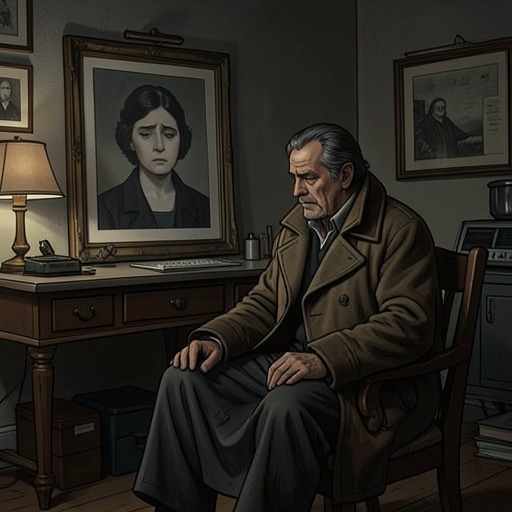
Moritz tells Smilla that she is like her mother, then begins to cry. His words shift the encounter from anger toward grief. Smilla understands that Ane’s disappearance took part of Moritz’s world with her: she remembers a gaiety and warmth he had shown in Greenland before Ane vanished, and sees him as having been left in a starkly diminished emotional world. This does not make their history harmless or undo his volatility. It gives Smilla a way to understand the sorrow beneath it without denying the harm and estrangement that have marked their bond.
She also sees more clearly why he had brought her to Denmark and endured her refusals. His attachment to her had become bound to his memory of Ane, making Smilla both his daughter and a living reminder of the absent woman. Once they have confronted one another, Smilla drops the scalpel she has been holding in the bushes; they return to the emergency room, and Moritz’s wound is bandaged. The encounter ends not in a declaration of reconciliation but in a practical act of care and a shared return indoors.
Freedom, Memory, and Inheritance
The family history is inseparable from the difference between Moritz’s relationship to Greenland and Ane’s. Smilla recalls that Ane could not tolerate being confined to the base, while Moritz followed her out to the settlement. Later, Smilla describes the locked room as a specifically European form of hell and connects her own insistence on spatial freedom to a childhood in which her mother resisted staying indoors or in one place for long. These memories make the father–daughter distance more than a private disagreement: Moritz belongs to a life of mobility between Greenland and Denmark, while Smilla’s understanding of freedom is rooted in Ane’s refusal to be cooped up.
Smilla’s account also carries an unresolved tension. She knows that explaining her connection to Inuit life risks distancing her from something she does not feel is fully hers. In a later moment of happiness with Moritz, she feels the impulse to explain that connection and the values she associates with it, but recognizes that sharing the present does not mean he can contain her childhood. The qualification matters: even after she has glimpsed his grief and remembered his earlier warmth, their past is not made mutually accessible. The relationship remains marked by loss, but Smilla’s view of her father has widened from seeing only his demands to recognizing the bereavement and dependence beneath them.