Smilla's confinement aboard the Kronos
Smilla's Sense of SnowSmilla’s confinement aboard the Kronos is a struggle over who controls her movement: the crew treats her as a prisoner, while she keeps searching for a way out. Her response draws on a lifelong attachment to spatial freedom shaped by her Greenlandic childhood, and the ship’s locked rooms make that freedom an immediate, physical stake.
Arrest and the ship’s locked rooms
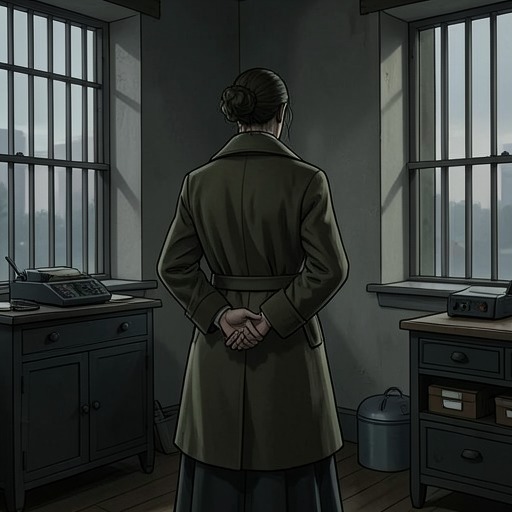
After being told she needs sleep and medical treatment, Smilla refuses to remain on an examination table. She removes the sheets and chair cushions and lies directly in front of the infirmary door, forcing anyone who tries to enter to move her first. No one does. She sleeps for several hours, while the Kronos’s hull scrapes against something outside and footsteps cross the deck; she suspects the ship has reached the edge of the ice near Gela Alta.
When she wakes, she tries to assess whom she might recruit, but abandons the effort. In her judgment, the crew divides into those already against her and those who will turn against her when the decisive moment comes. She excludes the mechanic from that calculation, while trying not to think about him. The crew’s opposition makes confinement more than a single locked door: it leaves her without a dependable ally aboard.
The limits of what she can observe sharpen that isolation. Someone leaves breakfast inside the infirmary after she asks that the light not be switched on; she recognizes Maurice, who cannot see the broken cupboard door in the darkness. Later, she hears the auxiliary engine and generators start, followed by unloading from the quarterdeck, but the infirmary windows face aft and she cannot see what is being unloaded.
Arrest and resistance
When Smilla asks how long the ship will remain there, Urs tells her she is under arrest. She answers that she has permission to walk around, but he does not believe her and hopes she will leave. The exchange establishes the immediate conflict: the crew asserts authority over her, while she continues to present her movement as something she is entitled to claim.
The ship’s practices also create an opening. At sea, doors are locked on leaving a room rather than on entering, so that they can be reached more easily during a fire or rescue. Lukas sleeps with his cabin door unlocked. Smilla closes it behind her and sits at the foot of his bunk. When he wakes in shock and tries to grab her, she shows him the revolver, raises it toward his face, and takes off the safety. Her exit from confinement depends not on winning the crew’s agreement, but on using a safety convention and the captain’s unlocked door to reach him on her own terms.
Spatial freedom and its history
The force of the arrest is rooted in Smilla’s memories of Greenland, where she recalls that she and her mother seemed never to be indoors. Staying in one place for long was unthinkable for her mother. Smilla describes spatial freedom as something she cradles and worships; the locked room therefore threatens a form of independence central to her sense of herself, not merely her convenience.
Her mother’s example joins mobility to practical competence. Although she carried out familiar domestic work, she also hunted, paddled a kayak, and brought meat home. When her father’s failing eyesight threatened the family’s survival, she stayed behind on the ice and shot the seal he had missed. Smilla’s own childhood hunting likewise involved learning through direct practice: after a day without food, she caught three birds with a large net, then released them when she imagined the chain of young lives connected to their capture. Such memories frame Greenlandic knowledge as lived experience rather than an outside description of a culture.
Confinement as a wider system
Smilla’s resistance to the infirmary connects with her earlier understanding of punishment. She recalls that Greenland has no prisons and that offenses punished by imprisonment in Denmark more often bring fines there. In her account, the specifically Greenlandic image of hell is a locked room. Against that history, the Kronos’s arrest makes the closed space itself a threat: it cuts off movement and places her under someone else’s control.
That control sits within a larger structure of surveillance and authority. Smilla has served as navigator on nine expeditions in twelve years, each using confidential maps, satellite and radar photographs, and meteorological information supplied by the military. She signed secrecy declarations on all nine occasions. Her confinement aboard the Kronos echoes the broader imbalance she has observed between Greenland and Danish institutions, in which access to the Arctic and knowledge gained there are subject to outside power.
Her reflections extend this critique to development and economic influence. At the Greenland Star platform, she concludes that the new industrial order has been created with coercion in mind, even as direct military force in the Arctic recedes. The restraint aboard the Kronos is thus part of a recurring conflict in her experience: imposed limits on where she may go, what she may know, and who has authority to decide.
Escape and significance
Even while confined, Smilla keeps planning for survival. When that planning offers no trustworthy recruit, she acts on the small opening provided by the unlocked cabin. Her refusal to sleep on the examination table, choice to guard the infirmary door with her body, and entry into Lukas’s cabin form successive acts of resistance rather than passive acceptance of arrest.
The episode brings the novel’s recurring opposition between enclosure and movement into a concentrated shipboard form. The Kronos can confine Smilla physically, but the crew’s control never becomes her consent: she observes their routines, identifies an opportunity, and moves toward escape. Her insistence on spatial freedom links the immediate confrontation to her childhood, her understanding of Greenlandic punishment, and her distrust of institutions that turn access into a privilege granted by others.