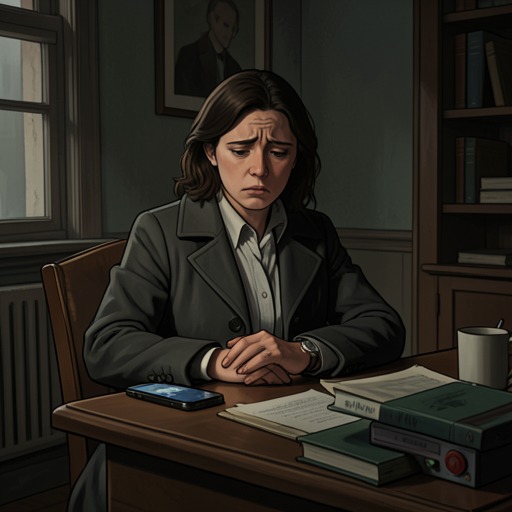
Smilla's depression
Smilla's Sense of SnowSmilla's depression is not presented simply as sadness but as a deliberate, perilous method of facing emotional defeat: she descends into a dark mood and studies it until its images become a tunnel she can approach. On Christmas Eve, that inward ritual gathers her fear of failing Isaiah, her dread of being cowed by Ravn, her unresolved thoughts of her father, and her uncertainty about speaking to the mechanic into a near-suicidal vision. The scene’s decisive tension is that Smilla imagines meeting death alone, while the people she has withdrawn from begin, literally, to arrive at her doors.
A Chosen Way of Facing Despair
Smilla describes two contrasting responses to depression. The European method, as she characterizes it, tries to work out of problems through action: one might seek help by telephone, with the further knowledge that someone is listening. Her own Greenlandic way is the opposite. She submerges herself in the dark mood, magnifies defeat, and dwells on what she sees. Depression becomes both a condition and a procedure: rather than turn away from painful thoughts, she studies them at close range.
That procedure is not a claim that despair is harmless. Smilla’s examples make its danger plain. She describes attempts to cover depression with Bach’s organ music at Our Saviour’s Church or with drugs arranged on a pocket mirror, and contrasts both with asking for help. Her account keeps the alternatives concrete: music, powder, a telephone, and the deliberate inward descent are different ways of meeting distress, not interchangeable decorations for a generalized mood.
The Tunnel and the Christmas Eve Crisis
When things are at their worst, Smilla imagines a black tunnel and walks toward it after stripping away her clothes and the objects that mark her public, Danish identity: her hard hat and passport as well as her underwear and good clothes. At the tunnel’s end she expects a lead-lined steam locomotive carrying strontium 90. The image gives her despair the shape of a lethal encounter. Yet she says she can imagine going to meet it because she is thirty-seven and knows that a small spot of light lies beneath the wheels, between the ties. The vision holds danger and an anticipated possibility of survival together, without making the danger disappear.
On Christmas Eve morning, after several days of withdrawing from the world, Smilla believes that a final descent has to come. She connects it to specific pressures: Ravn has cowed her; she is failing Isaiah; she cannot get her father out of her thoughts; she does not know what to say to the mechanic; and she fears she will never become any smarter. The accumulated list matters because it shows the crisis as more than one isolated disappointment. Her depression draws together present threats, grief and unresolved relationships, then presents their sum as evidence that she has failed.
Smilla prepares for the confrontation by skipping breakfast, which she says will expedite it, and locking the door. In the big chair, she invokes her own bad mood and names her circumstances: hungry, in debt, and alone on Christmas Eve, while other people have families, sweethearts, canaries, and one another. The inventory is at once material and social. Hunger and debt sharpen the scene’s physical hardship, while the repeated contrast with other people makes loneliness feel like the central verdict her depression is delivering. The exercise works in the immediate sense that she finds herself standing before the imagined tunnel, aging, a failure, abandoned.
The Closed Door and the Returning Past
The mechanic’s cautious ringing reaches Smilla while she is in this state. She recognizes him by the way he rings, but she has not seen him since the funeral and has not wanted to think about him. Instead of opening the door, she disconnects the bell and sits down again. The gesture turns withdrawal into an action: she actively severs the signal from someone trying to reach her, even as she understands who is outside and how carefully he is asking for attention.
Smilla then turns inward to a memory of the second time she ran away and Moritz came to get her in Thule. She recalls standing with him on the uncovered cement platform leading to the plane, while her aunt whimpered. She tried to take as many deep breaths as possible, imagining that she might carry the clear, dry, somehow sweet air back to Denmark. In the Christmas Eve scene, this remembered departure surfaces as she sits alone behind a closed door. Its precise setting and sensory detail give the past a place in her present crisis: she is thinking of an earlier separation and return while unable to answer someone who has come to see her.
Interruption and the Limits of Isolation
The scene does not resolve Smilla’s depression through an announced recovery. The mechanic remains at the entrance when she disconnects the bell, and someone else begins knocking at the back door: Juliane. She gets down on her knees and calls through the mail slot, inviting Smilla with the simple news that she is making fish balls. The invitation counters the imagined Christmas table of families and sweethearts not with an abstract reassurance but with a specific offer of food and company.
The contrast is structural as well as emotional. Smilla has locked the front door and silenced its bell, but the call comes from the back entrance and through a mail slot. Her vision had reduced the world to a tunnel, the approaching train, and a tiny spot of light; the knock and Juliane’s words introduce a human presence into that closed image. The evidence here stops at the invitation, not at Smilla’s response, so the interruption should not be mistaken for a cure. It does, however, place care within hearing distance at the very moment her self-imposed isolation seems most complete.
Narrative Significance
Smilla’s account makes depression visible through repeated contrasts between enclosure and contact, descent and a possible point of light, isolation and the presence of people at the door. Its imagery is unusually exact: the stripped clothing and passport, the strontium-90 locomotive, the locked door, the disconnected bell, the remembered cement platform, and the meal Juliane is preparing. These objects and places keep the crisis from becoming a vague statement of unhappiness; each marks a different relation between Smilla and the world she is trying not to face.
The passage also preserves an unresolved tension in Smilla’s chosen method. She regards the dark mood as something to enter and examine, and the tunnel vision includes a small light beyond the imagined train. But the Christmas Eve ritual moves her to the point where she calls herself abandoned and a failure, while her concrete circumstances include isolation, debt, hunger, grief and fear. Other people’s arrival does not erase those pressures. It reveals instead how depression can narrow her sense of available connection even as the mechanic and Juliane are trying, in different ways, to reach her.