Smilla's hypothermia
Smilla's Sense of SnowSmilla's hypothermia is a physical emergency in which her learned understanding of cold becomes a means of survival, but not a guarantee of control. After escaping a burning ship, she jumps into the freezing water at Svajer Wharf and swims toward the dock, measuring the body's deterioration even as her strength fails. The episode makes the body at once an instrument of knowledge and the fragile limit against which that knowledge is tested.
The Body Under Cold
The water shocks Smilla into opening her eyes beneath the surface. Fire illuminates it in green and red, but she does not look back. She knows that in water below 42°F a person can survive only a few minutes, with the available time dependent on physical condition; she judges herself to be in very poor shape. This is not detached exposition: the figures describe the narrowing margin between swimming and death.
She swims almost vertically, keeping only her lips above water, aware that the exposed part of the body carries weight. Shaking begins after a few seconds. She tracks the fall from a normal body temperature of 98.6°F: the shaking stops as the temperature reaches 86°F, a critical point at which apathy sets in and freezing to death becomes imminent. Her precise account gives physiological stages to a crisis that otherwise might appear as a single undifferentiated struggle.
Survival by Increment
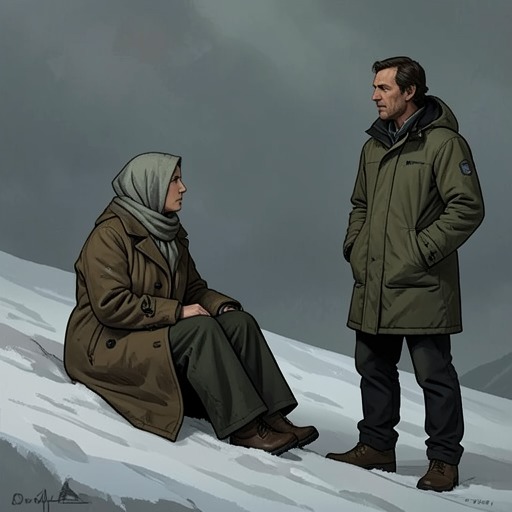
After a hundred yards, Smilla can no longer straighten her arms. Thinking about her past does not help, nor does thinking about Isaiah. She feels as though she is standing on a slope, leaning into a stiff wind, and could simply give up. The image marks a change in the effort: swimming has become an action she must consciously renew rather than a movement she can take for granted.
The thought that someone has tried to kill her, and is now congratulating themselves, carries her through the last stretch. She decides to take ten more strokes. At the eighth, she strikes her head against a tractor tire hung as a bumper on the Northern Light's berth. The collision confirms that she has reached the dock; survival arrives not as triumph over the cold but as contact with a solid boundary after each stroke has been counted.
Cold, Knowledge, and Greenland
The harbor ordeal resonates with the book's other accounts of Smilla's life in Greenland, where survival is presented as practiced knowledge rather than abstraction. As a child on the ice, she learns to wait for birds and catch them with a large net; after going twenty-four hours without food, she gets three on her second attempt. The account places hunger, patience, and bodily action together, though her sudden vision of the birds' young leads her to turn the net over and release them. Knowledge of how to live in a harsh environment does not remove the moral and emotional force of what survival requires.
Her understanding of Greenland also rests on ways of living that resist simple categorization. She recalls Inuit accounts of a world begun by two men, one of whom transformed his body to give birth, and records of Greenlandic women who hunted as men did. Her mother, in particular, lived across such divisions: she gave birth, gossiped, and cleaned skins, while also shooting, paddling a kayak, and hauling meat. These memories help frame Smilla's competence as embodied and situated, not as an abstract claim of mastery over nature.
Space and Vulnerability
Cold is not the only condition that makes Smilla vulnerable. When an interlocutor describes imprisonment in a small, soundproof, windowless room, she reflects that Greenland has no prisons and that offenses punishable by imprisonment in Denmark more often bring fines there. In her formulation, the Greenlandic hell is the locked room. The recollection that she and her mother seemed never to be indoors explains why confinement threatens something fundamental: she cherishes spatial freedom with an intensity she compares to the way men feel about their testicles.
Her escape through the water turns that concern into immediate physical stakes. The open harbor offers a route away from the fire, but its cold nearly kills her; freedom is not a safe abstraction, but a passage through conditions her body cannot indefinitely withstand. Her hypothermia thus gathers together the novel's recurring contrasts between knowledge and exposure, mobility and confinement, and survival as both a practical skill and a precarious bodily fact.