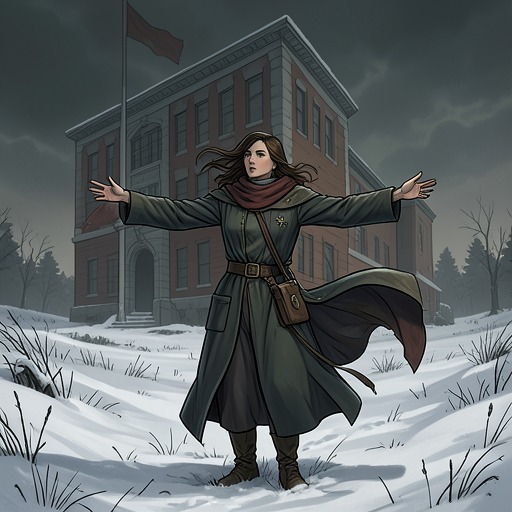
Strange object sliding on ice
Smilla's Sense of Snow“The foreign body skating on top of the ice” names Smilla’s momentary freedom after Isaiah’s death: she moves across Copenhagen Harbor as an outsider loosened from the frozen arrangement of Danish society. The image is both personal and political, linking her literal passage over harbor ice to a broader contrast between imposed order and forms of life that exceed it.
The Harbor Image
At two in the morning, crossing Copenhagen Harbor in a clown hat and borrowed shoes, Smilla sees Denmark as a drifting spit of ice. Though it moves, it holds people frozen in fixed positions relative to one another. Isaiah’s death has opened a fissure in that surface. The rupture sets Smilla in motion, making her a foreign body skating over the ice rather than someone locked into its established place.
The image does not describe a permanent escape. Smilla calls the freedom brief and cannot explain how it has come about. Its force lies in the contrast: Denmark’s social arrangement appears stable and immobilizing, while the foreign body is defined by its movement across that arrangement. From this altered angle, another Denmark comes into view, made up of people who have partly wrested themselves free.
A Life Shaped by Movement
The image resonates with Smilla’s memories of her mother, who could not imagine living in one place for long. Greenland, in Smilla’s childhood recollection, meant a life spent outdoors rather than indoors. She understands spatial freedom as something precious and intimate, and the locked room—not a conventional landscape of torment—as the Greenlandic form of hell. Against that background, skating over the harbor is not merely a picturesque escape: movement itself carries the weight of survival and self-possession.
Smilla’s account of her mother also complicates fixed social categories. Her mother gave birth, cleaned skins, and took part in women’s social life, while also shooting, paddling a kayak, and hauling meat. Smilla places this life beside accounts of Inuit people who could embody capacities conventionally assigned to the other sex. Her mother did not simply exchange one prescribed role for another; she lived across the boundary. The novel’s recurring resistance to rigid classification therefore has a personal history as well as a political dimension.
Learning Without Reducing
Smilla distrusts attempts to rank cultures by standards devised by European science. She argues that understanding another culture requires living within it as a guest and learning its language; whatever understanding comes remains wordless. Explanation can create distance from what it claims to clarify. When she begins speaking about Qaanaaq, she feels she is already losing something that was never fully hers to possess.
That tension informs the foreign-body image. Smilla can recognize Denmark’s structures and describe their effects, but her moment of movement does not turn her into an uncomplicated interpreter of Greenlandic life. She associates Inuit experience with the capacity to hold irreconcilable contradictions without simplifying them. Her own mother’s mixed practices and the family’s mobile life give that thought concrete grounding, while the sudden release after Isaiah’s death makes it felt rather than merely argued.
Freedom and Its Limits
The foreign body’s passage is enabled by a death, not by a settled change in Denmark. Isaiah’s death becomes an eruption in the frozen order; the fissure it produces gives Smilla a brief opening through which she can move. Her crossing makes visible both the possibility of slipping free and the force of the arrangement that had held her in place.
The phrase thus gathers the novel’s images of ice, confinement, and motion into one scene. The harbor is a literal surface beneath Smilla’s borrowed shoes, but it is also the social ground she sees differently after loss. Her movement does not resolve the contradictions between Greenland and Denmark, or between belonging and estrangement. It makes those contradictions visible—and, for a brief time, allows her to skate across them.