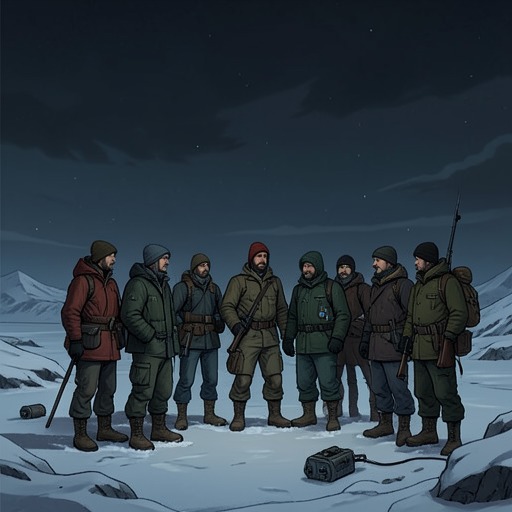
The Other
Smilla's Sense of Snow“The Other” is the book’s name for the vastness surrounding human beings—the sea, the earth, and the ice—and for what technological development attempts to bring under control. The expression links Smilla’s intimate, learned-through-attention knowledge of landscape with the novel’s criticism of development as a project of coercion.
The Meaning of the Expression
The idea emerges as Smilla considers a vast industrial complex and concludes that it was created with coercion in mind. She distinguishes this from the direct coercion of Greenlanders: in the Arctic, the army and civilization’s overt violence are becoming less necessary to development. Instead, she argues, a liberal appeal to greed can draw people into the same system. The object of coercion, in her account, is not simply a population but the nonhuman vastness around it—the Other that the complex is meant to master.
The expression therefore describes a relation of power rather than a simple opposition between civilization and wilderness. The Other is what resists being reduced to a human plan: sea, land, and ice. Smilla’s language makes the development project legible as an effort to impose human control on that surrounding world.
Development and Coercion
Smilla sets this argument against the rapid transformation of Greenland. She lists recent political and military changes, then turns to the Greenland Star, an oil platform made from 25,000 linked pontoons anchored 2,500 feet below the sea. Its scale and location make it a conspicuous example of the new development she is considering. The platform is not merely a backdrop: its physical presence gives her abstract account of coercion a concrete form.
Her analysis does not claim that technological culture alone destroyed Arctic peoples. Instead, she describes it as a catalyst that encourages a mixture of greed and naivety already possible in any culture or individual. This qualification shifts the critique away from a simple opposition between an innocent Arctic and a corrupt outside force. The danger lies in a general human potential that technological development can organize and intensify.
The contrast with the older oil installation at Exringehavn sharpens the change. Lukas recalls a small operation with a communications station, a cannery, and a plant on opposite sides of a fjord; five men ran it, and visiting sailors shared a drink with the manager. Against that remembered scale, the offshore complex appears as a new attempt to manage a far larger environment through industrial infrastructure.
Knowledge, Place, and Resistance
The expression also resonates with Smilla’s own way of knowing land and ice. During a winter journey in fog, her mother follows her direction, and Smilla remembers being placed at the front of the sled, sensing the route as a line connecting her to home in Qaanaaq. In another account of moving through fog, she knows her position in relation to landmarks on shore despite her limited familiarity with the underwater landscape. Her knowledge depends on attention to place rather than on making the environment fully transparent or controllable.
Maps provide a related contrast. Smilla can look at a map once and retain the landscape it represents, whether its symbols come from topographical, military, radar, satellite, geological, or thermal surveys. She describes learning those conventions as acquiring an alphabet that can then be forgotten in the act of reading the text of ice. The passage recognizes the usefulness of technical representation while distinguishing it from the landscape itself: symbols are a means of access, not the reality they render.
Taken together, these episodes give “The Other” a double significance. The surrounding world has its own scale and presence, beyond the ambitions of industrial control; at the same time, attentive knowledge can create a relationship with that world without claiming to conquer it. Smilla’s orientation to snow and terrain thus stands in meaningful contrast to the development project she identifies as an attempt to coerce what surrounds human beings.