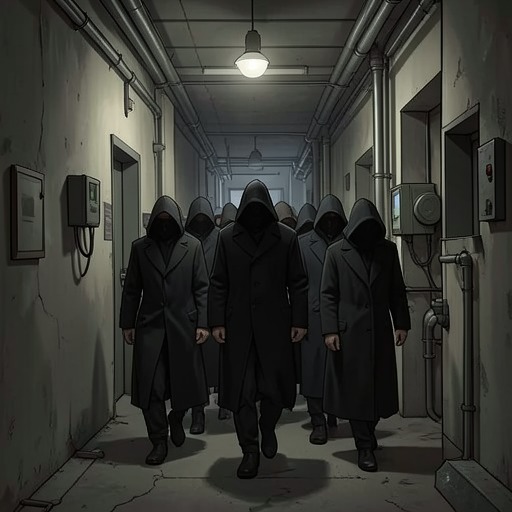
Verlaine, laboratory technician
Smilla's Sense of SnowVerlaine, the laboratory technician aboard the expedition, links its scientific investigation to the criminal enterprises and violence that sustain it. In the ice cave at Gela Alta, he helps explain the parasite’s history and experimental use, recounts his work for Khum Na, and faces Smilla after she has exposed his role in the shipboard crimes. His expertise makes him an interpreter of the expedition’s past; his death by Sigmund Lukas’s harpoon gun ends that role abruptly.
Laboratory Work and the 1966 Expedition
Verlaine stands at a tall worktable beside a dissecting microscope, adjusting its ocular and objective and moving a gas lamp closer so Smilla can examine a specimen. Around him are chromatographs, microscopes, crystallization jars, an incubator, a generator, and an electrophoresis apparatus. He identifies the apparatus as a protein-separation instrument brought by Loyen in 1966, when the researchers still believed they were dealing with some form of organic life. The equipment, left under gray ice, makes the older expedition materially present in the cave: scientific instruments survive as evidence of an inquiry that did not end with the expedition’s collapse.
Verlaine also guides Smilla through a view of Cyclops marinus, a water flea used in the parasite’s life cycle. He explains that the organism, or its relatives, occurs across the world’s oceans and identifies the threads as organs of equilibrium. The specimen has been treated with hydrochloric acid and is unusually still. Through the microscope, the exchange makes Verlaine’s authority concrete: he can name and handle minute biological details, even as the investigation around him points toward consequences far beyond the laboratory.
He reconstructs the disaster of 1966 as a sudden reversal. Loyen, Ving, and Licht had planned the work, located the stone, built an entryway and rooms, and prepared a hardened-steel band saw to cut a piece from it. Loyen had opposed using blowtorches. Then, as the Greenlanders were positioning the saw, the expedition members died almost simultaneously, within an hour of one another and forty-eight hours after their first dive. With the project failed and time running out, Loyen improvised an accident rather than destroy the bodies. Verlaine’s account stresses that Loyen preserved them because he already suspected that something was wrong; after reaching Nuuk, Loyen performed an autopsy. The sequence ties the old equipment to the concealed history of the deaths and shows how scientific plans gave way to concealment.
The Parasite and Human Experimentation
Verlaine’s explanation extends from the parasite’s development in sea mammals to the conditions that might accelerate its spread. He says the process is slow in marine mammals: even if parasites from the island’s lakes reach the sea, they must survive until seals carry them farther. In his account, human presence changes that pace, because development accelerates once people become involved. The distinction helps explain why the organism’s isolation does not make it harmless; it has a route toward people, and human involvement may transform its development.
He describes experiments in which Loyen grafted female parasites onto two Greenlanders with AIDS, then had them flown to Denmark and admitted to small private hospitals where admission depended on the account number rather than questions. Ultrasound scanners tracked the organisms as they moved toward the heart and emptied themselves out. Verlaine dwells on the females’ size and their burrowing into flesh, then places humans within the same reproductive pattern he attributes to the parasite. His clinical vocabulary does not soften the procedure: the account makes clear that vulnerable people were treated as experimental hosts and moved across borders under cover of medical access.
This knowledge gives Verlaine a double position. He can explain the parasite’s biology and the expedition’s earlier decisions, but his participation in the work does not place him outside its exploitation. Scientific observation, medical institutions, and clandestine experimentation become parts of the same chain. The specimens and instruments in the cave are not neutral remnants; through his explanation, they disclose how research became an instrument for acting on human bodies.
Khum Na and the Criminal Past
When Smilla asks what Verlaine had been doing in Chiang Rai, he says he was a laboratory technician making heroin for Khum Na. He recalls that police officers arrived while the group was at war with Laos, Cambodia, and eventually Burma, with support from the United States. He says twelve officers came and that only one escaped, a woman who had posed as an English nurse and spoke English and Thai without an accent. Smilla identifies her as Nathalie Ravn, and Verlaine confirms it.
The recollection makes the laboratory role inseparable from political violence and organized drug production. Verlaine recounts Khum Na’s televised threat: the group would put 900 tons on the market that year, 1,300 the next, and 2,000 the year after unless the soldiers were recalled. Verlaine says the war ended on the day of the announcement. The exchange presents drug trafficking not as a private sideline but as leverage within a conflict, while Verlaine’s matter-of-fact account places him inside the machinery that connected laboratory work, heroin production, and armed power.
His explanation ends with a more encompassing claim: human beings ate the parasites, and the worm is an instrument of the gods, like the poppy. That formulation joins the biological and the criminal histories he has recounted. The parasite and the poppy are both described as forces that enter human life through consumption, but Verlaine’s own history complicates any attempt to treat either as an impersonal force: he has worked in a laboratory that produced heroin and speaks from within the human systems that exploit both substances and people.
Confrontation and Death in the Ice Cave
Later, Smilla waits at a dead end, beside an ice wall, after following the passage in darkness. A light approaches, attached to Verlaine’s forehead. She tells him that she has shown Lukas the refrigerator and that, together with what Verlaine did to Jakkelsen, this will bring him a life sentence without parole. Her words make the evidence against him explicit: the hidden refrigerator and the violence against Jakkelsen are no longer isolated secrets but grounds for his arrest and punishment.
Verlaine bows his head and mutters what sounds like a prayer, then steps toward her. A rose-shaped spray of red dots appears on the ice wall. He lifts off the ground and is thrown against it, held there like an insect by the harpoon. The sound is brief; a gray cloud passes through the lamp’s light, and Lukas steps into view holding the compressed-air harpoon gun. Verlaine fumbles at his back, where a thin black line protrudes beneath his shoulder blade. The weapon’s metal point has pierced him and supports his weight against the wall.
Smilla walks past Lukas while he looks at Verlaine rather than at her. The encounter ends not with Verlaine’s arrest or an answer to the accusation, but with his violent death in the cave. The image of the laboratory technician pinned like a specimen reverses his earlier role at the microscope: the man who adjusted the instrument for examining a water flea becomes himself a body fixed for inspection. The reversal concentrates the character’s narrative significance in one image, joining scientific observation, bodily vulnerability, and the violence that the expedition’s research has carried from the past into the present.