You can't win against the ice.
Smilla's Sense of Snow“You can't win against the ice.” is the closing passage’s compressed verdict on human vulnerability in the landscape. Spoken as the pursued figure’s strength fails, it names not a contest that can be won through greater effort, but an environment whose scale and conditions ultimately exceed him.
The Phrase in Its Scene
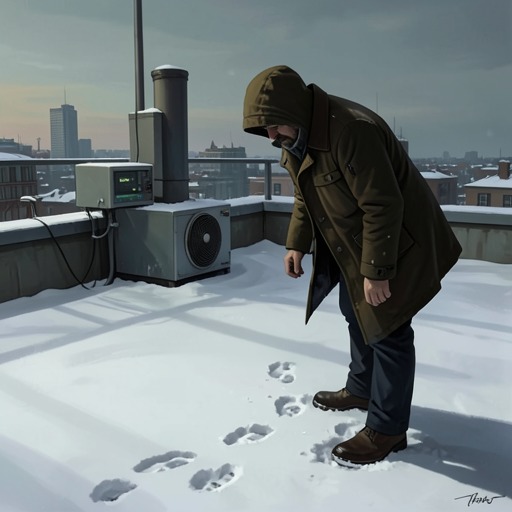
The sentence follows a sequence of possible outcomes. The figure may fall through the ice, where the cold water could make him weightless and draw him under; from below, even at night, the ice might appear bluish white, like neon. Or he may change direction and keep moving across it. Neither possibility offers safety: the first imagines immediate submersion, while the second prolongs exposure to a temperature that will continue to drop and an approaching snowstorm.
The phrase arrives after the passage has made that alternative painfully concrete. The figure is expected to survive only a couple of hours. When he stops, the cold will close around his remaining life like a frozen shell around a stalactite, until his pulse ceases. The sentence therefore concludes a chain of physical possibilities with a broader judgment: movement may postpone the end, but cannot reverse the conditions governing it.
Ice as an Active Force
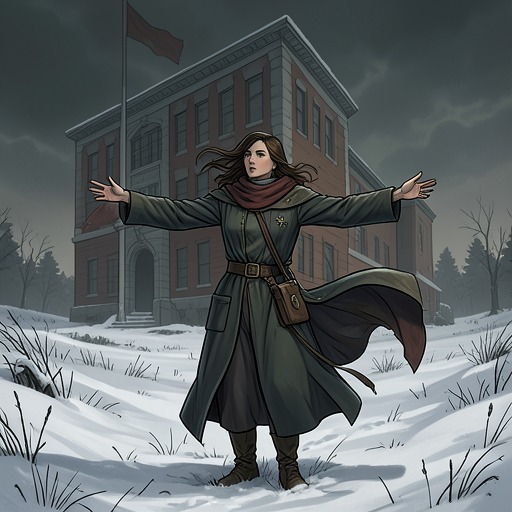
Here ice is not merely scenery or an obstacle. The landscape consumes strength from anyone who has not grown up in it; the cold transforms a living body, and the ice may either give way beneath a person or hold him exposed on its surface. These alternatives make the setting both unstable and inescapable. The danger comes not from one isolated hazard but from a whole environment—cold, falling temperature, snowstorm, water, and distance—that steadily narrows the figure’s chances.
The closing image of the man becoming one with the landscape gives the phrase its most unsettling resonance. The frozen shell does not simply kill him; it makes the boundary between body and terrain seem to disappear. The landscape’s power is expressed through this transformation, not through any claim that the ice possesses intention. Its indifference is enough: a human life can be reduced to a pulse that stops beneath the cold.
The Ending and Its Refusal of Resolution
The passage does not confirm which fate the figure meets. He remains ahead, running, and slowly grows darker in the narrator’s sight. Behind the narrator, the stone remains with its mystery and unanswered questions; the mechanic is also there. The closing sentence thus belongs to an ending that leaves both the figure’s immediate outcome and the stone’s meaning unresolved.
That refusal is reinforced by the narrator’s anticipation of being asked to explain, so that others can understand and settle matters. The narrator judges that they will be mistaken: only what is not understood can be resolved, and there will be no resolution. The phrase about the ice consequently resonates beyond physical survival. It stands beside a deliberate rejection of mastery through explanation: neither the landscape nor the mystery behind it is made safely manageable by a final account.